## Chart Type: Line Chart - Proportion of Flips for Qwen2.5-14B
### Overview
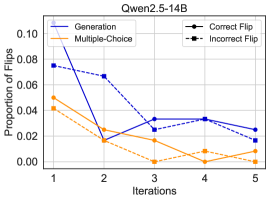
This image displays a line chart titled "Qwen2.5-14B", illustrating the "Proportion of Flips" across five "Iterations" for two different task types: "Generation" and "Multiple-Choice". For each task type, the chart differentiates between "Correct Flip" and "Incorrect Flip" outcomes. The legend uses color and marker shape to denote the task type, and line style (solid vs. dashed) to denote the flip outcome.
### Components/Axes
The chart is composed of a main plotting area, a title, axis labels, axis markers, and a legend.
* **Title:** "Qwen2.5-14B" is centered at the top of the chart.
* **X-axis:** Labeled "Iterations" at the bottom. The axis ranges from 1 to 5, with integer markers at 1, 2, 3, 4, and 5.
* **Y-axis:** Labeled "Proportion of Flips" on the left side. The axis ranges from 0.00 to 0.10, with major tick markers at 0.00, 0.02, 0.04, 0.06, 0.08, and 0.10.
* **Legend:** Located in the top-right quadrant of the plotting area. It is structured to define four distinct data series by combining attributes:
* **Generation:** Represented by blue color and square markers.
* **Correct Flip:** Solid line style. (Implies: Blue solid line with square markers)
* **Incorrect Flip:** Dashed line style. (Implies: Blue dashed line with square markers)
* **Multiple-Choice:** Represented by orange color and circle markers.
* **Correct Flip:** Solid line style. (Implies: Orange solid line with circle markers)
* **Incorrect Flip:** Dashed line style. (Implies: Orange dashed line with circle markers)
### Detailed Analysis
The chart displays four distinct data series, each representing a combination of task type and flip outcome, plotted against iterations.
1. **Generation - Correct Flip (Blue solid line with square markers):**
* **Trend:** Starts at a moderate level, drops significantly, then recovers to a stable level before a final slight decrease.
* **Data Points (approximate):**
* Iteration 1: ~0.075
* Iteration 2: ~0.015
* Iteration 3: ~0.033
* Iteration 4: ~0.033
* Iteration 5: ~0.017
2. **Generation - Incorrect Flip (Blue dashed line with square markers):**
* **Trend:** Starts at a high level, shows a gradual decrease, then a sharp drop, followed by a slight increase and then another slight decrease.
* **Data Points (approximate):**
* Iteration 1: ~0.075
* Iteration 2: ~0.067
* Iteration 3: ~0.025
* Iteration 4: ~0.033
* Iteration 5: ~0.025
3. **Multiple-Choice - Correct Flip (Orange solid line with circle markers):**
* **Trend:** Starts at a lower level than Generation, shows a consistent downward trend, reaching near zero, then a slight recovery.
* **Data Points (approximate):**
* Iteration 1: ~0.042
* Iteration 2: ~0.025
* Iteration 3: ~0.017
* Iteration 4: ~0.000
* Iteration 5: ~0.008
4. **Multiple-Choice - Incorrect Flip (Orange dashed line with circle markers):**
* **Trend:** Starts at a moderate level, drops sharply, reaches near zero, then shows a slight, stable increase.
* **Data Points (approximate):**
* Iteration 1: ~0.042
* Iteration 2: ~0.017
* Iteration 3: ~0.000
* Iteration 4: ~0.008
* Iteration 5: ~0.008
### Key Observations
* At Iteration 1, both "Generation" flip proportions (Correct and Incorrect) are significantly higher than "Multiple-Choice" flip proportions.
* For "Generation", both "Correct Flip" and "Incorrect Flip" proportions show a sharp decrease from Iteration 1 to Iteration 2.
* For "Multiple-Choice", both "Correct Flip" and "Incorrect Flip" proportions decrease to very low levels (near 0.00) by Iteration 3.
* The "Generation - Correct Flip" and "Generation - Incorrect Flip" lines start at the same point at Iteration 1 (~0.075).
* The "Multiple-Choice - Correct Flip" and "Multiple-Choice - Incorrect Flip" lines also start at the same point at Iteration 1 (~0.042).
* After Iteration 2, the "Generation - Incorrect Flip" proportion remains consistently higher than "Generation - Correct Flip" proportion.
* After Iteration 3, the "Multiple-Choice - Incorrect Flip" proportion is slightly higher than or equal to the "Multiple-Choice - Correct Flip" proportion.
* The overall "Proportion of Flips" for "Multiple-Choice" tasks is generally lower and decreases more rapidly than for "Generation" tasks across iterations.
### Interpretation
This chart likely evaluates the performance of the "Qwen2.5-14B" model in two distinct task settings ("Generation" and "Multiple-Choice") over several "Iterations," possibly representing training steps, fine-tuning epochs, or sequential task attempts. The "Proportion of Flips" could refer to instances where the model's output changes or "flips" its classification or generated content, with "Correct Flip" indicating a change to the correct state and "Incorrect Flip" indicating a change to an incorrect state.
The data suggests that:
* **Initial Instability/High Flip Rate:** At Iteration 1, the model exhibits a relatively high proportion of flips for both task types, especially for "Generation." This could indicate initial uncertainty or a high rate of change in its outputs.
* **Learning/Stabilization:** For "Generation" tasks, there's a significant reduction in both correct and incorrect flips after the first iteration, suggesting the model quickly stabilizes or learns to reduce its flip rate. However, the "Incorrect Flip" rate for "Generation" remains notable throughout, even surpassing the "Correct Flip" rate after Iteration 2. This might imply that while the model reduces overall changes, a significant portion of the remaining changes are still incorrect for generation tasks.
* **Superior Performance in Multiple-Choice:** The "Multiple-Choice" task shows a much lower and more rapidly decreasing proportion of flips, with both "Correct" and "Incorrect" flips approaching zero by Iteration 3. This indicates that the Qwen2.5-14B model is either more stable, more confident, or more accurate in multiple-choice scenarios, leading to fewer changes in its output, and those changes are less likely to be incorrect.
* **Implications for Model Reliability:** The persistent "Incorrect Flip" rate for "Generation" tasks, even as "Correct Flips" decrease, could be a concern for the reliability of the model's generated outputs. In contrast, the near-zero flip rates for "Multiple-Choice" tasks suggest high stability and potentially high accuracy in those contexts.
* **Relationship between Flip Types:** The fact that "Correct Flip" and "Incorrect Flip" start at the same point for each task type at Iteration 1 might suggest an initial phase where changes are equally likely to be beneficial or detrimental. The subsequent divergence shows the model's learning trajectory, ideally reducing "Incorrect Flips" more effectively than "Correct Flips" (or reducing both if stability is the goal). For "Multiple-Choice," this ideal is largely achieved. For "Generation," while both decrease, "Incorrect Flips" become the dominant type of flip in later iterations.