## Chart: Frametime vs. Shader Complexity for Different Rendering Techniques
### Overview
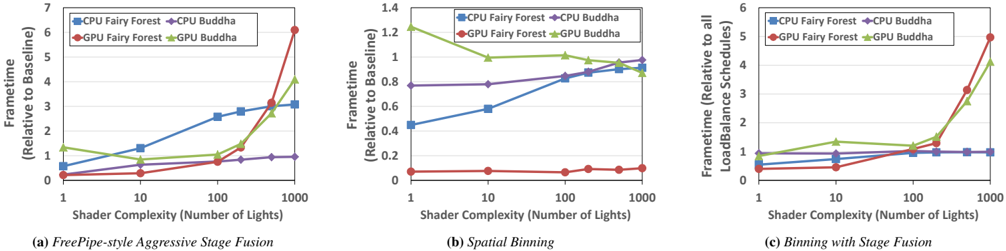
The image presents three line charts comparing the frametime performance of CPU and GPU rendering for two scenes ("Fairy Forest" and "Buddha") under different shader complexities. The charts illustrate the performance of three rendering techniques: FreePipe-style Aggressive Stage Fusion, Spatial Binning, and Binning with Stage Fusion. The x-axis represents shader complexity (number of lights), and the y-axis represents frametime relative to a baseline.
### Components/Axes
**Common Elements:**
* **X-axis:** Shader Complexity (Number of Lights). The x-axis is logarithmic, with markers at 1, 10, 100, and 1000.
* **Y-axis:** Frametime (Relative to Baseline). The y-axis scale varies between the three charts.
* **Legend:** Located at the top of each chart.
* Blue: CPU Fairy Forest
* Purple: CPU Buddha
* Red: GPU Fairy Forest
* Green: GPU Buddha
**Chart (a): FreePipe-style Aggressive Stage Fusion**
* Y-axis ranges from 0 to 7.
**Chart (b): Spatial Binning**
* Y-axis ranges from 0 to 1.4.
**Chart (c): Binning with Stage Fusion**
* Y-axis ranges from 0 to 6. Y-axis label is "Frametime (Relative to all LoadBalance Schedules)".
### Detailed Analysis
**Chart (a): FreePipe-style Aggressive Stage Fusion**
* **CPU Fairy Forest (Blue):** The frametime increases steadily with shader complexity.
* At 1 light: ~0.6
* At 10 lights: ~1.3
* At 100 lights: ~2.5
* At 1000 lights: ~3.0
* **CPU Buddha (Purple):** The frametime remains relatively constant with increasing shader complexity.
* At 1 light: ~0.5
* At 10 lights: ~0.6
* At 100 lights: ~0.8
* At 1000 lights: ~0.9
* **GPU Fairy Forest (Red):** The frametime remains very low until a sharp increase at 1000 lights.
* At 1 light: ~0.1
* At 10 lights: ~0.3
* At 100 lights: ~0.4
* At 1000 lights: ~6.5
* **GPU Buddha (Green):** The frametime increases slowly until a sharp increase at 1000 lights.
* At 1 light: ~1.3
* At 10 lights: ~1.1
* At 100 lights: ~1.3
* At 1000 lights: ~2.0
**Chart (b): Spatial Binning**
* **CPU Fairy Forest (Blue):** The frametime increases with shader complexity, but plateaus.
* At 1 light: ~0.45
* At 10 lights: ~0.6
* At 100 lights: ~0.9
* At 1000 lights: ~0.95
* **CPU Buddha (Purple):** The frametime remains relatively constant with increasing shader complexity.
* At 1 light: ~0.78
* At 10 lights: ~0.78
* At 100 lights: ~0.85
* At 1000 lights: ~0.9
* **GPU Fairy Forest (Red):** The frametime remains very low and constant.
* At 1 light: ~0.08
* At 10 lights: ~0.08
* At 100 lights: ~0.1
* At 1000 lights: ~0.1
* **GPU Buddha (Green):** The frametime decreases slightly with shader complexity, then plateaus.
* At 1 light: ~1.25
* At 10 lights: ~1.05
* At 100 lights: ~1.0
* At 1000 lights: ~0.95
**Chart (c): Binning with Stage Fusion**
* **CPU Fairy Forest (Blue):** The frametime remains relatively constant.
* At 1 light: ~0.5
* At 10 lights: ~0.6
* At 100 lights: ~0.7
* At 1000 lights: ~0.7
* **CPU Buddha (Purple):** The frametime remains relatively constant.
* At 1 light: ~0.7
* At 10 lights: ~0.7
* At 100 lights: ~0.7
* At 1000 lights: ~0.7
* **GPU Fairy Forest (Red):** The frametime remains low until a sharp increase at 1000 lights.
* At 1 light: ~0.4
* At 10 lights: ~0.3
* At 100 lights: ~0.3
* At 1000 lights: ~5.5
* **GPU Buddha (Green):** The frametime increases slowly until a sharp increase at 1000 lights.
* At 1 light: ~1.0
* At 10 lights: ~1.5
* At 100 lights: ~2.0
* At 1000 lights: ~2.0
### Key Observations
* GPU rendering of the "Fairy Forest" scene (Red line) experiences a significant performance drop (increased frametime) at high shader complexity (1000 lights) in the "FreePipe-style Aggressive Stage Fusion" and "Binning with Stage Fusion" techniques.
* Spatial Binning (Chart b) generally provides more stable frametimes across all shader complexities for both CPU and GPU rendering.
* CPU rendering of the "Fairy Forest" scene (Blue line) shows a steady increase in frametime with increasing shader complexity in the "FreePipe-style Aggressive Stage Fusion" technique.
* CPU rendering of the "Buddha" scene (Purple line) is relatively stable across all shader complexities and rendering techniques.
* GPU rendering of the "Buddha" scene (Green line) shows a sharp increase in frametime with increasing shader complexity in the "FreePipe-style Aggressive Stage Fusion" and "Binning with Stage Fusion" techniques.
### Interpretation
The charts demonstrate the impact of shader complexity on frametime performance for different rendering techniques and hardware (CPU vs. GPU). The "Fairy Forest" scene appears to be more sensitive to shader complexity, particularly when rendered on the GPU using "FreePipe-style Aggressive Stage Fusion" and "Binning with Stage Fusion". Spatial Binning seems to offer a more stable performance profile, suggesting it is more resilient to increasing shader complexity. The "Buddha" scene, when rendered on the CPU, exhibits relatively consistent performance across all techniques and shader complexities. The sharp increase in frametime for GPU rendering at 1000 lights in charts (a) and (c) suggests a potential bottleneck or limitation in the GPU's ability to handle extremely complex shaders with these techniques. These results could inform decisions about which rendering technique to use based on the target hardware and the complexity of the scene.