\n
## Diagram: Iterative Response Generation Pipeline
### Overview
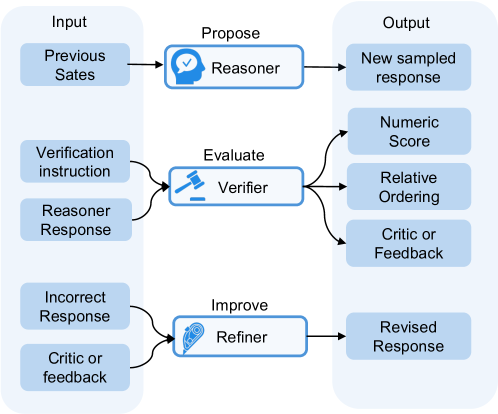
The image depicts a diagram illustrating an iterative pipeline for generating responses, involving a Reasoner, Verifier, and Refiner. The diagram shows the flow of information between these components, along with inputs and outputs at each stage. It appears to be a system for improving the quality of generated text, likely in a large language model context.
### Components/Axes
The diagram consists of three main processing blocks:
* **Reasoner:** Receives "Previous States" as input and produces a "New sampled response" as output. It is visually represented with a chat bubble icon.
* **Verifier:** Receives "Verification instruction" and "Reasoner Response" as input and outputs a "Numeric Score", "Relative Ordering", and "Critic or Feedback". It is visually represented with a gavel icon.
* **Refiner:** Receives "Incorrect Response" and "Critic or Feedback" as input and outputs a "Revised Response". It is visually represented with a wrench icon.
The diagram also shows input and output connections between these blocks, represented by arrows. The diagram is organized in a roughly circular flow, suggesting an iterative process.
### Detailed Analysis or Content Details
The diagram shows a three-stage process:
1. **Propose (Reasoner):**
- Input: "Previous States"
- Output: "New sampled response"
2. **Evaluate (Verifier):**
- Input 1: "Verification instruction"
- Input 2: "Reasoner Response"
- Output 1: "Numeric Score"
- Output 2: "Relative Ordering"
- Output 3: "Critic or Feedback"
3. **Improve (Refiner):**
- Input 1: "Incorrect Response"
- Input 2: "Critic or Feedback"
- Output: "Revised Response"
The arrows indicate the direction of information flow. The "Incorrect Response" input to the Refiner appears to be a feedback loop from the Verifier, suggesting that the Verifier identifies responses that need improvement. The "Critic or Feedback" is used by both the Verifier and the Refiner.
### Key Observations
The diagram highlights an iterative refinement process. The Verifier acts as a quality control mechanism, providing feedback that is used to improve the response. The system appears designed to move from an initial response to a more accurate and refined output. The use of "Numeric Score" and "Relative Ordering" suggests a quantitative evaluation of the responses.
### Interpretation
This diagram illustrates a common architecture for building robust and high-quality response generation systems, particularly in the context of large language models. The Reasoner generates an initial response, the Verifier assesses its quality, and the Refiner uses the feedback to improve it. This iterative process allows the system to learn from its mistakes and produce more accurate and relevant responses over time. The inclusion of both a "Numeric Score" and "Critic or Feedback" suggests a hybrid evaluation approach, combining quantitative metrics with qualitative assessment. The system is designed to handle incorrect responses and refine them based on feedback, indicating a focus on continuous improvement. The diagram doesn't provide specific data or numerical values, but rather a conceptual framework for a response generation pipeline. It is a high-level overview of the process, not a detailed implementation.