## Process Diagram: Iterative Reasoning and Refinement System
### Overview
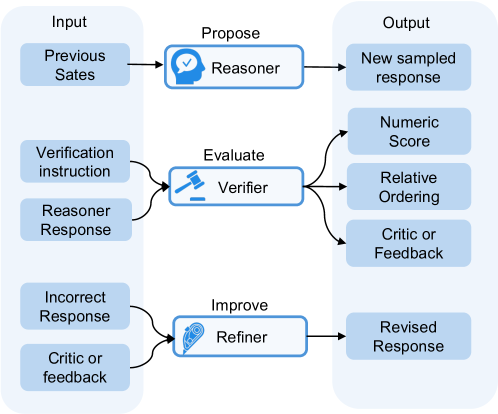
The image displays a technical flowchart or process diagram illustrating a three-stage iterative system for generating, evaluating, and refining responses. The diagram is structured into three vertical columns: **Input**, a central processing column with three distinct stages (**Propose**, **Evaluate**, **Improve**), and **Output**. The flow is indicated by directional arrows connecting specific input elements to processing components and then to output elements.
### Components/Axes
The diagram is organized into three main columns:
1. **Left Column (Input):** Contains three input data blocks.
* **Top:** "Previous States".
* **Middle:** "Verification instruction".
* **Bottom:** "Incorrect Response".
2. **Central Column (Processing Stages):** Contains three processing components, each with an associated icon and action verb.
* **Top Stage - Propose:** The component is labeled **Reasoner**, accompanied by a brain icon.
* **Middle Stage - Evaluate:** The component is labeled **Verifier**, accompanied by a gavel icon.
* **Bottom Stage - Improve:** The component is labeled **Refiner**, accompanied by a pencil/editing icon.
3. **Right Column (Output):** Contains five output data blocks.
* **Top:** "New sampled response".
* **Middle Group (from Verifier):** "Numeric Score", "Relative Ordering", "Critic or Feedback".
* **Bottom:** "Revised Response".
**Flow and Connections (Spatial Grounding):**
* The "Previous States" block (top-left) connects via an arrow to the **Reasoner** (top-center). The Reasoner then outputs to "New sampled response" (top-right).
* The "Verification instruction" block (middle-left) and the "Reasoner Response" (implied as the output from the Reasoner, though not explicitly drawn as a separate box) connect via arrows to the **Verifier** (middle-center). The Verifier produces three outputs: "Numeric Score", "Relative Ordering", and "Critic or Feedback" (all in the middle-right).
* The "Incorrect Response" block (bottom-left) and the "Critic or feedback" (output from the Verifier) connect via arrows to the **Refiner** (bottom-center). The Refiner then outputs to "Revised Response" (bottom-right).
### Detailed Analysis
The diagram explicitly defines the inputs, processing actions, and outputs for each stage of the cycle:
* **Propose Stage:**
* **Input:** Previous States.
* **Processor:** Reasoner.
* **Output:** New sampled response.
* **Evaluate Stage:**
* **Inputs:** Verification instruction and the Reasoner's response.
* **Processor:** Verifier.
* **Outputs:** A triad of evaluation metrics: a quantitative Numeric Score, a comparative Relative Ordering, and qualitative Critic or Feedback.
* **Improve Stage:**
* **Inputs:** An Incorrect Response and the Critic or feedback from the Verifier.
* **Processor:** Refiner.
* **Output:** A Revised Response.
### Key Observations
1. **Iterative Feedback Loop:** The diagram's core logic is a closed loop. The "Critic or Feedback" generated during the **Evaluate** stage is a critical input for the **Improve** stage, enabling refinement.
2. **Dual Evaluation Output:** The Verifier produces both a discrete score ("Numeric Score") and a relational judgment ("Relative Ordering"), suggesting a multi-faceted assessment approach.
3. **Typographical Error:** The label "Previous Sates" is almost certainly intended to be "Previous States," a common term in sequential or state-based systems.
4. **Iconography:** The icons (brain, gavel, pencil) provide immediate visual metaphors for the functions of reasoning, judging/verifying, and editing/refining.
### Interpretation
This diagram models a sophisticated, self-correcting pipeline for AI or computational reasoning systems. It represents a **Reinforcement Learning from Human Feedback (RLHF)** or similar iterative training/evaluation paradigm.
* **What it demonstrates:** The system doesn't just generate a response; it subjects that response to a rigorous, multi-criteria evaluation. The evaluation isn't a simple pass/fail but generates structured feedback (score, order, critique). This feedback is then systematically used to correct errors and improve the output.
* **Relationships:** The flow shows a clear hierarchy and dependency. The **Reasoner** is the generator, the **Verifier** is the judge, and the **Refiner** is the corrector. The Verifier acts as the central quality control hub, and its output ("Critic or Feedback") is the essential bridge that enables learning and improvement in the Refiner.
* **Notable Implications:** The inclusion of "Relative Ordering" implies the system may be comparing multiple responses against each other, not just scoring them in isolation. The separation of "Incorrect Response" and "Critic or feedback" as distinct inputs to the Refiner suggests the system needs both the flawed artifact and the specific reason for its flaw to perform an effective correction. This architecture is designed for continuous quality enhancement, reducing errors over successive iterations.