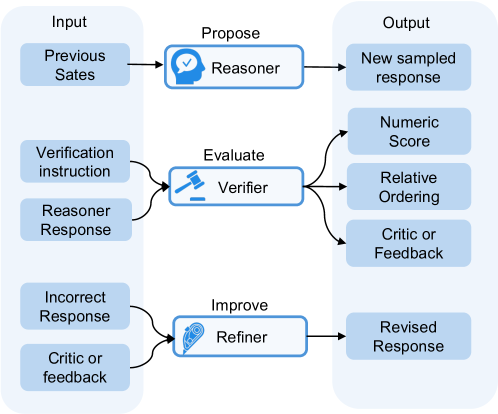
## Flowchart: Automated Response Generation and Refinement System
### Overview
The diagram illustrates a multi-stage process for generating, evaluating, and refining responses in an automated system. It features four primary stages (Input, Propose, Evaluate, Improve) and an Output section, with components connected by directional arrows indicating workflow.
### Components/Axes
**Input Section:**
- **Previous States** (likely a typo for "States")
- **Verification instruction**
- **Reasoner Response**
**Propose Stage:**
- **Reasoner** (icon: head with checkmark)
**Evaluate Stage:**
- **Verifier** (icon: gavel)
- **Numeric Score**
- **Relative Ordering**
- **Critic or Feedback**
**Improve Stage:**
- **Refiner** (icon: pencil)
- **Incorrect Response**
- **Critic or feedback**
**Output Section:**
- **New sampled response**
- **Numeric Score**
- **Relative Ordering**
- **Critic or Feedback**
- **Revised Response**
**Arrows/Connections:**
1. Input → Propose (Reasoner)
2. Propose → Evaluate (Verifier)
3. Evaluate → Improve (Refiner)
4. Improve → Output (Revised Response)
5. Evaluate branches to:
- Reasoner Response (loop back to Propose)
- Verification instruction (loop back to Input)
6. Improve branches to:
- Incorrect Response (loop back to Evaluate)
- Critic or feedback (loop back to Evaluate)
### Detailed Analysis
**Input Section:**
- Contains historical data ("Previous States") and current instructions ("Verification instruction") feeding into the Reasoner Response.
**Propose Stage:**
- The Reasoner generates initial responses based on input data.
**Evaluate Stage:**
- The Verifier assesses responses using three metrics:
1. Numeric Score (quantitative evaluation)
2. Relative Ordering (comparative ranking)
3. Critic or Feedback (qualitative assessment)
- Branching logic:
- Valid responses proceed to Output
- Invalid responses trigger refinement
**Improve Stage:**
- The Refiner processes:
- Incorrect Responses
- Critic or feedback
- Produces Revised Responses for re-evaluation
**Output Section:**
- Final outputs include both the new response and evaluation metrics for transparency.
### Key Observations
1. **Iterative Workflow**: The system employs a cyclical process where responses are continuously refined based on evaluation feedback.
2. **Multi-Metric Evaluation**: The Verifier uses three distinct evaluation criteria (numeric, ordinal, qualitative) for comprehensive assessment.
3. **Feedback Loops**: All evaluation components feed back into earlier stages, enabling continuous improvement.
4. **Potential Typo**: "Sates" in Input section likely should be "States" (referring to previous system states).
### Interpretation
This flowchart represents an adaptive response generation system with built-in quality control. The Verifier's multi-criteria evaluation ensures responses meet quantitative, comparative, and qualitative standards. The branching logic creates a feedback loop where:
- Valid responses are directly output
- Invalid responses undergo refinement through the Refiner component
- Critic feedback and incorrect responses trigger iterative improvements
The system's strength lies in its holistic evaluation approach, combining numerical scoring with qualitative feedback. However, the typo in "Sates" suggests potential documentation errors in the original diagram. The process mirrors human reasoning workflows, with the Reasoner acting as a hypothesis generator, the Verifier as a critic, and the Refiner as an editor.