## Diagram: AI System Development Phases
### Overview
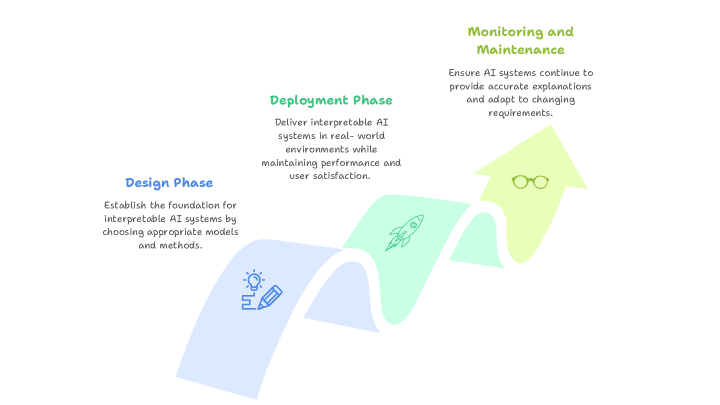
The image is a diagram illustrating the phases of AI system development, presented as a winding arrow moving upwards from left to right. The phases are Design, Deployment, and Monitoring & Maintenance. Each phase is associated with a brief description and a corresponding icon.
### Components/Axes
* **Phases:** Design Phase, Deployment Phase, Monitoring and Maintenance
* **Flow:** The diagram uses a winding arrow to indicate the progression of phases. The arrow starts at the bottom-left and moves upwards to the top-right.
* **Icons:** Each phase has an associated icon:
* Design Phase: A lightbulb and pencil
* Deployment Phase: A rocket ship
* Monitoring and Maintenance: Eyeglasses
* **Colors:** Each phase is represented by a different color:
* Design Phase: Light blue
* Deployment Phase: Light green
* Monitoring and Maintenance: Light green
### Detailed Analysis
* **Design Phase (Bottom-Left):**
* Color: Light blue
* Text: "Design Phase. Establish the foundation for interpretable AI systems by choosing appropriate models and methods."
* Icon: A lightbulb being drawn by a pencil.
* **Deployment Phase (Center):**
* Color: Light green
* Text: "Deployment Phase. Deliver interpretable AI systems in real-world environments while maintaining performance and user satisfaction."
* Icon: A rocket ship taking off.
* **Monitoring and Maintenance (Top-Right):**
* Color: Light green
* Text: "Monitoring and Maintenance. Ensure AI systems continue to provide accurate explanations and adapt to changing requirements."
* Icon: A pair of eyeglasses.
### Key Observations
* The diagram uses a visual metaphor of an upward-moving path to represent the progression of AI system development.
* The descriptions for each phase emphasize the importance of interpretability, performance, and adaptation.
* The icons are simple and visually represent the core activities of each phase.
### Interpretation
The diagram provides a high-level overview of the key phases involved in developing and maintaining AI systems. It highlights the importance of not only designing and deploying AI systems but also continuously monitoring and maintaining them to ensure they remain accurate and adaptable. The emphasis on interpretability suggests a focus on building AI systems that are transparent and understandable. The progression from design to deployment to monitoring and maintenance indicates an iterative and ongoing process.