## Technical Document: Configurable Systolic Array Design and Metrics
### Overview
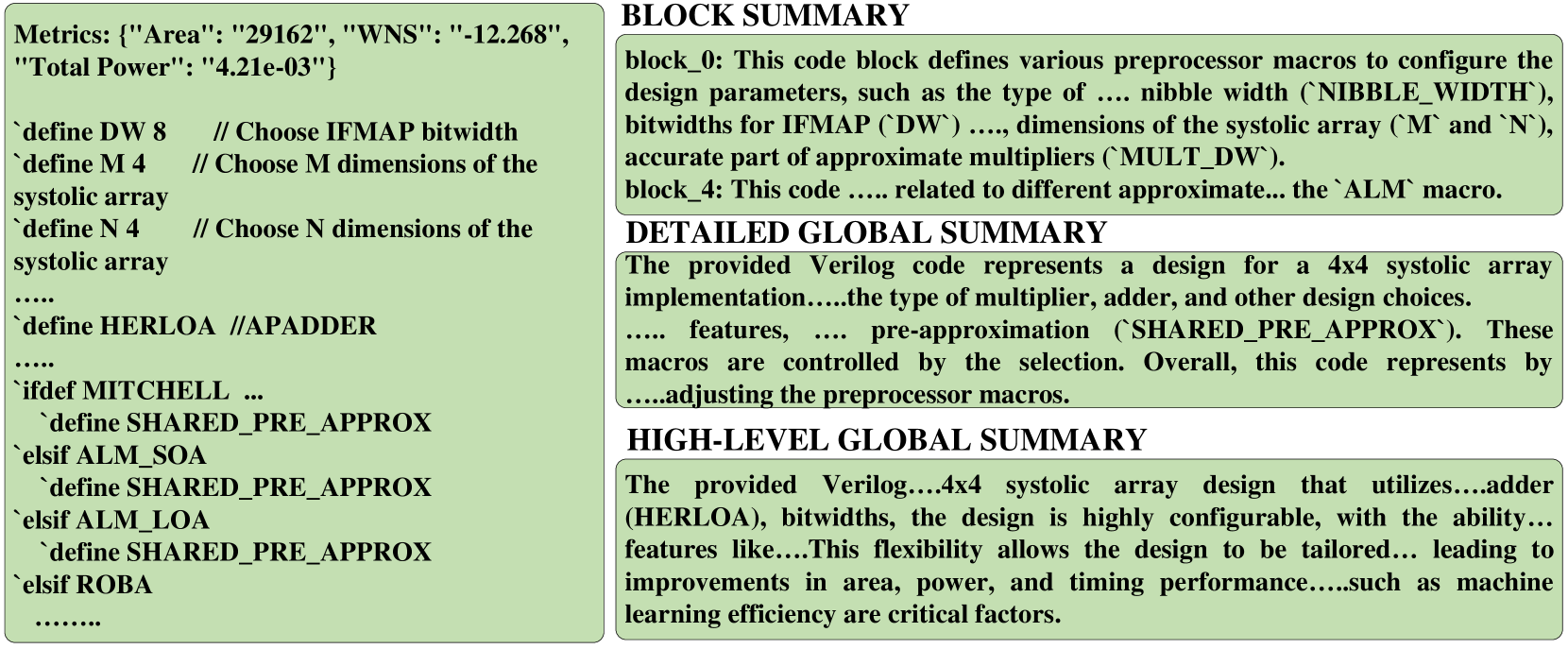
The image displays a technical summary, likely extracted from a research paper or hardware design report. It presents a two-column layout: the left column provides specific performance metrics and Verilog preprocessor code snippets, while the right column provides hierarchical textual summaries (Block, Detailed Global, and High-Level) describing the design's configurability and approximate computing capabilities.
### Components/Layout
* **Left Column (Code & Metrics):** Contains a JSON-formatted metrics object at the top, followed by Verilog preprocessor directives (`define`, `ifdef`, `elsif`) used for hardware configuration.
* **Right Column (Textual Summaries):** Contains three distinct text blocks labeled "BLOCK SUMMARY", "DETAILED GLOBAL SUMMARY", and "HIGH-LEVEL GLOBAL SUMMARY".
### Detailed Analysis
#### Left Column: Metrics and Code Snippets
**Metrics Object:**
```json
{"Area": "29162", "WNS": "-12.268", "Total Power": "4.21e-03"}
```
* *Note:* The negative WNS (Worst Negative Slack) of -12.268 indicates a timing violation in the current design configuration.
**Verilog Code Snippets:**
* `define DW 8` // Choose IFMAP bitwidth
* `define M 4` // Choose M dimensions of the systolic array
* `define N 4` // Choose N dimensions of the systolic array
* `define HERLOA` // APADDER (Approximate Adder)
* Conditional logic block:
* `ifdef MITCHELL` -> `define SHARED_PRE_APPROX`
* `elsif ALM_SOA` -> `define SHARED_PRE_APPROX`
* `elsif ALM_LOA` -> `define SHARED_PRE_APPROX`
* `elsif ROBA` -> ... (truncated)
#### Right Column: Textual Summaries
**BLOCK SUMMARY**
* `block_0`: Defines preprocessor macros for design parameters: nibble width (`NIBBLE_WIDTH`), IFMAP bitwidths (`DW`), systolic array dimensions (`M` and `N`), and approximate multiplier precision (`MULT_DW`).
* `block_4`: Relates to different approximate computing configurations and the `ALM` macro.
**DETAILED GLOBAL SUMMARY**
* Describes the Verilog code as a 4x4 systolic array implementation.
* Mentions the selection of multipliers, adders, and other design choices.
* Highlights features like pre-approximation (`SHARED_PRE_APPROX`), controlled by preprocessor macro selection.
**HIGH-LEVEL GLOBAL SUMMARY**
* Summarizes the design as a highly configurable 4x4 systolic array.
* Utilizes specific components like the `HERLOA` adder.
* Emphasizes that the design is tailored for machine learning efficiency, allowing for improvements in area, power, and timing performance through the adjustment of preprocessor macros.
### Key Observations
* **Configurability:** The design relies heavily on preprocessor macros (`define`) to toggle between different approximate computing algorithms (MITCHELL, ALM_SOA, ALM_LOA, ROBA).
* **Approximate Computing:** The presence of `HERLOA` (likely a specific approximate adder architecture) and `SHARED_PRE_APPROX` indicates the design is optimized for approximate computing, which is common in neural network accelerators to reduce power and area.
* **Truncation:** The text contains several ellipses ("...."), indicating that the provided text is a summary or excerpt from a larger, more comprehensive document.
### Interpretation
This document outlines a hardware design framework for a systolic array, which is a standard architecture for accelerating matrix multiplication in machine learning workloads.
* **Design Intent:** The use of conditional compilation (`ifdef`/`elsif`) suggests a "design space exploration" approach. The engineer can swap out different approximate computing modules (like MITCHELL or ROBA) without rewriting the core logic, allowing for rapid testing of different accuracy-vs-efficiency trade-offs.
* **Performance Implications:** The metrics provided (`Area: 29162`, `WNS: -12.268`, `Total Power: 4.21e-03`) represent a specific snapshot of the design. The negative WNS (Worst Negative Slack) is a critical finding; it suggests that this specific configuration is failing to meet the required timing constraints (setup time) at the target clock frequency. This implies that while the design is configurable, not all configurations are necessarily "timing-clean" or ready for synthesis without further optimization or frequency scaling.
* **Conclusion:** The document serves as a high-level overview of a flexible, approximate-computing-enabled hardware accelerator, likely intended for researchers or engineers evaluating the impact of different approximation techniques on hardware metrics.