## Diagram: Simulation Ontology
### Overview
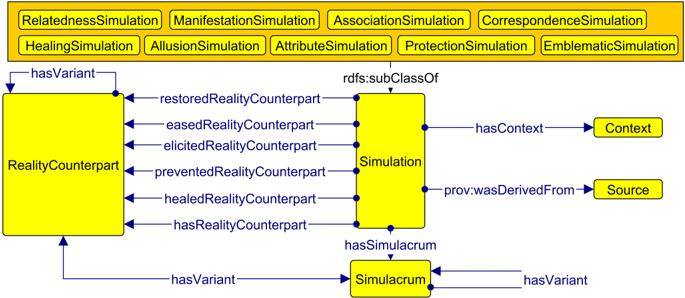
The image presents a diagram illustrating the relationships between different concepts within a simulation ontology. It shows how "Simulation" relates to "RealityCounterpart", "Simulacrum", "Context", and "Source", as well as various types of simulations.
### Components/Axes
* **Nodes:** The diagram consists of rectangular nodes representing concepts: "RealityCounterpart", "Simulation", "Simulacrum", "Context", and "Source". All nodes are filled with yellow color.
* **Relationships:** Labeled arrows indicate the relationships between these concepts, such as "hasVariant", "rdfs:subClassOf", "hasContext", "prov:wasDerivedFrom", and "hasSimulacrum".
* **Simulation Types:** A horizontal list of simulation types is present at the top, including "RelatednessSimulation", "ManifestationSimulation", "AssociationSimulation", "CorrespondenceSimulation", "HealingSimulation", "AllusionSimulation", "AttributeSimulation", "ProtectionSimulation", and "EmblematicSimulation". These are also yellow filled rectangles.
### Detailed Analysis or ### Content Details
* **RealityCounterpart:**
* Located on the left side of the diagram.
* Connected to "Simulation" via several relationships:
* "restoredRealityCounterpart" (arrow pointing from "Simulation" to "RealityCounterpart")
* "easedRealityCounterpart" (arrow pointing from "Simulation" to "RealityCounterpart")
* "elicitedRealityCounterpart" (arrow pointing from "Simulation" to "RealityCounterpart")
* "preventedRealityCounterpart" (arrow pointing from "Simulation" to "RealityCounterpart")
* "healedRealityCounterpart" (arrow pointing from "Simulation" to "RealityCounterpart")
* "hasRealityCounterpart" (arrow pointing from "RealityCounterpart" to "Simulation")
* Connected to "Simulacrum" via "hasVariant" relationship (arrow pointing from "RealityCounterpart" to "Simulacrum").
* Connected to itself via "hasVariant" relationship (arrow pointing from "RealityCounterpart" to itself).
* **Simulation:**
* Located in the center of the diagram.
* Related to "RealityCounterpart" as described above.
* Related to "Context" via "hasContext" relationship (arrow pointing from "Simulation" to "Context").
* Related to "Source" via "prov:wasDerivedFrom" relationship (arrow pointing from "Simulation" to "Source").
* Related to "Simulacrum" via "hasSimulacrum" relationship (arrow pointing from "Simulation" to "Simulacrum").
* "rdfs:subClassOf" relationship is indicated above the "Simulation" node.
* **Simulacrum:**
* Located at the bottom of the diagram.
* Connected to "RealityCounterpart" and itself via "hasVariant" relationships.
* **Context:**
* Located on the right side of the diagram.
* Connected to "Simulation" via "hasContext" relationship.
* **Source:**
* Located on the right side of the diagram, below "Context".
* Connected to "Simulation" via "prov:wasDerivedFrom" relationship.
* **Simulation Types (Top Row):**
* "RelatednessSimulation", "ManifestationSimulation", "AssociationSimulation", "CorrespondenceSimulation", "HealingSimulation", "AllusionSimulation", "AttributeSimulation", "ProtectionSimulation", "EmblematicSimulation"
### Key Observations
* The diagram illustrates a hierarchical relationship with "Simulation" as a central concept.
* "RealityCounterpart" and "Simulacrum" are linked to "Simulation" through various relationships, indicating their roles in the simulation process.
* "Context" and "Source" provide additional information related to the simulation.
* The simulation types at the top provide specific categories or aspects of simulations.
### Interpretation
The diagram represents an ontology for simulations, defining the key concepts and their relationships. It suggests that a simulation involves a "RealityCounterpart", which is transformed or represented as a "Simulacrum". The "Simulation" itself is derived from a "Source" and occurs within a specific "Context". The various simulation types at the top likely represent different applications or focuses of the simulation. The relationships like "hasVariant", "hasContext", and "prov:wasDerivedFrom" define the nature of the connections between these concepts, providing a structured understanding of the simulation process.