\n
## Diagram: Ontology Relationship Visualization
### Overview
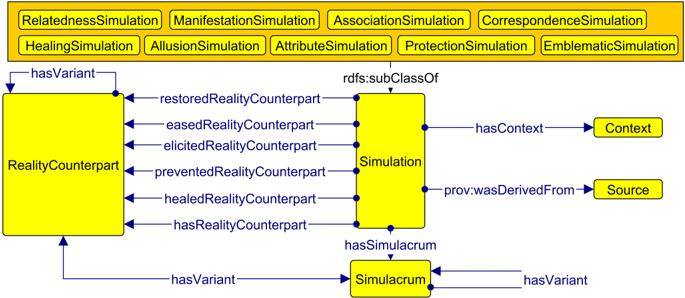
The image presents a diagram illustrating relationships between different classes within an ontology. It depicts a network of concepts related to simulations, reality, and their counterparts, using a visual representation of class hierarchies and properties. The diagram uses yellow rounded rectangles to represent classes and arrows to represent relationships between them.
### Components/Axes
The diagram consists of the following key components:
* **Classes:**
* RelatednessSimulation
* ManifestationSimulation
* AssociationSimulation
* CorrespondenceSimulation
* HealingSimulation
* AllusionSimulation
* AttributeSimulation
* ProtectionSimulation
* EmblematicSimulation
* RealityCounterpart
* Simulation
* Context
* Source
* Simulacrum
* **Relationships (Properties):**
* `hasVariant`
* `restoredRealityCounterpart`
* `easedRealityCounterpart`
* `elicitedRealityCounterpart`
* `preventedRealityCounterpart`
* `healedRealityCounterpart`
* `hasRealityCounterpart`
* `hasContext`
* `prov:wasDerivedFrom`
* `hasSimulacrum`
* `rdf:subClassOf`
The classes are arranged in a central area, with the simulation classes at the top, RealityCounterpart on the left, and Context/Source on the right. The relationships are represented by arrows connecting these classes.
### Detailed Analysis / Content Details
The diagram shows the following relationships:
* **Simulation Classes:** The top row contains several simulation classes: RelatednessSimulation, ManifestationSimulation, AssociationSimulation, CorrespondenceSimulation, HealingSimulation, AllusionSimulation, AttributeSimulation, ProtectionSimulation, and EmblematicSimulation.
* **Hierarchy:** All simulation classes are subclasses of `Simulation` via the `rdf:subClassOf` relationship.
* **RealityCounterpart Relationships:** `RealityCounterpart` has several relationships to itself via `hasRealityCounterpart`. It also has relationships to `Simulation` via `restoredRealityCounterpart`, `easedRealityCounterpart`, `elicitedRealityCounterpart`, `preventedRealityCounterpart`, and `healedRealityCounterpart`.
* **Simulation Relationships:** `Simulation` has a `hasContext` relationship to `Context` and a `prov:wasDerivedFrom` relationship to `Source`.
* **Simulacrum Relationship:** `Simulation` has a `hasSimulacrum` relationship to `Simulacrum`.
* **Simulacrum Variant:** `Simulacrum` has a `hasVariant` relationship to `RealityCounterpart`.
* **RealityCounterpart Variant:** `RealityCounterpart` has a `hasVariant` relationship to itself.
### Key Observations
* The diagram emphasizes the interconnectedness of simulations, reality, and their counterparts.
* `RealityCounterpart` appears to be a central concept, with multiple relationships to itself and other classes.
* The use of `hasVariant` suggests a notion of different versions or interpretations of reality and simulacra.
* The `prov:wasDerivedFrom` relationship indicates a provenance or lineage aspect, linking simulations to their sources.
### Interpretation
This diagram represents a conceptual model, likely an ontology, for understanding the relationships between simulations, reality, and their representations. The ontology appears to be focused on the idea that simulations can be related to reality in various ways (restored, eased, elicited, prevented, healed), and that these relationships are mediated by concepts like context and source. The inclusion of `Simulacrum` suggests an interest in the nature of copies and representations, and how they relate to the original reality. The `hasVariant` relationships indicate that both reality and simulacra can have multiple interpretations or versions.
The diagram suggests a complex system where simulations are not simply copies of reality, but rather active constructions that can influence and be influenced by it. The ontology could be used to model and reason about the effects of simulations on our understanding of the world, or to develop more sophisticated simulation technologies. The diagram is a high-level overview and doesn't provide specific data points, but rather a framework for understanding the relationships between these concepts.