TECHNICAL ASSET FINGERPRINT
d074cbb43e3f3f66f4c1d221
Click to view fullscreen
Press ESC or click to close
FOUND IN PAPERS
EXPERT: healer-alpha-free VERSION 1
RUNTIME: free/openrouter/healer-alpha
INTEL_VERIFIED
\n
## Ontology Diagram: Simulation and Reality Counterpart Relationships
### Overview
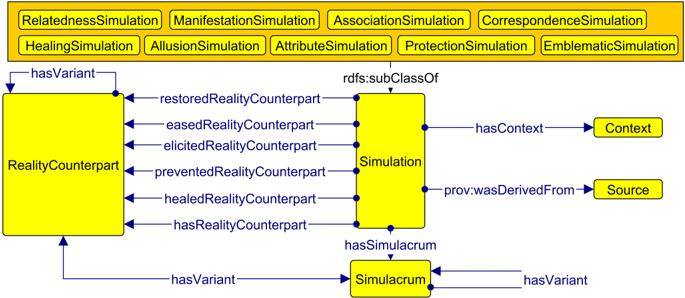
The image displays a formal ontology or class diagram, likely from a knowledge representation or semantic web context. It defines entities and relationships related to simulations, their counterparts in reality, and associated concepts. The diagram uses a consistent visual language: yellow rectangular boxes represent classes or entities, and blue arrows with labeled text represent directed relationships (properties) between them.
### Components/Axes
The diagram is structured into three main regions:
1. **Header Region (Top):** A horizontal array of eight distinct simulation type classes.
2. **Core Class Region (Center):** The primary entities `RealityCounterpart`, `Simulation`, `Simulacrum`, `Context`, and `Source`.
3. **Relationship Network:** Blue arrows connecting the core classes, each labeled with a specific property name.
**List of All Textual Elements (Classes & Properties):**
* **Header Simulation Types (Top Row, Left to Right):**
* `RelatednessSimulation`
* `ManifestationSimulation`
* `AssociationSimulation`
* `CorrespondenceSimulation`
* `HealingSimulation`
* `AllusionSimulation`
* `AttributeSimulation`
* `ProtectionSimulation`
* `EmblematicSimulation`
* **Core Classes (Yellow Boxes):**
* `RealityCounterpart` (Large box, left-center)
* `Simulation` (Large box, right-center)
* `Simulacrum` (Smaller box, bottom-center)
* `Context` (Small box, far right)
* `Source` (Small box, far right, below `Context`)
* **Relationships (Blue Arrow Labels):**
* `hasVariant` (Appears twice: connecting `RealityCounterpart` to itself and `Simulacrum` to itself)
* `rdfs:subClassOf` (Connecting the header simulation types to the `Simulation` class)
* `restoredRealityCounterpart` (From `Simulation` to `RealityCounterpart`)
* `easedRealityCounterpart` (From `Simulation` to `RealityCounterpart`)
* `elicitedRealityCounterpart` (From `Simulation` to `RealityCounterpart`)
* `preventedRealityCounterpart` (From `Simulation` to `RealityCounterpart`)
* `healedRealityCounterpart` (From `Simulation` to `RealityCounterpart`)
* `hasRealityCounterpart` (From `Simulation` to `RealityCounterpart`)
* `hasContext` (From `Simulation` to `Context`)
* `prov:wasDerivedFrom` (From `Simulation` to `Source`)
* `hasSimulacrum` (From `Simulation` to `Simulacrum`)
### Detailed Analysis
The diagram establishes a structured ontology with the following precise relationships:
1. **Class Hierarchy:** The eight specific simulation types in the header are all declared as subclasses (`rdfs:subClassOf`) of the general `Simulation` class.
2. **Core Relationship - Simulation to RealityCounterpart:** The `Simulation` class has six distinct, named relationships pointing to the `RealityCounterpart` class. These are:
* `restoredRealityCounterpart`
* `easedRealityCounterpart`
* `elicitedRealityCounterpart`
* `preventedRealityCounterpart`
* `healedRealityCounterpart`
* `hasRealityCounterpart` (This appears to be the most generic link).
3. **Other Simulation Relationships:**
* A `Simulation` `hasContext` (links to the `Context` class).
* A `Simulation` `prov:wasDerivedFrom` a `Source` (using the PROV-O provenance ontology prefix).
* A `Simulation` `hasSimulacrum` (links to the `Simulacrum` class).
4. **Internal and Cross-Entity Variants:**
* The `RealityCounterpart` class has a self-referential `hasVariant` relationship.
* The `Simulacrum` class also has a self-referential `hasVariant` relationship.
* There is a `hasVariant` relationship connecting `Simulacrum` back to `RealityCounterpart`.
### Key Observations
* **Asymmetry in Relationships:** The diagram is not symmetrical. Relationships flow primarily from `Simulation` to other entities (`RealityCounterpart`, `Context`, `Source`, `Simulacrum`). The only reverse flow is the `hasVariant` link from `Simulacrum` to `RealityCounterpart`.
* **Specificity of Simulation Effects:** The six relationships from `Simulation` to `RealityCounterpart` suggest a nuanced model where different simulations can have different types of effects or connections to their real-world counterparts (e.g., restoring, easing, preventing, healing).
* **Provenance Tracking:** The inclusion of `prov:wasDerivedFrom` indicates this ontology is designed to track the origin or derivation history of simulations.
* **Visual Grouping:** The eight specific simulation types are visually grouped at the top, emphasizing they are a set of specialized forms under the general `Simulation` concept.
### Interpretation
This diagram represents a formal semantic model for a system involving simulations and their real-world correlates. It goes beyond a simple "simulation vs. reality" dichotomy by introducing several key concepts:
1. **Multifaceted Interaction:** A simulation doesn't just mirror reality; it can actively interact with its `RealityCounterpart` in multiple defined ways (restoring, easing, preventing, etc.). This suggests applications in areas like therapeutic simulations, predictive modeling, or counterfactual analysis.
2. **Layered Abstraction:** The model includes a `Simulacrum` (an image or representation) as an intermediate entity between `Simulation` and `RealityCounterpart`, adding a layer of abstraction. The `hasVariant` relationships imply that both realities and their representations can have multiple forms or versions.
3. **Context and Provenance are First-Class Citizens:** By explicitly linking simulations to a `Context` and a `Source`, the model emphasizes that understanding *why* and *from what* a simulation was created is as important as the simulation itself. This is critical for reproducibility, evaluation, and trust.
4. **Peircean Investigative Lens:** From a semiotic perspective (Peirce's triad of sign, object, interpretant), this ontology maps well. The `Simulation` is the *sign* or representamen, the `RealityCounterpart` is the *object*, and the various relationships (`healed`, `prevented`, etc.) describe the *interpretant*—the effect or meaning the simulation generates in relation to its object. The `Context` and `Source` further ground this interpretive process.
In essence, this is not just a data model but a framework for reasoning about the purpose, effect, and origin of simulations in relation to the realities they seek to represent or influence.
DECODING INTELLIGENCE...