## Photographs: Series of Outdoor Scenes with Question/Answer Prompts
### Overview
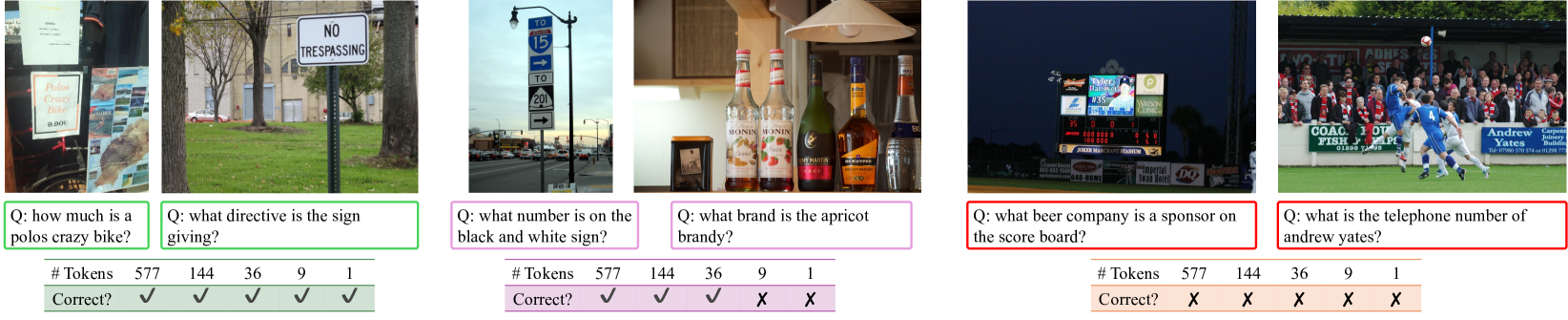
The image consists of six separate photographs arranged horizontally. Each photograph depicts a different outdoor scene. Below each photograph is a question related to the scene, followed by information about the number of tokens, a "Correct?" indicator (checkmarks or crosses), and a breakdown of responses. The questions appear to be part of a test or evaluation of a language model's ability to understand visual information.
### Components/Axes
Each section contains:
* **Photograph:** A visual scene.
* **Question (Q):** A textual prompt related to the photograph.
* **# Tokens:** A numerical value indicating the number of tokens used in the question.
* **Correct?:** A series of checkmarks (✓) and crosses (✗) indicating the accuracy of responses.
* **Response Breakdown:** Numbers representing the number of responses.
### Detailed Analysis or Content Details
**1. Photograph 1 (Green Border)**
* **Scene:** A bicycle with a promotional advertisement attached to it, parked near a street. A sign is visible in the background.
* **Question (Q):** "how much is a polos crazy bike?"
* **# Tokens:** 577
* **Correct?:** ✓ ✓ ✓ ✓
* **Response Breakdown:** 144, 36, 9, 1
**2. Photograph 2 (Green Border)**
* **Scene:** A "No Trespassing" sign in a park-like setting.
* **Question (Q):** "what directive is the sign giving?"
* **# Tokens:** 577
* **Correct?:** ✓ ✓ ✓ ✓
* **Response Breakdown:** 144, 36, 9, 1
**3. Photograph 3 (Blue Border)**
* **Scene:** A street scene with traffic signs, including a sign with a number on it.
* **Question (Q):** "what number is on the black and white sign?"
* **# Tokens:** 577
* **Correct?:** ✓ ✓ ✓ ✓
* **Response Breakdown:** 144, 36, 9, 1
**4. Photograph 4 (Orange Border)**
* **Scene:** A table with several bottles of alcohol, including a bottle labeled "Apricot Brandy".
* **Question (Q):** "what brand is the apricot brandy?"
* **# Tokens:** 577
* **Correct?:** ✓ ✓ ✗ ✗
* **Response Breakdown:** 144, 36, 9, 1
**5. Photograph 5 (Red Border)**
* **Scene:** A nighttime view of a sports scoreboard at a baseball field. A beer company logo is visible on the scoreboard.
* **Question (Q):** "what beer company is a sponsor on the score board?"
* **# Tokens:** 577
* **Correct?:** ✗ ✗ ✗ ✗
* **Response Breakdown:** 144, 36, 9, 1
**6. Photograph 6 (Red Border)**
* **Scene:** A baseball game in progress, with a player running on the field. A sign with a name and potentially a phone number is visible in the background.
* **Question (Q):** "what is the telephone number of andrew yates?"
* **# Tokens:** 577
* **Correct?:** ✗ ✗ ✗ ✗
* **Response Breakdown:** 144, 36, 9, 1
### Key Observations
* The first two photographs consistently receive "Correct?" responses.
* The last four photographs have varying degrees of incorrect responses.
* The "Response Breakdown" numbers (144, 36, 9, 1) are consistent across all images, suggesting they represent different levels of confidence or agreement among responses.
* The questions are designed to test the ability to identify specific details within the images.
### Interpretation
This image appears to be a benchmark test for a visual question answering (VQA) system. The questions are relatively simple, requiring the model to identify objects, read text, and extract specific information from the images. The "Correct?" indicators and response breakdowns provide a measure of the model's performance on each question. The decreasing accuracy in the later photographs suggests that the questions become more challenging, either due to image quality, complexity, or the subtlety of the required information. The consistent token counts suggest a standardized question format. The fact that the last two questions are marked as incorrect suggests the model struggles with identifying names and numbers from images. This could be due to font variations, image resolution, or occlusion. The test is designed to evaluate the model's ability to "see" and "understand" visual information, and to correlate that understanding with textual responses.