\n
## Violin Plot: Reliance Sensibility Across Four Model Configurations
### Overview
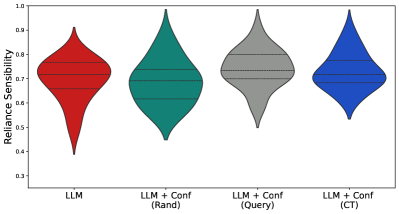
The image displays a violin plot comparing the distribution of a metric called "Reliance Sensibility" across four different model configurations. A violin plot combines a box plot with a kernel density plot, showing the data's probability density at different values, mirrored symmetrically.
### Components/Axes
* **Chart Type:** Violin Plot (mirrored density plot with embedded box plot elements).
* **Y-Axis:**
* **Label:** "Reliance Sensibility"
* **Scale:** Linear, ranging from 0.3 to 1.0.
* **Major Ticks:** 0.3, 0.4, 0.5, 0.6, 0.7, 0.8, 0.9, 1.0.
* **X-Axis (Categories):** Four distinct model configurations, labeled from left to right:
1. **LLM** (Violin color: Red)
2. **LLM + Conf (Rand)** (Violin color: Teal/Dark Cyan)
3. **LLM + Conf (Query)** (Violin color: Gray)
4. **LLM + Conf (CT)** (Violin color: Blue)
* **Legend:** The categories are defined by their x-axis labels and corresponding violin colors. There is no separate legend box; the labels are placed directly beneath each violin.
* **Embedded Box Plot Elements:** Each violin contains three horizontal lines. The central, longest line likely represents the median. The two shorter lines above and below it likely represent the interquartile range (IQR: 25th and 75th percentiles).
### Detailed Analysis
The analysis is segmented by the four model configurations, processed from left to right.
**1. LLM (Red Violin, Leftmost)**
* **Shape & Trend:** The distribution is widest (highest density) in the upper-middle range, approximately between 0.7 and 0.8. It tapers significantly towards both the upper (1.0) and lower (0.4) bounds, with a long, thin tail extending down to about 0.4.
* **Central Tendency (Estimated):**
* Median (central line): ~0.75
* IQR (upper/lower lines): ~0.70 to ~0.80
* **Spread:** Shows a relatively wide spread, with a notable concentration of data between 0.65 and 0.85, but with a long lower tail.
**2. LLM + Conf (Rand) (Teal Violin, Second from Left)**
* **Shape & Trend:** Similar overall shape to the LLM violin but appears slightly more concentrated. The widest section is also around 0.7-0.8. The lower tail is less pronounced than the LLM's, ending around 0.5.
* **Central Tendency (Estimated):**
* Median: ~0.76 (Marginally higher than LLM)
* IQR: ~0.71 to ~0.81
* **Spread:** Slightly tighter than LLM, with most data between 0.65 and 0.85.
**3. LLM + Conf (Query) (Gray Violin, Third from Left)**
* **Shape & Trend:** This distribution is more symmetric and "plump" in the middle compared to the first two. Its widest point is centered around 0.75. The tails are shorter and more balanced, extending from roughly 0.55 to 0.95.
* **Central Tendency (Estimated):**
* Median: ~0.76 (Similar to Rand)
* IQR: ~0.72 to ~0.80 (Slightly tighter IQR than Rand)
* **Spread:** More concentrated around the median, with less extreme values at the tails.
**4. LLM + Conf (CT) (Blue Violin, Rightmost)**
* **Shape & Trend:** This violin is the most concentrated and has the highest central density. Its widest section is clearly above 0.75, peaking near 0.8. The distribution is compact, with short tails extending from about 0.6 to 0.95.
* **Central Tendency (Estimated):**
* Median: ~0.78 (Appears to be the highest of the four)
* IQR: ~0.74 to ~0.82 (The highest and tightest IQR)
* **Spread:** The narrowest spread of the four, indicating the most consistent performance in the "Reliance Sensibility" metric.
### Key Observations
1. **Central Cluster:** All four distributions are primarily clustered in the 0.7 to 0.8 range on the "Reliance Sensibility" scale.
2. **Progressive Tightening:** Moving from left to right (LLM -> Rand -> Query -> CT), the distributions generally become more compact (narrower spread) and their central tendency (median) shifts slightly upward.
3. **Highest Performer:** The **LLM + Conf (CT)** configuration exhibits the highest median Reliance Sensibility and the most consistent results (tightest distribution).
4. **Lowest Tail Risk:** The **LLM** baseline shows the longest lower tail, indicating a higher probability of very low Reliance Sensibility scores compared to the other methods.
5. **Similarity of Rand and Query:** The "LLM + Conf (Rand)" and "LLM + Conf (Query)" distributions are quite similar in median and spread, though "Query" appears slightly more symmetric.
### Interpretation
This chart demonstrates the impact of different "Confidence" (Conf) mechanisms added to a base Large Language Model (LLM) on a metric termed "Reliance Sensibility." Assuming "Reliance Sensibility" is a desirable trait (higher is better), the data suggests:
* **Adding any confidence mechanism improves consistency** over the base LLM, as seen by the reduction in the lower tail and the tightening of the distributions for Rand, Query, and CT.
* **The type of confidence mechanism matters.** The "CT" variant (the specific meaning of "CT" is not defined in the image) yields the best overall performance, pushing the median score higher and making the model's output most reliably fall within a high-scoring band.
* **The "Rand" and "Query" mechanisms offer moderate, similar improvements** over the baseline, primarily by reducing the risk of very poor performance (low scores) without dramatically shifting the central tendency.
* **The base LLM, while capable of high scores, is also the most volatile,** with a significant chance of producing outputs with low Reliance Sensibility.
In essence, the plot provides visual evidence that integrating confidence estimation—particularly the "CT" method—into an LLM system leads to more reliable and consistently higher "Reliance Sensibility" outcomes.