TECHNICAL ASSET FINGERPRINT
d096ad18e7f9584ae63a0119
Click to view fullscreen
Press ESC or click to close
FOUND IN PAPERS
EXPERT: gemini-2.0-flash VERSION 1
RUNTIME: nugit/gemini/gemini-2.0-flash
INTEL_VERIFIED
## Type Inference Rules: Operational Semantics
### Overview
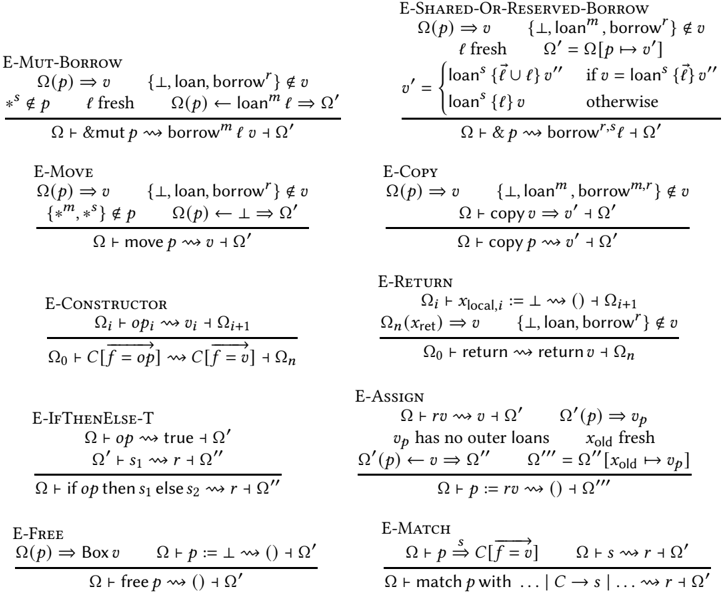
The image presents a set of type inference rules, likely representing the operational semantics of a programming language with borrowing and memory management features. Each rule describes how a program state transitions to a new state based on certain conditions.
### Components/Axes
Each rule generally follows the format:
* **Rule Name:** (e.g., E-MUT-BORROW, E-SHARED-OR-RESERVED-BORROW)
* **Premises:** Conditions that must be true for the rule to apply. These are written above the horizontal line.
* **Conclusion:** The resulting state transition if the premises are met. This is written below the horizontal line.
* **Context:** Ω represents the typing context or environment.
* **Variables:** Various symbols like `p`, `v`, `l`, `r`, `s`, etc., represent program variables, values, locations, or other semantic entities.
### Detailed Analysis or ### Content Details
Here's a breakdown of each rule:
**1. E-MUT-BORROW**
* Premises:
* `Ω(p) => v`: The value of `p` in context `Ω` is `v`.
* `{⊥, loan, borrow'} ∉ v`: `v` does not contain `⊥`, `loan`, or `borrow'`.
* `*s ∉ p`: `p` is not marked with `*s`.
* `l fresh`: `l` is a fresh location.
* `Ω(p) -loan^l=> Ω'`: The context `Ω` is updated such that `p` now loans `l`, resulting in context `Ω'`.
* Conclusion:
* `Ω ⊢ &mut p ⇝ borrow^l v + Ω'`: The mutable borrow of `p` results in `borrow^l v` and the updated context `Ω'`.
**2. E-SHARED-OR-RESERVED-BORROW**
* Premises:
* `Ω(p) => v`: The value of `p` in context `Ω` is `v`.
* `{⊥, loan^m, borrow^r} ∉ v`: `v` does not contain `⊥`, `loan^m`, or `borrow^r`.
* `l fresh`: `l` is a fresh location.
* `Ω' = Ω[p ↦ v']`: The context `Ω'` is `Ω` updated with `p` mapping to `v'`.
* `v' = loans^s {l ∪ l'} v'' if v = loans^s {l'} v''`: `v'` is `loans^s {l ∪ l'} v''` if `v` is `loans^s {l'} v''`.
* `v' = loans^s {l} v otherwise`: Otherwise, `v'` is `loans^s {l} v`.
* Conclusion:
* `Ω ⊢ &p ⇝ borrow^s,l v' + Ω'`: The shared or reserved borrow of `p` results in `borrow^s,l v'` and the updated context `Ω'`.
**3. E-MOVE**
* Premises:
* `Ω(p) => v`: The value of `p` in context `Ω` is `v`.
* `{⊥, loan, borrow'} ∉ v`: `v` does not contain `⊥`, `loan`, or `borrow'`.
* `{*m, *s} ∉ p`: `p` is not marked with `*m` or `*s`.
* `Ω(p) ⟵ ⊥ => Ω'`: The context `Ω` is updated such that `p` is now `⊥`, resulting in context `Ω'`.
* Conclusion:
* `Ω ⊢ move p ⇝ v + Ω'`: Moving `p` results in `v` and the updated context `Ω'`.
**4. E-COPY**
* Premises:
* `Ω(p) => v`: The value of `p` in context `Ω` is `v`.
* `{⊥, loan^m, borrow^m,r} ∉ v`: `v` does not contain `⊥`, `loan^m`, or `borrow^m,r`.
* Conclusion:
* `Ω ⊢ copy v ⇝ v' + Ω'`: Copying `v` results in `v'` and the updated context `Ω'`.
* Conclusion:
* `Ω ⊢ copy p ⇝ v' + Ω'`: Copying `p` results in `v'` and the updated context `Ω'`.
**5. E-CONSTRUCTOR**
* Premises:
* `Ω_i ⊢ op_i ⇝ v_i + Ω_{i+1}`: The operation `op_i` in context `Ω_i` results in `v_i` and the updated context `Ω_{i+1}`.
* `Ω_0 ⊢ C[f = op] ⇝ C[f = v] + Ω_n`: The constructor `C[f = op]` in context `Ω_0` results in `C[f = v]` and the updated context `Ω_n`.
**6. E-RETURN**
* Premises:
* `Ω_i ⊢ x_{local,i} := ⊥ ⇝ () + Ω_{i+1}`: Setting the local variable `x_{local,i}` to `⊥` results in `()` and the updated context `Ω_{i+1}`.
* `Ω_n(x_{ret}) => v`: The value of `x_{ret}` in context `Ω_n` is `v`.
* `{⊥, loan, borrow'} ∉ v`: `v` does not contain `⊥`, `loan`, or `borrow'`.
* Conclusion:
* `Ω_0 ⊢ return ⇝ return v + Ω_n`: Returning results in `return v` and the updated context `Ω_n`.
**7. E-IFTHENELSE-T**
* Premises:
* `Ω ⊢ op ⇝ true + Ω'`: The operation `op` in context `Ω` results in `true` and the updated context `Ω'`.
* `Ω' ⊢ s_1 ⇝ r + Ω''`: The statement `s_1` in context `Ω'` results in `r` and the updated context `Ω''`.
* Conclusion:
* `Ω ⊢ if op then s_1 else s_2 ⇝ r + Ω''`: The if-then-else statement results in `r` and the updated context `Ω''`.
**8. E-ASSIGN**
* Premises:
* `Ω ⊢ rv ⇝ v + Ω'`: Evaluating `rv` in context `Ω` results in `v` and the updated context `Ω'`.
* `Ω'(p) => v_p`: The value of `p` in context `Ω'` is `v_p`.
* `v_p has no outer loans`: `v_p` has no outer loans.
* `x_{old} fresh`: `x_{old}` is a fresh variable.
* `Ω'(p) ⟵ v => Ω''`: The context `Ω'` is updated such that `p` is now `v`, resulting in context `Ω''`.
* `Ω''' = Ω''[x_{old} ↦ v_p]`: The context `Ω'''` is `Ω''` updated with `x_{old}` mapping to `v_p`.
* Conclusion:
* `Ω ⊢ p := rv ⇝ () + Ω'''`: The assignment results in `()` and the updated context `Ω'''`.
**9. E-FREE**
* Premises:
* `Ω(p) => Box v`: The value of `p` in context `Ω` is `Box v`.
* `Ω ⊢ p := ⊥ ⇝ () + Ω'`: The context `Ω` is updated such that `p` is now `⊥`, resulting in context `Ω'`.
* Conclusion:
* `Ω ⊢ free p ⇝ () + Ω'`: Freeing `p` results in `()` and the updated context `Ω'`.
**10. E-MATCH**
* Premises:
* `Ω ⊢ p ⇝^s C[f = v]`: Matching `p` results in `C[f = v]`.
* `Ω ⊢ s ⇝ r + Ω'`: The statement `s` results in `r` and the updated context `Ω'`.
* Conclusion:
* `Ω ⊢ match p with ... | C -> s | ... ⇝ r + Ω'`: The match statement results in `r` and the updated context `Ω'`.
### Key Observations
* The rules define how different operations (borrowing, moving, copying, assignment, etc.) affect the program state, represented by the context `Ω`.
* The rules often involve checks to ensure that certain conditions are met before an operation can proceed (e.g., checking for existing loans or borrows).
* The rules update the context `Ω` to reflect the changes caused by the operation.
### Interpretation
These rules describe the operational semantics of a language with memory safety features, likely related to borrowing and ownership. The rules ensure that memory is accessed and modified in a safe and controlled manner, preventing issues like dangling pointers and data races. The presence of "loan" and "borrow" concepts suggests a system similar to Rust's borrow checker. The rules enforce constraints on how memory can be accessed and modified, ensuring that multiple mutable references to the same memory location are not allowed simultaneously, and that references do not outlive the data they point to. The rules are crucial for understanding the behavior of programs written in this language and for verifying their correctness.
DECODING INTELLIGENCE...
EXPERT: nemotron-free VERSION 1
RUNTIME: free/nvidia/nemotron-nano-12b-v2-vl:free
INTEL_VERIFIED
## Technical Ruleset: Memory and Type System Operations
### Overview
The image presents a formal set of rules governing memory operations, type systems, and ownership semantics in a programming language. Each rule is labeled (e.g., `E-Mut-Borrow`, `E-Move`) and defines logical relationships between program states, ownership, and borrowing constraints.
### Components/Axes
- **Labels**:
- `E-Mut-Borrow`, `E-Move`, `E-Shared-Or-Reserved-Borrow`, `E-Copy`, `E-Constructor`, `E-Return`, `E-Assign`, `E-IfThenElse-T`, `E-Free`, `E-Match`.
- **Logical Formulas**:
- Premises (e.g., `Ω(p) ⇒ v`, `Ω(p) ⊢ loan^m, borrow^r ∉ v`).
- Conclusions (e.g., `Ω ⊢ borrow^m ℓ v ⊢ Ω'`).
- **Operators/Symbols**:
- `⇒` (implies), `⊢` (proves), `∉` (not in), `∪` (union), `↔` (if and only if), `→` (arrow), `:=` (assignment).
### Detailed Analysis
1. **E-Mut-Borrow**:
- Premise: `Ω(p) ⇒ v` and `Ω(p) ⊢ loan^m, borrow^r ∉ v`.
- Conclusion: `Ω ⊢ &mut p ⇔ borrow^m ℓ v ⊢ Ω'`.
- *Interpretation*: Allows mutable borrowing of a value `v` under ownership constraints.
2. **E-Move**:
- Premise: `Ω(p) ⇒ v`, `Ω(p) ⊢ loan^m, borrow^r ∉ v`, and `(*^m, *^s) ∉ p`.
- Conclusion: `Ω ⊢ move p ⇔ v ⊢ Ω'`.
- *Interpretation*: Moves ownership of `v` from `p` to a new state `Ω'`.
3. **E-Shared-Or-Reserved-Borrow**:
- Premise: `Ω(p) ⇒ v`, `Ω(p) ⊢ loan^m, borrow^r ∉ v`, and `ℓ fresh`.
- Conclusion: `Ω' = Ω[p ↦ v']`, where `v'` depends on `v` and `ℓ`.
- *Interpretation*: Handles shared or reserved borrowing with freshness conditions.
4. **E-Copy**:
- Premise: `Ω(p) ⇒ v`, `Ω(p) ⊢ loan^m, borrow^m,r ∉ v`.
- Conclusion: `Ω ⊢ copy v ⇒ v' ⊢ Ω'`.
- *Interpretation*: Copies `v` into `v'` under ownership constraints.
5. **E-Constructor**:
- Premise: `Ω_i ⊢ op_i ⇔ v_i ⊢ Ω_{i+1}`.
- Conclusion: `Ω_0 ⊢ C[f = op] ⇔ C[f = v] ⊢ Ω_n`.
- *Interpretation*: Constructs values using operations `op_i` and tracks ownership across steps.
6. **E-Return**:
- Premise: `Ω_i ⊢ x_local,i := ⊥ ⇔ () ⊢ Ω_{i+1}`.
- Conclusion: `Ω_n(x_ret) ⇒ v`, `Ω_0 ⊢ return ⇔ return v ⊢ Ω_n`.
- *Interpretation*: Returns a value `v` after local variable initialization.
7. **E-Assign**:
- Premise: `Ω ⊢ rv ⇔ v ⊢ Ω'`, `x_old fresh`, `v_p has no outer loans`.
- Conclusion: `Ω' ⊢ p := rv ⇔ () ⊢ Ω''`.
- *Interpretation*: Assigns `rv` to `p` with freshness and ownership checks.
8. **E-IfThenElse-T**:
- Premise: `Ω ⊢ op ⇔ true ⊢ Ω'`, `Ω' ⊢ s_1 ⇔ r ⊢ Ω''`, `Ω ⊢ if op then s_1 else s_2 ⇔ r ⊢ Ω''`.
- *Interpretation*: Conditional execution with ownership tracking for branches.
9. **E-Free**:
- Premise: `Ω(p) ⇒ Box v`, `Ω ⊢ p := ⊥ ⇔ () ⊢ Ω'`.
- Conclusion: `Ω ⊢ free p ⇔ () ⊢ Ω'`.
- *Interpretation*: Frees a boxed value `v` and updates ownership.
10. **E-Match**:
- Premise: `Ω ⊢ p ⇒ C[f = v]`, `Ω ⊢ s ⇔ r ⊢ Ω'`.
- Conclusion: `Ω ⊢ match p with ... ⇒ s ⇔ r ⊢ Ω'`.
- *Interpretation*: Matches patterns `p` against constructors `C` and updates ownership.
### Key Observations
- **Ownership Constraints**: Rules like `loan^m, borrow^r ∉ v` enforce that values cannot be simultaneously loaned or borrowed.
- **Freshness**: Variables like `ℓ` and `x_old` are marked `fresh` to avoid capture in closures.
- **Ownership Transfers**: Operations like `move` and `return` explicitly transfer ownership between states.
### Interpretation
This ruleset formalizes a type system with ownership and borrowing semantics, likely inspired by Rust or similar languages. Key features include:
- **Memory Safety**: Rules prevent dangling pointers by tracking loans and borrows.
- **Type Inference**: The `E-Constructor` and `E-Match` rules suggest a type inference mechanism for algebraic data types.
- **Concurrency Safety**: The absence of simultaneous loans/borrows ensures thread-safe access.
The absence of numerical data or visual trends indicates this is a formal specification rather than empirical data. The rules collectively define a sound and complete system for managing resources in a concurrent, memory-safe language.
DECODING INTELLIGENCE...