\n
## Mathematical Formulas: Operational Semantics
### Overview
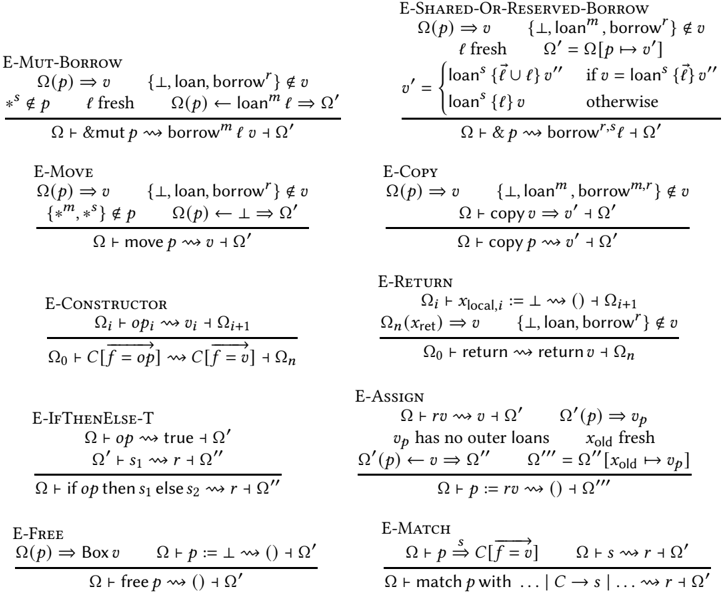
The image presents a collection of mathematical formulas, likely representing operational semantics for a programming language or a formal system. Each formula defines a transition rule, showing how a system state changes based on a specific operation. The formulas use a notation involving state variables (Ω), preconditions, operations, and resulting states (Ω'). The notation includes symbols for borrowing, loans, and various logical operations.
### Components/Axes
There are no axes or traditional chart components. The image consists entirely of mathematical expressions. Each expression is labeled with a name indicating the operation it defines (e.g., "E-MUT-Borrow", "E-SHARED-OR-RESERVED-Borrow"). The formulas are arranged in a grid-like structure, with each formula occupying a distinct rectangular region.
### Detailed Analysis or Content Details
Here's a transcription of each formula, attempting to capture the mathematical notation as accurately as possible:
**1. E-MUT-Borrow**
Ω(p) ⇒ v {L, loan, borrow"} ∉ v
x⁵ ∉ p ⇔ p ⊣ fresh
Ω & mut p ↦ borrow" l v Ω'
**2. E-SHARED-OR-RESERVED-Borrow**
Ω(p) ⇒ v {L, loanᵐ, borrow"} ∉ v
v' = {loans' {l | u} if u' = loans' {l"} v'
= loans' {l} v otherwise
Ω & p ↦ borrow"s l v Ω'
**3. E-Move**
Ω(p) ⇒ v {L, loan, borrow"} ∉ v
{xᵐ, x⁵} ∉ p Ω(p) ↦ ⊥ ⊣ Ω'
Ω & move p ↦ v Ω'
**4. E-Copy**
Ω(p) ⇒ v {L, loanᵐ, borrowᵐr} ∉ v
Ω & copy p ↦ v' Ω'
**5. E-CONSTRUCTOR**
Ωᵢ + opᵢ ⇒ vᵢ Ωᵢ + 1
Ω₀ + [lf = op] ↦ C[lf = v] ↦ Ωₙ
**6. E-RETURN**
Ωᵢ + localᵢ i := 1 ↦ Ωᵢ + 1
Ωₙ(xᵣet) ⇒ v {L, loan, borrow"} ∉ v
Ω₀ + return ↦ return v ↦ Ωₙ
**7. E-IF-THEN-ELSE-T**
Ω + op true ⇒ Ω'
Ω + S₁ ↦ r ↦ Ω"
r: if op then s₁ else s₂ ↦ r ↦ Ω"
**8. E-FREE**
Ω(p) ⇒ Box v
Ω & free p ↦ () ↦ Ω'
**9. E-ASSIGN**
Ω & r v ↦ v' ↦ Ω'
Ω'(p) ⇒ vₚ
up has no outer loans
Ω'(p) ↦ v ↦ Ω"
Ω" = [xold ↦ vₚ]
**10. E-MATCH**
Ω & p ↦ C[f = v]
Ω & s ↦ r ↦ Ω'
Ω & match p with ... | C → s | ... ↦ r ↦ Ω'
### Key Observations
* The formulas consistently use the notation Ω to represent a state, and Ω' to represent the resulting state after an operation.
* The curly braces { } are used to denote sets of conditions or properties that must hold for the transition to be valid.
* The symbol "↦" appears to represent a state transition or assignment.
* The notation "∉" indicates set membership exclusion.
* The formulas involve concepts like borrowing, loans, and mutation, suggesting a system dealing with resource management or memory allocation.
* The formulas are highly symbolic and require a deep understanding of the underlying formal system to interpret fully.
### Interpretation
The image presents a formal specification of the operational semantics of a programming language or a computational model. Each formula defines a rule for how the system's state changes when a particular operation is performed. These rules are crucial for defining the meaning of the language and for reasoning about its behavior.
The presence of concepts like "borrowing" and "loans" suggests that the system may be concerned with managing resources, such as memory or access rights. The formulas involving "move" and "copy" indicate operations related to data manipulation. The "match" formula suggests pattern matching capabilities.
The formulas are written in a highly abstract and mathematical style, typical of formal semantics. They are intended to be precise and unambiguous, allowing for rigorous analysis and verification of the system's behavior. The notation is dense and requires specialized knowledge to interpret correctly. The overall structure suggests a well-defined and formally specified system.