## Technical Ruleset: Memory and Type System Operations
### Overview
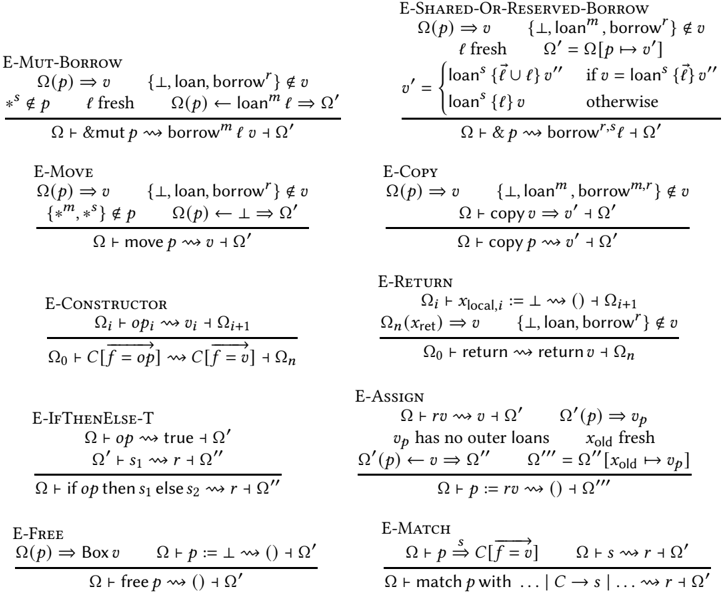
The image presents a formal set of rules governing memory operations, type systems, and ownership semantics in a programming language. Each rule is labeled (e.g., `E-Mut-Borrow`, `E-Move`) and defines logical relationships between program states, ownership, and borrowing constraints.
### Components/Axes
- **Labels**:
- `E-Mut-Borrow`, `E-Move`, `E-Shared-Or-Reserved-Borrow`, `E-Copy`, `E-Constructor`, `E-Return`, `E-Assign`, `E-IfThenElse-T`, `E-Free`, `E-Match`.
- **Logical Formulas**:
- Premises (e.g., `Ω(p) ⇒ v`, `Ω(p) ⊢ loan^m, borrow^r ∉ v`).
- Conclusions (e.g., `Ω ⊢ borrow^m ℓ v ⊢ Ω'`).
- **Operators/Symbols**:
- `⇒` (implies), `⊢` (proves), `∉` (not in), `∪` (union), `↔` (if and only if), `→` (arrow), `:=` (assignment).
### Detailed Analysis
1. **E-Mut-Borrow**:
- Premise: `Ω(p) ⇒ v` and `Ω(p) ⊢ loan^m, borrow^r ∉ v`.
- Conclusion: `Ω ⊢ &mut p ⇔ borrow^m ℓ v ⊢ Ω'`.
- *Interpretation*: Allows mutable borrowing of a value `v` under ownership constraints.
2. **E-Move**:
- Premise: `Ω(p) ⇒ v`, `Ω(p) ⊢ loan^m, borrow^r ∉ v`, and `(*^m, *^s) ∉ p`.
- Conclusion: `Ω ⊢ move p ⇔ v ⊢ Ω'`.
- *Interpretation*: Moves ownership of `v` from `p` to a new state `Ω'`.
3. **E-Shared-Or-Reserved-Borrow**:
- Premise: `Ω(p) ⇒ v`, `Ω(p) ⊢ loan^m, borrow^r ∉ v`, and `ℓ fresh`.
- Conclusion: `Ω' = Ω[p ↦ v']`, where `v'` depends on `v` and `ℓ`.
- *Interpretation*: Handles shared or reserved borrowing with freshness conditions.
4. **E-Copy**:
- Premise: `Ω(p) ⇒ v`, `Ω(p) ⊢ loan^m, borrow^m,r ∉ v`.
- Conclusion: `Ω ⊢ copy v ⇒ v' ⊢ Ω'`.
- *Interpretation*: Copies `v` into `v'` under ownership constraints.
5. **E-Constructor**:
- Premise: `Ω_i ⊢ op_i ⇔ v_i ⊢ Ω_{i+1}`.
- Conclusion: `Ω_0 ⊢ C[f = op] ⇔ C[f = v] ⊢ Ω_n`.
- *Interpretation*: Constructs values using operations `op_i` and tracks ownership across steps.
6. **E-Return**:
- Premise: `Ω_i ⊢ x_local,i := ⊥ ⇔ () ⊢ Ω_{i+1}`.
- Conclusion: `Ω_n(x_ret) ⇒ v`, `Ω_0 ⊢ return ⇔ return v ⊢ Ω_n`.
- *Interpretation*: Returns a value `v` after local variable initialization.
7. **E-Assign**:
- Premise: `Ω ⊢ rv ⇔ v ⊢ Ω'`, `x_old fresh`, `v_p has no outer loans`.
- Conclusion: `Ω' ⊢ p := rv ⇔ () ⊢ Ω''`.
- *Interpretation*: Assigns `rv` to `p` with freshness and ownership checks.
8. **E-IfThenElse-T**:
- Premise: `Ω ⊢ op ⇔ true ⊢ Ω'`, `Ω' ⊢ s_1 ⇔ r ⊢ Ω''`, `Ω ⊢ if op then s_1 else s_2 ⇔ r ⊢ Ω''`.
- *Interpretation*: Conditional execution with ownership tracking for branches.
9. **E-Free**:
- Premise: `Ω(p) ⇒ Box v`, `Ω ⊢ p := ⊥ ⇔ () ⊢ Ω'`.
- Conclusion: `Ω ⊢ free p ⇔ () ⊢ Ω'`.
- *Interpretation*: Frees a boxed value `v` and updates ownership.
10. **E-Match**:
- Premise: `Ω ⊢ p ⇒ C[f = v]`, `Ω ⊢ s ⇔ r ⊢ Ω'`.
- Conclusion: `Ω ⊢ match p with ... ⇒ s ⇔ r ⊢ Ω'`.
- *Interpretation*: Matches patterns `p` against constructors `C` and updates ownership.
### Key Observations
- **Ownership Constraints**: Rules like `loan^m, borrow^r ∉ v` enforce that values cannot be simultaneously loaned or borrowed.
- **Freshness**: Variables like `ℓ` and `x_old` are marked `fresh` to avoid capture in closures.
- **Ownership Transfers**: Operations like `move` and `return` explicitly transfer ownership between states.
### Interpretation
This ruleset formalizes a type system with ownership and borrowing semantics, likely inspired by Rust or similar languages. Key features include:
- **Memory Safety**: Rules prevent dangling pointers by tracking loans and borrows.
- **Type Inference**: The `E-Constructor` and `E-Match` rules suggest a type inference mechanism for algebraic data types.
- **Concurrency Safety**: The absence of simultaneous loans/borrows ensures thread-safe access.
The absence of numerical data or visual trends indicates this is a formal specification rather than empirical data. The rules collectively define a sound and complete system for managing resources in a concurrent, memory-safe language.