## Diagram: Python Module Dependency and Formalization Status
### Overview
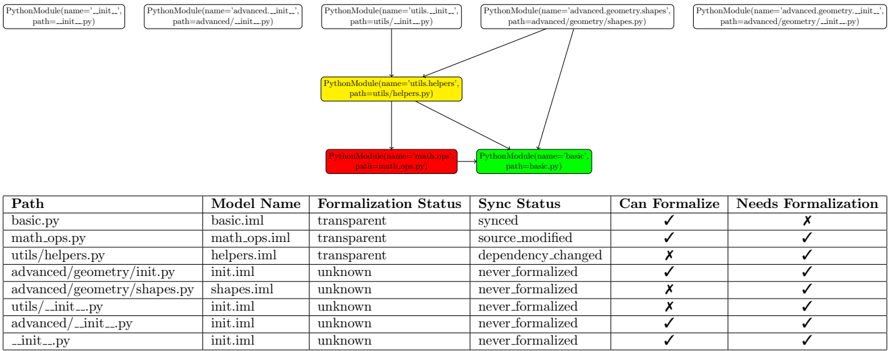
The image consists of two primary components: a dependency flowchart at the top and a detailed status table at the bottom. The flowchart visualizes the import/dependency relationships between several Python modules. The table provides metadata and formalization status for each module's corresponding file. The overall purpose appears to be tracking the formalization (likely a code verification or documentation process) of a Python codebase.
### Components/Axes
**Flowchart Components:**
* **Nodes:** Six rectangular boxes representing Python modules. Each contains text in the format `PythonModule(name='[module_name]', path='[file_path]')`.
* **Edges:** Directed arrows indicating dependency (likely "imports" or "depends on") relationships between modules.
* **Color Coding:**
* Top row (5 modules): White background.
* Middle module (`utils.helpers`): Yellow background.
* Bottom-left module (`math.ops`): Red background.
* Bottom-right module (`basic`): Green background.
**Table Columns:**
1. **Path:** File path of the Python module.
2. **Model Name:** Name of an associated model file (with `.iml` extension).
3. **Formalization Status:** Current state of formalization (e.g., `transparent`, `unknown`).
4. **Sync Status:** Synchronization state with the source (e.g., `synced`, `source_modified`).
5. **Can Formalize:** Indicates if formalization is possible (✓ = Yes, ✗ = No).
6. **Needs Formalization:** Indicates if formalization is required (✓ = Yes, ✗ = No).
### Detailed Analysis
**Flowchart Module Details (Top to Bottom, Left to Right):**
1. `PythonModule(name='__init__', path='__init__.py')`
2. `PythonModule(name='advanced.__init__', path='advanced/__init__.py')`
3. `PythonModule(name='utils.__init__', path='utils/__init__.py')`
4. `PythonModule(name='advanced.geometry.shapes', path='advanced/geometry/shapes.py')`
5. `PythonModule(name='advanced.geometry.__init__', path='advanced/geometry/__init__.py')`
6. **Middle (Yellow):** `PythonModule(name='utils.helpers', path='utils/helpers.py')`
* **Dependencies (Incoming Arrows):** Receives dependencies from modules #2, #3, #4, and #5.
7. **Bottom-Left (Red):** `PythonModule(name='math.ops', path='math/ops.py')`
* **Dependencies (Incoming Arrow):** Receives a dependency from the middle module (`utils.helpers`).
8. **Bottom-Right (Green):** `PythonModule(name='basic', path='basic.py')`
* **Dependencies (Incoming Arrows):** Receives dependencies from the middle module (`utils.helpers`) and from module #4 (`advanced.geometry.shapes`).
**Table Data Transcription:**
| Path | Model Name | Formalization Status | Sync Status | Can Formalize | Needs Formalization |
| :--- | :--- | :--- | :--- | :--- | :--- |
| basic.py | basic.iml | transparent | synced | ✓ | ✗ |
| math_ops.py | math_ops.iml | transparent | source_modified | ✓ | ✓ |
| utils/helpers.py | helpers.iml | transparent | dependency_changed | ✗ | ✓ |
| advanced/geometry/__init__.py | init.iml | unknown | never_formalized | ✓ | ✓ |
| advanced/geometry/shapes.py | shapes.iml | unknown | never_formalized | ✗ | ✓ |
| utils/__init__.py | init.iml | unknown | never_formalized | ✗ | ✓ |
| advanced/__init__.py | init.iml | unknown | never_formalized | ✓ | ✓ |
| __init__.py | init.iml | unknown | never_formalized | ✓ | ✓ |
### Key Observations
1. **Dependency Hub:** The `utils.helpers` module (yellow) is a central dependency hub, imported by four other modules (`math.ops`, `basic`, `advanced.geometry.shapes`, and indirectly by others via `advanced.geometry.__init__`).
2. **Formalization Disparity:** There is a clear split in status. Modules with `transparent` formalization status (`basic.py`, `math_ops.py`, `utils/helpers.py`) are partially or fully processed. All modules with `unknown` status are `never_formalized`.
3. **Action Required:** The `Needs Formalization` column shows a ✓ for 6 out of 8 modules, indicating most of the codebase requires formalization work.
4. **Blockers:** Two modules (`utils/helpers.py` and `advanced/geometry/shapes.py`) have `dependency_changed` or `never_formalized` sync status and are marked with ✗ in the `Can Formalize` column, suggesting their dependencies must be resolved first.
5. **Color-Coded Status in Flowchart:** The red (`math.ops`) and green (`basic`) modules in the flowchart likely correspond to their table status. `math.ops` is `source_modified` and needs formalization (red for attention/action), while `basic` is `synced` and does not need formalization (green for complete/ok). The yellow `utils.helpers` is a critical dependency with a `dependency_changed` status.
### Interpretation
This diagram serves as a project management tool for a code formalization initiative. The flowchart maps the architectural dependency structure, highlighting `utils.helpers` as a critical, shared component whose status change (`dependency_changed`) has cascading effects. The table provides the actionable project status.
The data suggests the formalization process is in its early stages. Only three modules have been touched (`transparent` status), and even among those, only `basic.py` is fully synchronized and complete. The high number of `unknown` and `never_formalized` entries indicates a significant amount of work remains. The key bottleneck is the `utils/helpers.py` module; its `dependency_changed` status and inability to be formalized currently (`Can Formalize: ✗`) likely block progress on `math.ops.py` and potentially others that depend on it. The project's next logical step would be to resolve the dependencies for `utils/helpers.py` and `advanced/geometry/shapes.py` to unblock their formalization.