## Diagram: Shared Memory Access Scenarios in Multi-Threaded Systems
### Overview
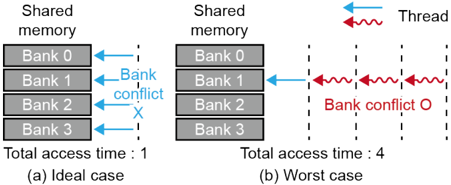
The diagram compares two scenarios of shared memory access in a multi-threaded environment:
- **(a) Ideal case**: Smooth, conflict-free memory access with minimal latency.
- **(b) Worst case**: Severe memory bank conflicts causing significant delays.
### Components/Axes
- **Shared memory banks**: Labeled `Bank 0` to `Bank 3` (vertical axis).
- **Access indicators**:
- **Blue arrows**: Represent thread access to memory banks.
- **Red wavy arrows**: Denote bank conflicts (labeled `Bank conflict O` and `Bank conflict x`).
- **Total access time**:
- Ideal case: `1` (bottom-left of diagram).
- Worst case: `4` (bottom-right of diagram).
- **Legend**:
- Blue: Thread.
- Red: Bank conflict.
### Detailed Analysis
1. **Ideal case (a)**:
- All four memory banks (`Bank 0`–`Bank 3`) are accessed sequentially by a single thread (blue arrows).
- No conflicts (`x` or `O` markers) are present.
- Total access time is explicitly labeled as `1`.
2. **Worst case (b)**:
- Thread accesses (`blue arrows`) and bank conflicts (`red wavy arrows`) overlap across all banks.
- Conflicts are marked with `x` (Bank 2) and `O` (Bank 3), suggesting different conflict types or severities.
- Total access time increases to `4`, a 4x slowdown compared to the ideal case.
### Key Observations
- **Conflict impact**: The worst case shows a direct correlation between bank conflicts and increased latency.
- **Conflict distribution**: Conflicts occur in Bank 2 (`x`) and Bank 3 (`O`), but the exact meaning of `x` vs. `O` is unspecified.
- **Thread behavior**: The thread’s access pattern in the worst case involves repeated or simultaneous requests to the same banks.
### Interpretation
This diagram illustrates how **memory bank contention** in multi-threaded systems can degrade performance. The ideal case assumes perfect parallelism with no contention, while the worst case highlights the overhead of resolving conflicts (e.g., cache thrashing, arbitration delays). The use of `x` and `O` to denote conflicts may imply:
- `x`: Critical/irreconcilable conflicts requiring thread stalling.
- `O`: Overlapping access requests that resolve without stalling but still incur latency.
The stark difference in total access time (`1` vs. `4`) underscores the importance of memory bank architecture and conflict resolution strategies in optimizing parallel computing systems.