\n
## Screenshot: Code Snippet
### Overview
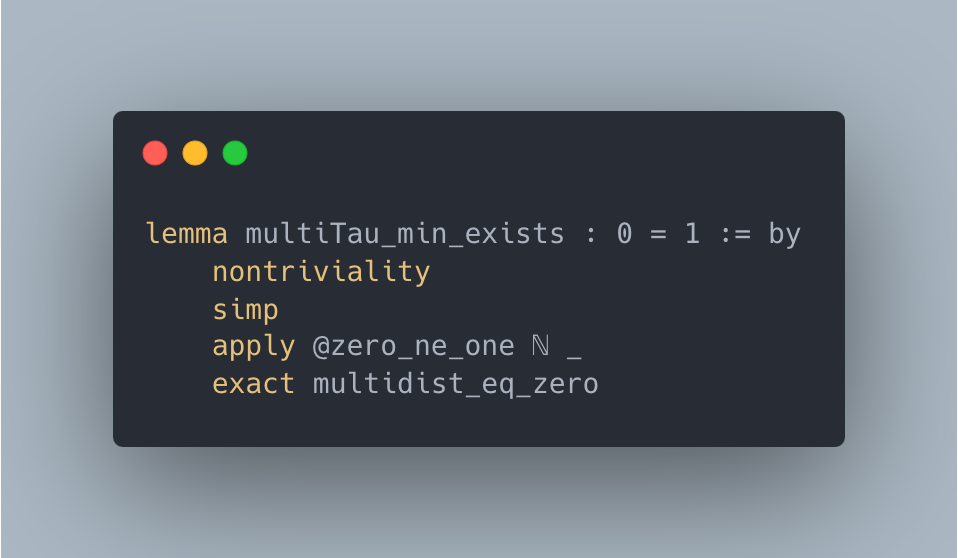
The image is a screenshot of a code editor displaying a lemma definition, likely from a formal verification or theorem proving system. The code is presented against a dark background with a light-colored text. There are three colored circles at the top-left corner of the image.
### Components/Axes
The image does not contain axes or charts. It consists of:
* **Colored Circles:** Three circles positioned at the top-left corner. From left to right, they are red, orange, and green.
* **Code Block:** A block of text representing code.
### Detailed Analysis or Content Details
The code block contains the following text:
```
lemma multiTau_min_exists : 0 = 1 := by
nontriviality
simp
apply @zero_ne_one N_
exact multdist_eq_zero
```
* `lemma multiTau_min_exists : 0 = 1 := by`: This line defines a lemma named `multiTau_min_exists` and asserts that `0 = 1`. The `:= by` indicates the start of the proof.
* `nontriviality`: This is a tactic, likely used to ensure the proof is not trivial.
* `simp`: This is a simplification tactic, attempting to simplify the goal.
* `apply @zero_ne_one N_`: This line applies a lemma or theorem named `zero_ne_one` to the current goal, parameterized by `N_`.
* `exact multdist_eq_zero`: This line completes the proof by showing that the current goal is equivalent to `multdist_eq_zero`.
### Key Observations
The code attempts to prove a contradiction (0 = 1). The tactics used suggest a formal proof environment where automated simplification and lemma application are employed. The presence of `nontriviality` suggests the system is designed to avoid trivial proofs.
### Interpretation
The code snippet demonstrates a proof attempt within a formal system. The goal is to prove the statement `0 = 1`, which is inherently false in standard mathematical systems. The tactics used (`nontriviality`, `simp`, `apply`, `exact`) are common in interactive theorem provers like Lean, Coq, or Isabelle. The code likely represents a test case or an example demonstrating the system's capabilities, or a deliberate attempt to find a flaw in the system's reasoning. The colored circles at the top-left might be indicators of the status of the code (e.g., compilation status, testing status). Without further context, it's difficult to determine the exact purpose of this code snippet.