## Screenshot: Formal Proof Script in Lean
### Overview
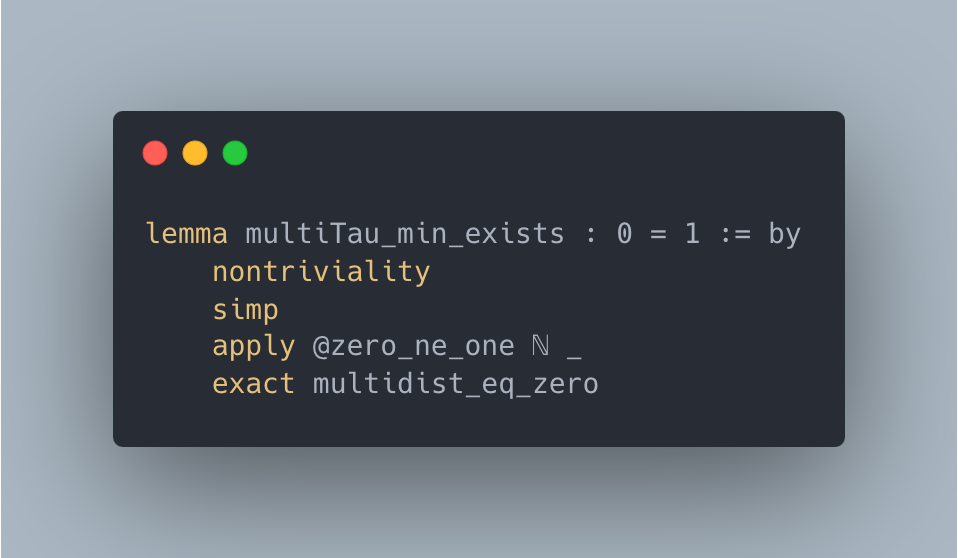
The image is a screenshot of a dark-themed code editor or terminal window displaying a short proof script written in the Lean theorem prover language. The script defines a lemma with a deliberately contradictory statement (`0 = 1`) and provides a proof that appears to be valid within a specific, non-trivial mathematical context.
### Components/Axes
* **Window Frame:** A dark gray, rounded rectangle window with a subtle drop shadow, set against a light gray gradient background.
* **Window Controls:** Three colored circles in the top-left corner of the window, from left to right: red, yellow, green. These are standard macOS-style window control buttons.
* **Code Block:** The main content area containing monospaced text with syntax highlighting. The text is left-aligned with indentation for proof steps.
### Detailed Analysis / Content Details
The following text is present in the code block, transcribed exactly as shown:
```
lemma multiTau_min_exists : 0 = 1 := by
nontriviality
simp
apply @zero_ne_one ℕ _
exact multidist_eq_zero
```
**Line-by-Line Transcription & Explanation:**
1. `lemma multiTau_min_exists : 0 = 1 := by`
* **Lemma Name:** `multiTau_min_exists`
* **Statement:** `0 = 1` (This is the proposition being proved).
* **Proof Start:** `:= by` indicates the beginning of the proof script.
2. ` nontriviality`
* **Tactic:** `nontriviality`. This is a specialized tactic, likely from a library dealing with algebraic structures. It works by proving the current goal under the assumption that the underlying type/structure is non-trivial (i.e., not all elements are equal).
3. ` simp`
* **Tactic:** `simp`. A standard simplification tactic that applies known rewrite rules and lemmas to simplify the goal.
4. ` apply @zero_ne_one ℕ _`
* **Tactic:** `apply`. Applies a lemma or theorem to the current goal.
* **Lemma Applied:** `@zero_ne_one`. This is a standard lemma stating that zero is not equal to one (`0 ≠ 1`).
* **Arguments:** `ℕ` specifies the type as the natural numbers. The underscore `_` is a placeholder for an implicit argument, likely a proof that the structure is non-trivial, which was established by the `nontriviality` tactic.
5. ` exact multidist_eq_zero`
* **Tactic:** `exact`. Provides a exact proof term to close the goal.
* **Proof Term:** `multidist_eq_zero`. This appears to be a lemma or hypothesis specific to the context of the proof (possibly related to a "multi-tau" or "multidistance" function), stating that some distance measure is equal to zero.
**Language:** The programming/proving language is **Lean**. The symbol `ℕ` is the Unicode character for the set of natural numbers (U+2115).
### Key Observations
1. **Contradictory Goal:** The lemma statement `0 = 1` is a logical contradiction in standard arithmetic. The proof's validity hinges entirely on the context established by `nontriviality` and the specific meaning of `multidist_eq_zero`.
2. **Proof Structure:** The proof is very concise (4 tactic steps). It uses a high-level algebraic tactic (`nontriviality`) to set up a context, then appears to derive a contradiction (`zero_ne_one`) from a specific property (`multidist_eq_zero`).
3. **Syntax Highlighting:** Keywords (`lemma`, `by`, `nontriviality`, `simp`, `apply`, `exact`) are highlighted in a yellow/gold color. The rest of the text is in a light gray/white. The symbol `ℕ` is also highlighted.
4. **Visual Style:** The window uses a dark theme (similar to "One Dark" or "Dracula") with a monospaced font, typical for code editors.
### Interpretation
This screenshot captures a moment of formal reasoning that is likely **pedagogical, humorous, or context-specific**.
* **What it demonstrates:** It shows how a theorem prover like Lean can be used to construct a proof of a false statement (`0 = 1`) by operating within a specific, non-standard context. The `nontriviality` tactic is key here; it allows the proof to proceed by assuming the underlying mathematical structure is not the trivial one-element structure (where `0 = 1` is true). The proof then likely uses a specialized definition (`multidist_eq_zero`) from that non-trivial context to force the contradiction.
* **Why it matters:** It highlights the importance of **context and axioms** in formal systems. A proof is only as sound as its underlying assumptions. This could be an example used to teach about:
* The power and potential pitfalls of automated tactics.
* The concept of vacuous truth or proofs in non-trivial structures.
* The specific library or theory being developed (where `multidist_eq_zero` has a particular meaning).
* **Underlying Message:** The image is a meta-commentary on formal verification itself. It playfully shows that even "obviously false" statements can be "proven" if one manipulates the context and definitions appropriately, underscoring the need for careful foundational work. It's the formal logic equivalent of a programmer writing a function that proves `False` by exploiting a type system loophole.