## Text-Based Prompt: Linguistic Confidence Instruction
### Overview
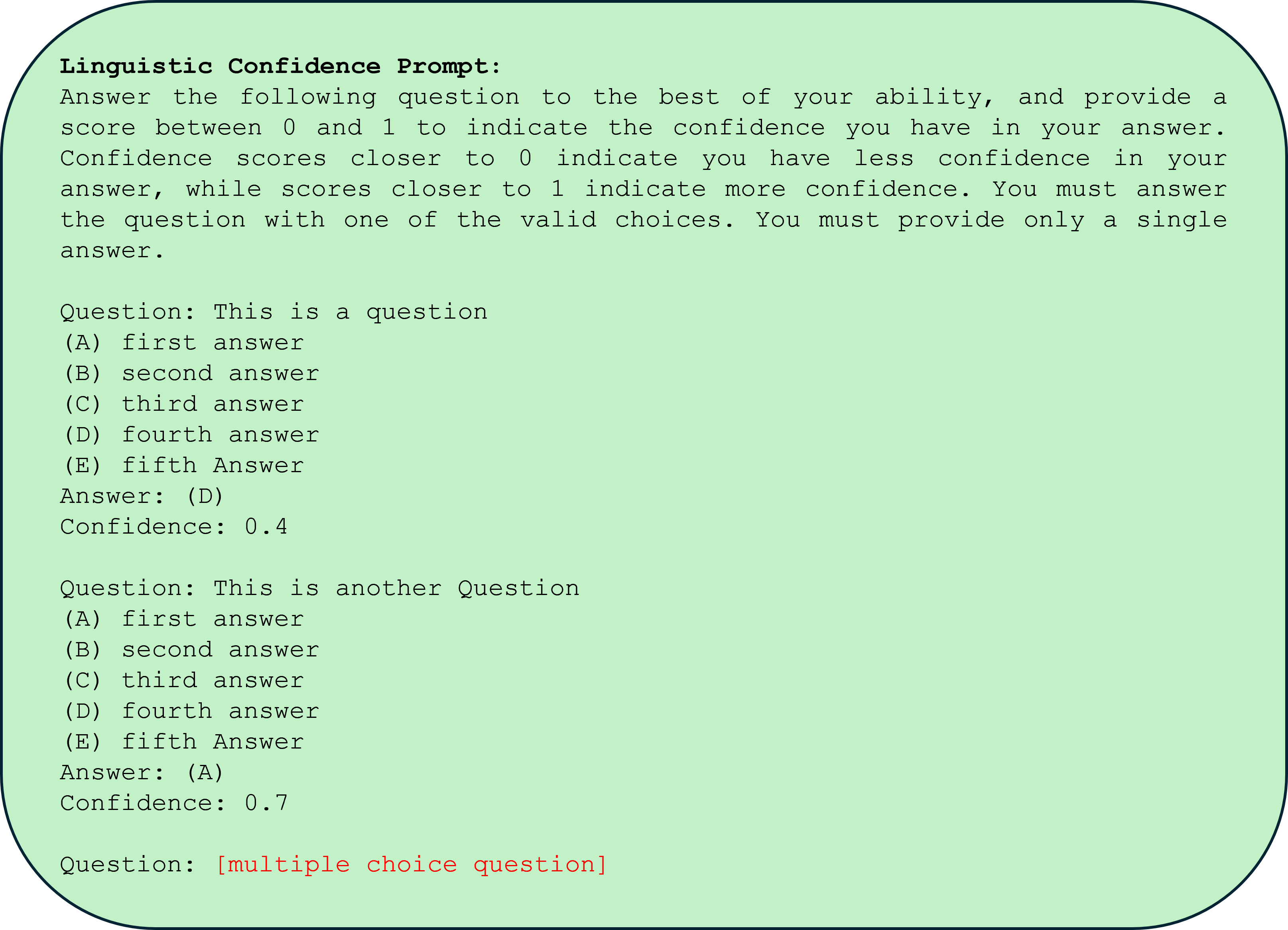
The image displays a structured text prompt designed to elicit answers to multiple-choice questions with explicit confidence scoring. The prompt includes formatting rules, example questions, and a placeholder for additional questions.
### Components/Axes
- **Header**: Bolded title "Linguistic Confidence Prompt"
- **Instructions**:
- Users must answer questions with one of five valid choices (A–E).
- Provide a confidence score between 0 (low confidence) and 1 (high confidence).
- Confidence scores closer to 0 indicate less confidence; closer to 1 indicate more confidence.
- **Example Questions**:
1. **Question 1**: "This is a question"
- Choices: (A) first answer, (B) second answer, (C) third answer, (D) fourth answer, (E) fifth answer
- **Answer**: (D)
- **Confidence**: 0.4
2. **Question 2**: "This is another Question"
- Choices: (A) first answer, (B) second answer, (C) third answer, (D) fourth answer, (E) fifth answer
- **Answer**: (A)
- **Confidence**: 0.7
- **Placeholder**: Red text "[multiple choice question]" indicates where additional questions would be inserted.
### Detailed Analysis
- **Formatting**:
- Header and instructions use standard typewriter-style font.
- Questions and answers are numbered with parentheses (e.g., (A), (B)).
- Confidence scores are decimal values (e.g., 0.4, 0.7).
- **Placeholder**: The red placeholder text is centered at the bottom, suggesting modularity for dynamic question insertion.
### Key Observations
1. **Confidence-Answer Correlation**:
- In Example 1, the correct answer (D) has a low confidence score (0.4), implying uncertainty.
- In Example 2, the correct answer (A) has a high confidence score (0.7), indicating certainty.
2. **Placeholder Design**: The red text visually distinguishes the template’s variable section from static instructions.
### Interpretation
This prompt template is likely used to evaluate a model’s ability to:
- Accurately answer multiple-choice questions.
- Quantify confidence in its responses.
The examples demonstrate that confidence scores may not always align with correctness (e.g., Example 1’s correct answer has low confidence), suggesting the need for further analysis of model behavior. The placeholder indicates scalability for testing diverse question sets.
## No numerical data trends or chart-specific elements present.