## Mathematical Diagram: Galois Extension and Subgroup Correspondence
### Overview
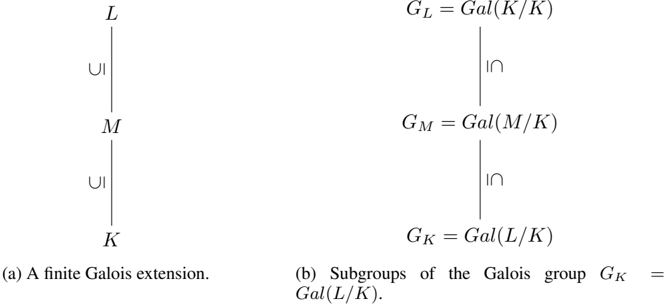
The image displays two related vertical diagrams illustrating concepts from Galois theory in abstract algebra. The left diagram (a) depicts a tower of field extensions, while the right diagram (b) shows the corresponding tower of Galois groups and their subgroup relationships. The diagrams are presented side-by-side with captions below each.
### Components/Axes
**Diagram (a) - Left Side:**
* **Title/Caption:** "(a) A finite Galois extension."
* **Vertical Structure:** A vertical line connecting three labels from top to bottom.
* **Labels (Top to Bottom):**
* `L` (Top)
* `M` (Middle)
* `K` (Bottom)
* **Relationship Symbols:** Between `L` and `M`, and between `M` and `K`, there is a symbol resembling a "U" with a vertical line through it (`U|`). In this mathematical context, this symbol denotes "is a subfield of" or "is contained in." Therefore, `M` is a subfield of `L`, and `K` is a subfield of `M`.
**Diagram (b) - Right Side:**
* **Title/Caption:** "(b) Subgroups of the Galois group `G_K = Gal(L/K)`."
* **Vertical Structure:** A vertical line connecting three labels from top to bottom.
* **Labels (Top to Bottom):**
* `G_L = Gal(K/K)` (Top)
* `G_M = Gal(M/K)` (Middle)
* `G_K = Gal(L/K)` (Bottom)
* **Relationship Symbols:** Between `G_L` and `G_M`, and between `G_M` and `G_K`, there is a symbol resembling an inverted "U" with a vertical line (`|∩`). This symbol denotes "contains" or "is a supergroup of." Therefore, `G_L` contains `G_M` as a subgroup, and `G_M` contains `G_K` as a subgroup.
### Detailed Analysis
The diagrams are purely conceptual and do not contain numerical data, charts, or graphs. They are schematic representations of algebraic structures.
* **Spatial Grounding:** The two diagrams are positioned side-by-side. Diagram (a) is on the left, and diagram (b) is on the right. Within each diagram, the elements are arranged vertically in a strict top-to-bottom order, indicating a hierarchy or chain of containment.
* **Trend/Flow Verification:** The visual flow in both diagrams is vertical. In (a), the flow from top (`L`) to bottom (`K`) represents a sequence of field extensions where each lower field is contained in the one above it. In (b), the flow from top (`G_L`) to bottom (`G_K`) represents a sequence of groups where each lower group is contained within the one above it. The key observation is the **reversal of inclusion direction** between the two diagrams: the field tower `K ⊆ M ⊆ L` corresponds to the group tower `G_K ⊇ G_M ⊇ G_L`.
### Key Observations
1. **Direct Correspondence:** The diagrams visually manifest the core of the Fundamental Theorem of Galois Theory. There is a one-to-one correspondence between the intermediate fields (`M`) and the intermediate subgroups (`G_M`).
2. **Inclusion Reversal:** The direction of the inclusion symbols (`U|` vs. `|∩`) is deliberately opposite between the two diagrams. This is a critical visual cue for the theorem's property that larger fields correspond to smaller subgroups, and vice-versa.
3. **Notation Specificity:** The Galois groups are explicitly defined. `G_K = Gal(L/K)` is the full Galois group of the extension `L` over `K`. `G_M = Gal(M/K)` is the Galois group of the intermediate extension `M` over `K`. `G_L = Gal(K/K)` is the trivial group (the group of automorphisms that fix `K` pointwise).
### Interpretation
This image is a pedagogical tool used to visualize a foundational concept in advanced algebra. It does not present empirical data but rather a theoretical relationship.
* **What it Demonstrates:** The diagrams illustrate the **Galois correspondence**. For a finite Galois extension `L/K`, there is an inclusion-reversing bijection between the set of intermediate fields (like `M`) and the set of subgroups of the Galois group `Gal(L/K)`.
* **Relationship Between Elements:** The left tower (a) shows the "field side" of the correspondence. The right tower (b) shows the "group side." The vertical alignment and matching labels (`M` and `G_M`) highlight which field corresponds to which subgroup. The symbol reversal is the visual encoding of the theorem's central mechanism.
* **Significance:** This correspondence is profound because it translates problems about solving polynomial equations (field theory) into problems about the structure of symmetry groups (group theory). The diagram encapsulates the idea that understanding the symmetries of the roots of a polynomial (the Galois group) allows one to deduce the possible intermediate fields generated by those roots, which in turn relates to the solvability of the polynomial by radicals. The "finite" in the caption is a key condition for this clean correspondence to hold.