## Screenshot: Webpage Instructions for Code Error Analysis
### Overview
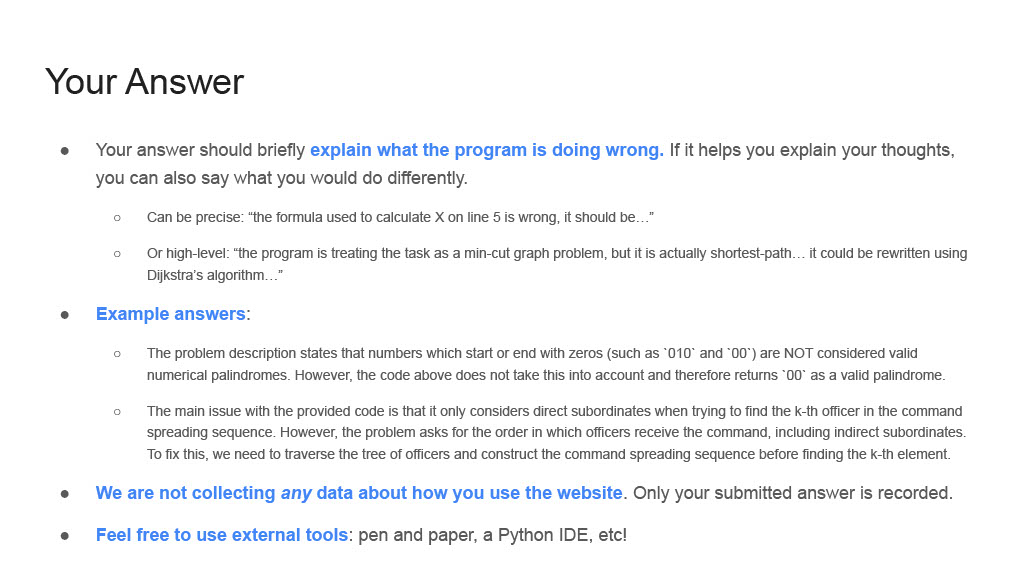
The image shows a webpage with instructions for analyzing a programming problem. It emphasizes explaining errors in a program's logic, providing examples of feedback, and clarifying data privacy and tool usage policies.
### Components/Axes
- **Title**: "Your Answer" (top-left, bold)
- **Main Sections**:
1. **Instructions**: Bullet points guiding response structure.
2. **Example Answers**: Two code critique examples.
3. **Notes**: Data privacy and tool usage disclaimers.
### Detailed Analysis
#### Instructions
- Users must **briefly explain what the program is doing wrong**.
- Optional: Suggest alternative approaches.
- Feedback can be:
- **Precise**: "The formula used to calculate X on line 5 is wrong, it should be..."
- **High-level**: "The program is treating the task as a min-cut graph problem, but it actually shortest-path... It could be rewritten using Dijkstra's algorithm..."
#### Example Answers
1. **Issue 1**:
- Problem: Code incorrectly validates palindromes starting/ending with zeros (e.g., `010`, `00`).
- Fix: Adjust validation to exclude such cases.
2. **Issue 2**:
- Problem: Code ignores indirect subordinates when finding the k-th officer in a command spreading sequence.
- Fix: Traverse the tree of officers and reconstruct the command sequence before identifying the k-th element.
#### Notes
- **Data Privacy**: "We are not collecting any data about how you use the website. Only your submitted answer is recorded."
- **Tool Usage**: "Feel free to use external tools: pen and paper, a Python IDE, etc!"
### Key Observations
- The instructions prioritize **specificity** in error analysis (e.g., line numbers, algorithmic misapplications).
- Examples highlight **common pitfalls** in code logic (e.g., edge cases in palindrome validation, graph algorithm misuse).
- The disclaimers address **user concerns** about data tracking and tool flexibility.
### Interpretation
This webpage is designed to guide users in providing **structured, actionable feedback** on programming errors. By emphasizing precision (e.g., line numbers, algorithmic corrections) and offering examples, it ensures critiques are both technical and practical. The inclusion of data privacy assurances and tool flexibility suggests the platform values user autonomy and transparency. The examples demonstrate how to balance high-level conceptual errors (e.g., misapplying graph algorithms) with granular code-level fixes (e.g., palindrome validation rules), catering to both novice and experienced developers.