## Text Document: Instructions for Answering a Question
### Overview
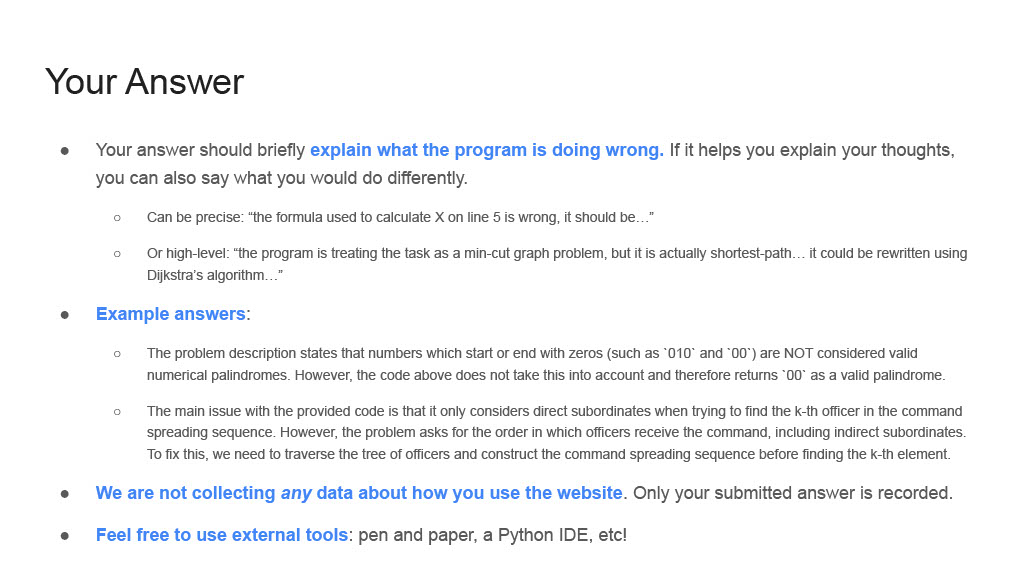
The image presents instructions and guidelines for answering a question, likely related to a programming problem. It provides guidance on the level of detail expected in the answer, offers example answers, and includes information about data collection and available tools.
### Components/Axes
The document is structured as follows:
* **Title:** "Your Answer"
* **Instructions:** A paragraph explaining the desired content of the answer.
* **Examples:** Two bullet points providing different levels of detail for the answer.
* **Example Answers:** Two bullet points providing specific examples of answers.
* **Data Collection Notice:** A statement about data collection practices.
* **Tool Suggestion:** A suggestion of tools that can be used.
### Detailed Analysis or ### Content Details
* **Title:** "Your Answer"
* **Instructions:** "Your answer should briefly explain what the program is doing wrong. If it helps you explain your thoughts, you can also say what you would do differently."
* **Examples:**
* "Can be precise: "the formula used to calculate X on line 5 is wrong, it should be...""
* "Or high-level: "the program is treating the task as a min-cut graph problem, but it is actually shortest-path... it could be rewritten using Dijkstra's algorithm...""
* **Example Answers:**
* "The problem description states that numbers which start or end with zeros (such as `010` and `00`) are NOT considered valid numerical palindromes. However, the code above does not take this into account and therefore returns `00` as a valid palindrome."
* "The main issue with the provided code is that it only considers direct subordinates when trying to find the k-th officer in the command spreading sequence. However, the problem asks for the order in which officers receive the command, including indirect subordinates. To fix this, we need to traverse the tree of officers and construct the command spreading sequence before finding the k-th element."
* **Data Collection Notice:** "We are not collecting any data about how you use the website. Only your submitted answer is recorded."
* **Tool Suggestion:** "Feel free to use external tools: pen and paper, a Python IDE, etc!"
### Key Observations
* The instructions emphasize explaining the program's errors and suggesting alternative approaches.
* The examples illustrate different levels of detail acceptable in the answer.
* The example answers provide concrete scenarios and solutions.
* The data collection notice assures users that only their submitted answers are recorded.
* The tool suggestion encourages the use of external resources.
### Interpretation
The document provides clear and concise instructions for answering a programming-related question. It aims to guide users in identifying and explaining errors in a program, while also encouraging them to think critically and propose alternative solutions. The inclusion of example answers and a data collection notice further enhances the user experience by providing clarity and reassurance. The suggestion of external tools promotes a flexible and resourceful approach to problem-solving.