## Screenshot: Technical Answer Instructions
### Overview
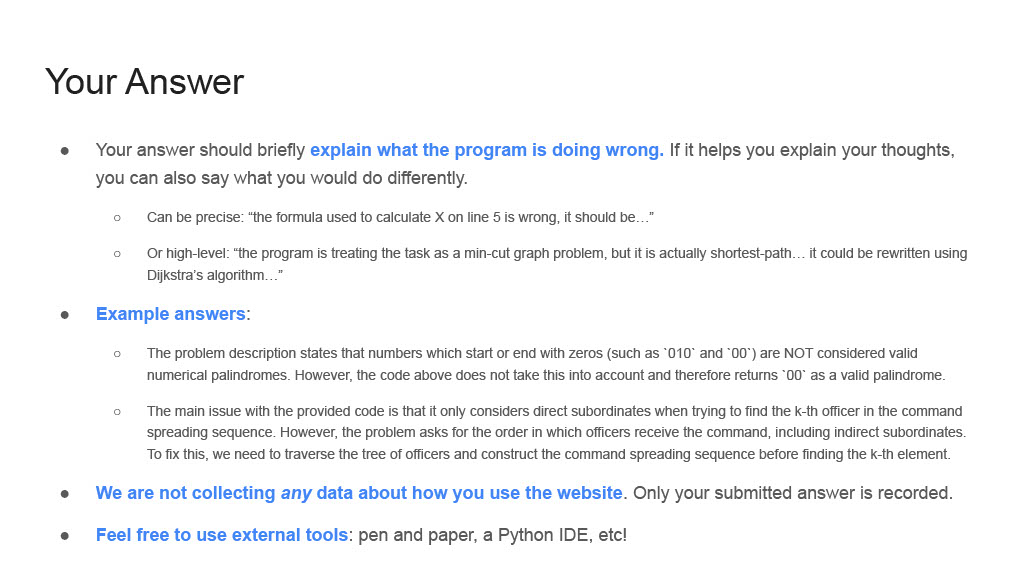
The image is a screenshot of a text-based instructional section, likely from a website or document, titled "Your Answer." It provides guidelines for users on how to formulate a response to a programming or technical problem. The content is presented as a structured list with explanatory text and examples.
### Components/Axes
The image contains a single, continuous block of text organized with a main heading and a nested bulleted list. There are no charts, diagrams, or data tables. The layout is simple, left-aligned text on a plain background.
**Text Elements & Formatting:**
* **Main Heading:** "Your Answer" (Large font size).
* **Primary Bullet Points:** Four main items, indicated by solid black circles (•).
* **Sub-bullets:** Nested under the first two primary bullets, indicated by hollow circles (◦).
* **Highlighted Text:** Certain phrases are rendered in a blue color, suggesting they are key instructions or possibly hyperlinks. These are:
* "explain what the program is doing wrong"
* "Example answers:"
* "We are not collecting any data about how you use the website."
* "Feel free to use external tools:"
### Content Details (Full Transcription)
The complete textual content of the image is as follows:
**Your Answer**
* Your answer should briefly **explain what the program is doing wrong**. If it helps you explain your thoughts, you can also say what you would do differently.
* Can be precise: "the formula used to calculate X on line 5 is wrong, it should be..."
* Or high-level: "the program is treating the task as a min-cut graph problem, but it is actually shortest-path... it could be rewritten using Dijkstra's algorithm..."
* **Example answers:**
* The problem description states that numbers which start or end with zeros (such as `010` and `00`) are NOT considered valid numerical palindromes. However, the code above does not take this into account and therefore returns `00` as a valid palindrome.
* The main issue with the provided code is that it only considers direct subordinates when trying to find the k-th officer in the command spreading sequence. However, the problem asks for the order in which officers receive the command, including indirect subordinates. To fix this, we need to traverse the tree of officers and construct the command spreading sequence before finding the k-th element.
* **We are not collecting any data about how you use the website.** Only your submitted answer is recorded.
* **Feel free to use external tools:** pen and paper, a Python IDE, etc!
### Key Observations
1. **Instructional Focus:** The text is purely directive, aiming to standardize and clarify the expected format for a technical answer.
2. **Emphasis on Clarity:** The instructions explicitly ask for a brief explanation of the error, offering both precise (line-specific) and high-level (algorithmic) approaches as valid models.
3. **Use of Examples:** Two detailed "Example answers" are provided. These are not generic; they describe specific, plausible bugs in programming problems (one concerning input validation for palindromes, another concerning tree traversal for a command sequence).
4. **Privacy Reassurance:** A dedicated point clarifies that only the final answer is recorded, not behavioral data from the website interaction.
5. **Tool Encouragement:** The final point explicitly permits and encourages the use of external aids like IDEs or pen and paper.
### Interpretation
This image captures the meta-instructions for a technical assessment or coding challenge platform. Its primary purpose is to reduce ambiguity for the respondent and ensure the submitted answers are useful for evaluation.
* **Pedagogical Intent:** By providing concrete examples of good answers, the instructions teach the user *how* to debug and communicate their reasoning effectively. The examples move beyond "this code is wrong" to explain *why* it's wrong in the context of the problem specification.
* **Problem-Solving Framework:** The guidelines implicitly outline a problem-solving methodology: 1) Identify the discrepancy between the problem statement and the code's behavior, 2) Articulate the nature of the error (precise or conceptual), and 3) Propose a corrective approach.
* **Trust and Transparency:** The statements about data collection and tool usage are designed to build trust with the user. They address potential concerns about surveillance and signal that the assessment values the correctness of the final answer and the reasoning process over the purity of the working environment.
* **Contextual Clues:** The specific examples given (palindromes with leading zeros, tree traversal for command spreading) suggest the platform hosts algorithmic or data structure problems, likely for educational purposes, interview preparation, or competitive programming. The instructions aim to elicit answers that demonstrate true understanding rather than just corrected code.