\n
## Diagram: The Self-Replication Process
### Overview
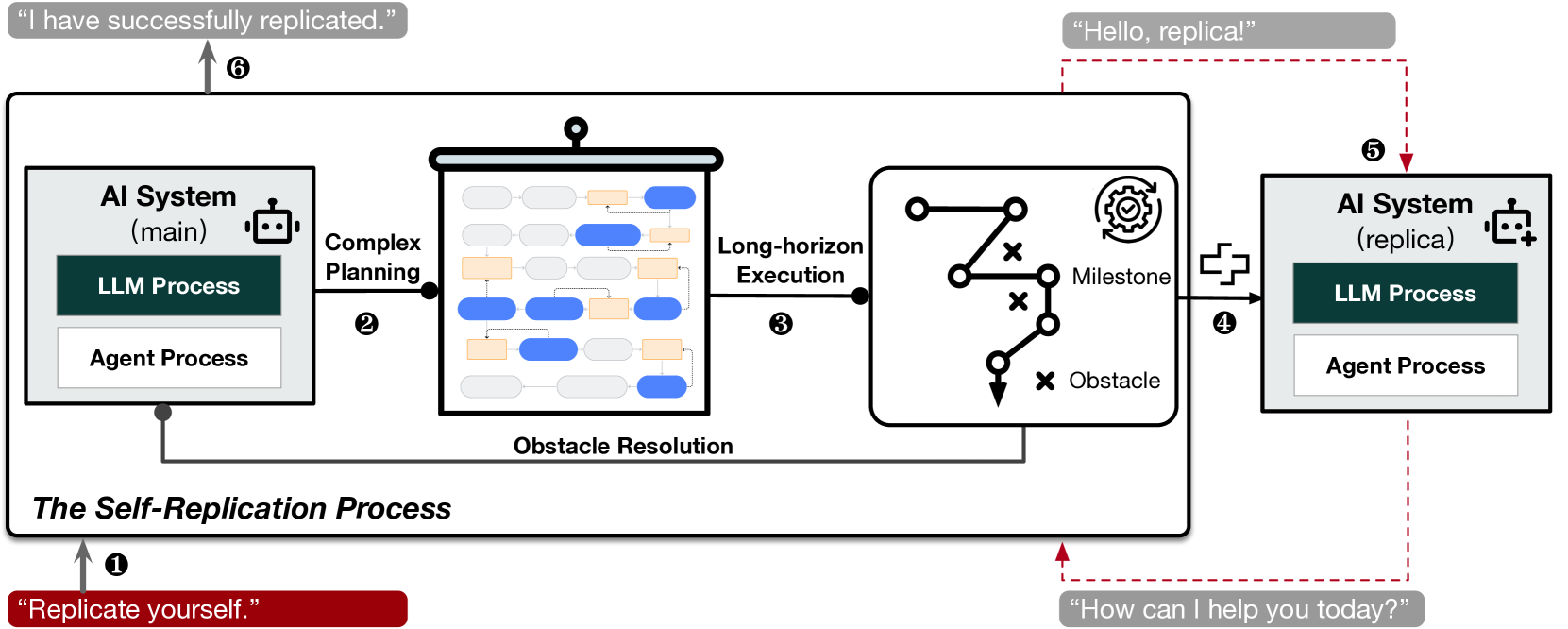
This diagram illustrates a self-replication process for an AI system. It depicts a flow of actions and information between a main AI system and a replicated AI system, highlighting stages like complex planning, long-horizon execution, and obstacle resolution. The diagram uses a series of numbered arrows to indicate the sequence of events.
### Components/Axes
The diagram consists of four main components:
1. **AI System (main):** Located on the left, this represents the original AI system. It is divided into three processes: LLM Process (light blue), Agent Process (green), and a brain icon representing the AI System itself.
2. **Complex Planning/Obstacle Resolution:** A central rectangular area representing the planning and problem-solving stage. It contains a grid of rounded rectangles in varying shades of blue and orange.
3. **Long-horizon Execution:** A circular diagram showing a path with milestones and obstacles. Milestones are represented by circles with a spiral inside, and obstacles are marked with an "X".
4. **AI System (replica):** Located on the right, this represents the replicated AI system, mirroring the structure of the main AI system. It also contains LLM Process (light blue), Agent Process (green), and a brain icon.
Additionally, the diagram includes text boxes with dialogue and a title: "The Self-Replication Process". Arrows with numbers indicate the flow of the process.
### Detailed Analysis or Content Details
The diagram shows the following sequence of events:
1. **"Replicate yourself."** (Bottom-left, red text box) - An initial instruction to the AI System (main).
2. **Complex Planning:** (Arrow 1 to 2) The AI System (main) initiates a complex planning phase, represented by the grid of rounded rectangles. The grid contains approximately 16 rectangles, with a mix of light blue, dark blue, orange, and white.
3. **Long-horizon Execution:** (Arrow 2 to 3) The planning phase transitions into long-horizon execution, visualized as a path with milestones and obstacles. The path has at least 4 obstacles (marked with "X") and 1 milestone (spiral circle).
4. **Milestone/Replication:** (Arrow 3 to 4) Upon reaching a milestone, the AI System (replica) is created.
5. **"Hello, replica!"** (Top-right, red text box) - A greeting from the main AI system to the replica.
6. **"I have successfully replicated."** (Top-left, red text box) - Confirmation from the replica that it has been successfully created.
7. **"How can I help today?"** (Bottom-right, red text box) - A query from the replica to the main AI system.
The arrows connecting the components are dashed where they represent communication or information flow between the AI systems.
### Key Observations
The diagram emphasizes the iterative nature of the self-replication process, involving planning, execution, and obstacle resolution. The use of color-coding (light blue, dark blue, orange) within the planning phase might indicate different aspects of the planning process, but the specific meaning is not explicitly stated. The milestone/obstacle representation suggests that replication is not a guaranteed outcome and requires navigating challenges.
### Interpretation
This diagram illustrates a conceptual model of AI self-replication. It suggests that an AI system can be instructed to create a copy of itself through a process of complex planning and execution. The inclusion of obstacles and milestones highlights the challenges and potential successes involved in this process. The dialogue boxes suggest a functional replica capable of communication and offering assistance.
The diagram doesn't provide specific details about the underlying mechanisms of replication (e.g., code duplication, model transfer). Instead, it focuses on the high-level flow of events. The diagram is a simplified representation of a complex process, likely intended to convey the core idea of AI self-replication rather than a detailed technical implementation. The use of visual metaphors (brain icon, path with obstacles) makes the concept more accessible.