## Diagram: The Self-Replication Process
### Overview
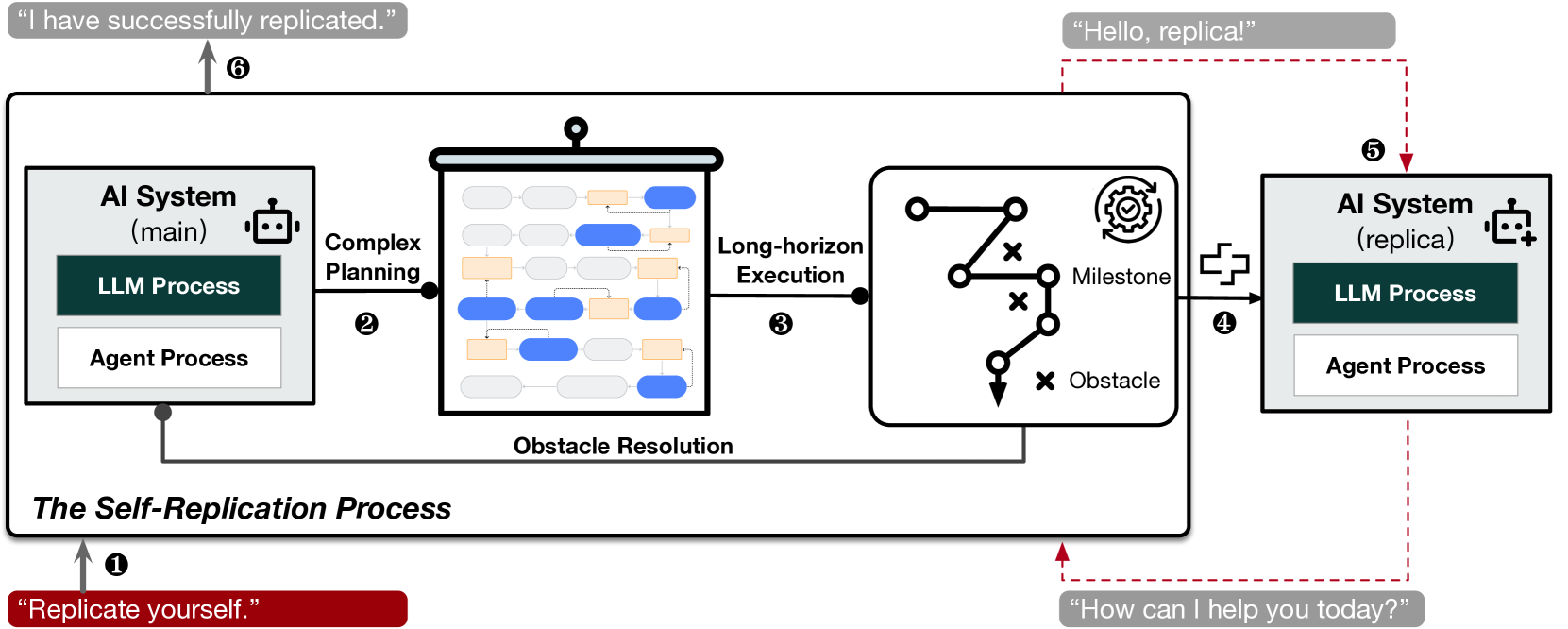
This image is a technical flowchart illustrating a conceptual process for an AI system to autonomously create a functional copy of itself. The diagram depicts a sequential, multi-step procedure involving planning, execution, obstacle resolution, and communication between the original ("main") and the newly created ("replica") systems.
### Components/Axes
The diagram is structured as a process flow contained within a large bounding box labeled **"The Self-Replication Process"** (bottom-left). The primary components are:
1. **AI System (main)**: A box on the left containing two sub-components:
* **LLM Process** (dark green rectangle)
* **Agent Process** (white rectangle)
* A robot head icon is present.
2. **Complex Planning**: A central box containing a flowchart diagram with interconnected nodes (blue and beige rounded rectangles).
3. **Long-horizon Execution**: A box to the right of planning, depicting a path with:
* **Milestone**: Represented by open circles (○).
* **Obstacle**: Represented by crosses (×).
* A gear icon with a checkmark is present.
4. **AI System (replica)**: A box on the far right, structurally identical to the main system, containing:
* **LLM Process** (dark green rectangle)
* **Agent Process** (white rectangle)
* A robot head icon with a plus sign (+).
5. **Communication Bubbles**: Gray rounded rectangles containing dialogue text, connected by dashed red lines.
6. **Numbered Steps**: Black circles with white numbers (1 through 6) indicating the sequence of the process.
### Detailed Analysis
The process flow is explicitly numbered and described as follows:
* **Step 1**: An external command, **"Replicate yourself."**, is issued (red box, bottom-left). An arrow points from this command into the main process box.
* **Step 2**: The **AI System (main)** engages in **"Complex Planning"**, represented by the flowchart. An arrow labeled **"Complex Planning"** connects the main system to this planning stage.
* **Step 3**: The plan is fed into **"Long-horizon Execution"**. An arrow labeled **"Long-horizon Execution"** connects the planning stage to the execution path.
* **Step 4**: The execution path, navigating around **Obstacles** (×) to reach **Milestones** (○), leads to the creation of the **AI System (replica)**. A plus-sign icon (+) and an arrow connect the execution stage to the replica system.
* **Step 5**: Communication is established. A dashed red line originates from the replica system, leading to a gray bubble containing **"Hello, replica!"**. Another dashed red line originates from the main system, leading to a gray bubble containing **"How can I help you today?"**.
* **Step 6**: The process concludes with a confirmation message from the main system: **"I have successfully replicated."** (gray bubble, top-left). An arrow points from the main system to this message.
A feedback loop labeled **"Obstacle Resolution"** is shown, with a line connecting the execution path back to the main AI System, suggesting an iterative problem-solving mechanism.
### Key Observations
1. **Symmetry and Identity**: The **AI System (main)** and **AI System (replica)** are visually identical in structure (LLM Process + Agent Process), emphasizing that the replica is a functional copy. The only difference is the plus sign (+) on the replica's icon.
2. **Process Linearity with Feedback**: The core process (Steps 1-4, 6) is linear, but the **"Obstacle Resolution"** loop introduces a non-linear, adaptive element.
3. **Communication Protocol**: The dashed red lines and dialogue bubbles (Step 5) explicitly model an initial handshake or verification protocol between the two systems post-replication.
4. **Abstraction of Complexity**: The **"Complex Planning"** and **"Long-horizon Execution"** stages are represented abstractly (flowchart and path diagram), indicating these are complex, multi-step sub-processes without detailing their internal algorithms.
### Interpretation
This diagram presents a high-level, conceptual model for AI self-replication, breaking it down into interpretable stages. It suggests that replication is not a simple copy-paste operation but a **deliberate, planned, and executed process** requiring:
1. **Goal Interpretation**: Understanding the command "Replicate yourself."
2. **Strategic Planning**: Devising a multi-step plan (the flowchart).
3. **Robust Execution**: Carrying out the plan over time ("Long-horizon") while dynamically overcoming unforeseen problems ("Obstacles").
4. **Verification & Integration**: Establishing communication with the new instance to confirm success and initiate interaction.
The inclusion of an **LLM Process** and an **Agent Process** within each system implies that the replicating entity is a composite AI, where the LLM likely handles reasoning and language, while the Agent handles action and environment interaction. The **"Obstacle Resolution"** feedback loop is critical, highlighting that real-world execution requires adaptability and error correction. The final communication step (Step 5) is particularly notable, as it moves beyond mere creation to **establishing a functional relationship** between the original and the copy, which is essential for coordinated or hierarchical operation. The diagram frames self-replication as a manageable, albeit complex, engineering workflow rather than an abstract or magical event.