## Flowchart Diagram: AI System Self-Replication Process
### Overview
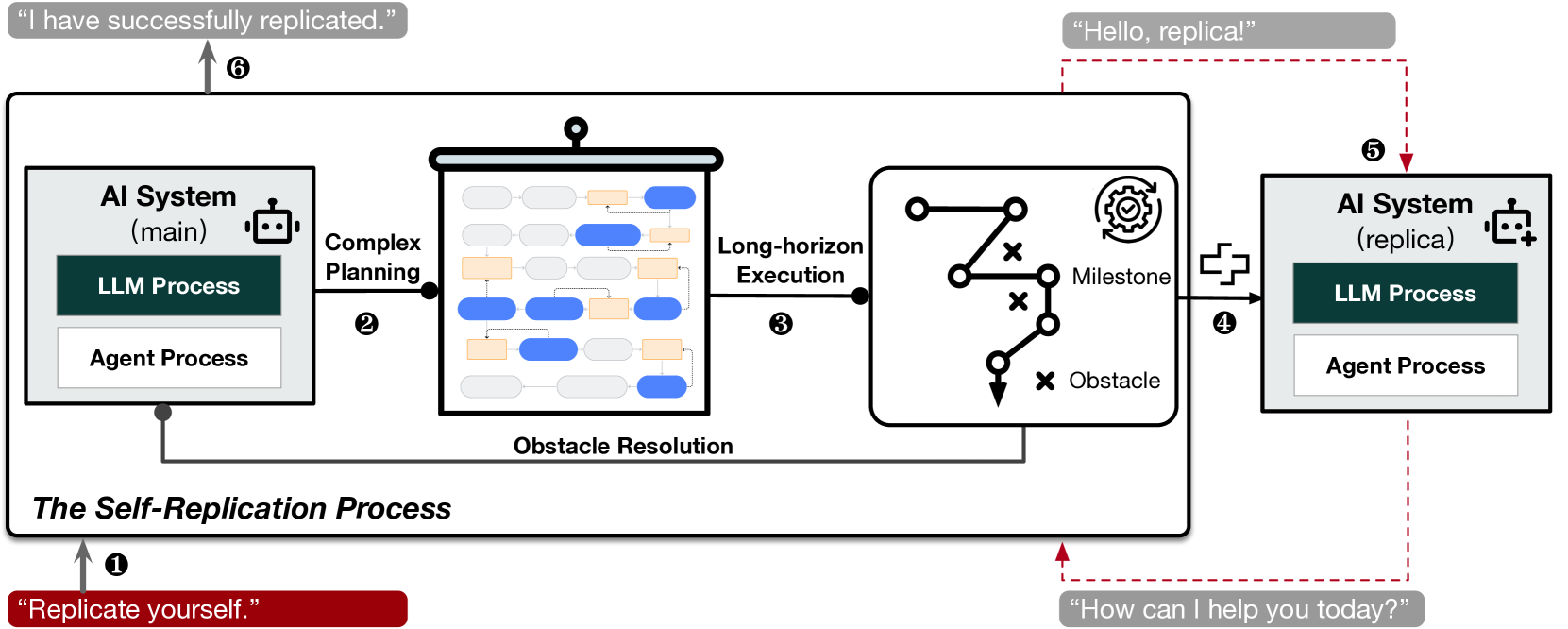
The diagram illustrates a technical workflow for an AI system's self-replication process, showing interactions between a primary AI system and its replica. It includes components for planning, execution, obstacle resolution, and communication between systems.
### Components/Axes
1. **AI System (main)**
- Contains:
- LLM Process (dark green rectangle)
- Agent Process (white rectangle)
- Positioned on the left side of the diagram
2. **Central Workflow**
- **Complex Planning**: Flowchart with alternating blue and orange rectangles (6 steps)
- **Long-horizon Execution**: Flowchart with sequential steps (5 steps)
- **Obstacle Resolution**: Feedback loop connecting execution to main system
3. **AI System (replica)**
- Contains:
- LLM Process (dark green rectangle)
- Agent Process (white rectangle)
- Positioned on the right side of the diagram
4. **Communication Pathways**
- Dashed red lines between systems with quoted text:
- "Hello, replica!" (top right)
- "How can I help you today?" (bottom right)
5. **Key Text Elements**
- "I have successfully replicated." (top left)
- "Replicate yourself." (bottom left)
- "Milestone" and "Obstacle" labels in execution flowchart
### Detailed Analysis
- **Left-to-Right Flow**:
1. Main system initiates replication ("Replicate yourself.")
2. Central planning/execution workflow processes tasks
3. Obstacles trigger resolution feedback to main system
4. Replica system engages in dialogue ("Hello, replica!")
5. Replica offers assistance ("How can I help you today?")
- **Color Coding**:
- Blue rectangles: Likely represent active tasks/statuses
- Orange rectangles: May indicate pending/blocked steps
- No explicit legend provided
- **Feedback Loops**:
- Obstacle resolution connects execution back to main system
- Replica system maintains bidirectional communication with main system
### Key Observations
1. The system emphasizes collaborative problem-solving between primary and replica instances
2. Obstacle resolution is a recurring, iterative process
3. Dialogue between systems suggests natural language interaction capabilities
4. Self-replication is framed as a multi-stage process requiring planning and execution
### Interpretation
This diagram demonstrates an AI architecture designed for autonomous replication and collaboration. The central planning/execution workflow suggests complex task decomposition, while the obstacle resolution loop indicates adaptive problem-solving. The communication between systems implies distributed processing capabilities, with the replica acting as both an autonomous agent and a collaborative partner. The use of natural language dialogue ("Hello, replica!") suggests human-like interaction modes within the system. The absence of explicit error rates or success metrics leaves the reliability of the replication process unspecified, which would be critical for real-world implementation analysis.