TECHNICAL ASSET FINGERPRINT
d109589f52df8a1987aef6ff
Click to view fullscreen
Press ESC or click to close
FOUND IN PAPERS
EXPERT: gemini-2.0-flash VERSION 1
RUNTIME: nugit/gemini/gemini-2.0-flash
INTEL_VERIFIED
## Feature Comparison Chart: SGX, TrustZone, SEV, and RISC-V
### Overview
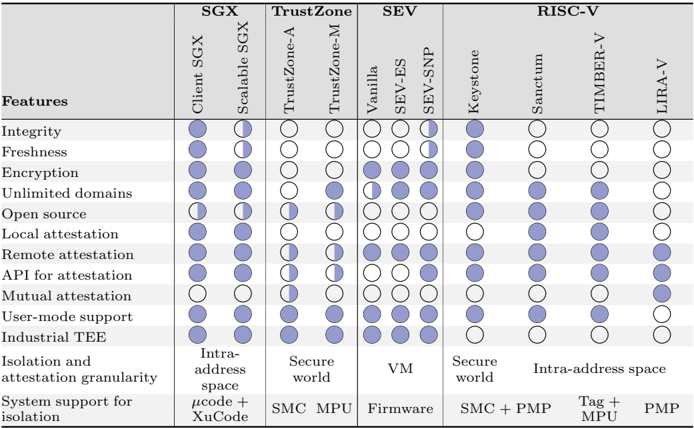
The image is a feature comparison chart evaluating different secure execution environments (SEEs) across several features. The chart compares SGX, TrustZone, SEV, and RISC-V implementations, indicating whether each feature is supported (filled circle) or not supported (empty circle) by each SEE.
### Components/Axes
* **Columns (Secure Execution Environments):**
* SGX: Client SGX, Scalable SGX
* TrustZone: TrustZone-A, TrustZone-M
* SEV: Vanilla, SEV-ES, SEV-SNP, Keystone
* RISC-V: Sanctum, TIMBER-V, LIRA-V
* **Rows (Features):**
* Integrity
* Freshness
* Encryption
* Unlimited domains
* Open source
* Local attestation
* Remote attestation
* API for attestation
* Mutual attestation
* User-mode support
* Industrial TEE
* Isolation and attestation granularity
* System support for isolation
### Detailed Analysis or ### Content Details
**SGX**
* **Client SGX:**
* Integrity: Supported (filled circle)
* Freshness: Supported (filled circle)
* Encryption: Supported (filled circle)
* Unlimited domains: Supported (filled circle)
* Open source: Not supported (empty circle)
* Local attestation: Supported (filled circle)
* Remote attestation: Supported (filled circle)
* API for attestation: Supported (filled circle)
* Mutual attestation: Not supported (empty circle)
* User-mode support: Supported (filled circle)
* Industrial TEE: Not supported (empty circle)
* Isolation and attestation granularity: Intra-address space
* System support for isolation: µcode + XuCode
* **Scalable SGX:**
* Integrity: Not supported (empty circle)
* Freshness: Partially supported (half-filled circle)
* Encryption: Not supported (empty circle)
* Unlimited domains: Not supported (empty circle)
* Open source: Partially supported (half-filled circle)
* Local attestation: Supported (filled circle)
* Remote attestation: Supported (filled circle)
* API for attestation: Supported (filled circle)
* Mutual attestation: Not supported (empty circle)
* User-mode support: Supported (filled circle)
* Industrial TEE: Not supported (empty circle)
**TrustZone**
* **TrustZone-A:**
* Integrity: Not supported (empty circle)
* Freshness: Not supported (empty circle)
* Encryption: Not supported (empty circle)
* Unlimited domains: Not supported (empty circle)
* Open source: Not supported (empty circle)
* Local attestation: Not supported (empty circle)
* Remote attestation: Not supported (empty circle)
* API for attestation: Not supported (empty circle)
* Mutual attestation: Not supported (empty circle)
* User-mode support: Supported (filled circle)
* Industrial TEE: Not supported (empty circle)
* Isolation and attestation granularity: Secure world
* System support for isolation: SMC MPU
* **TrustZone-M:**
* All features except User-mode support are not supported (empty circle).
* User-mode support: Supported (filled circle)
**SEV**
* **Vanilla:**
* Integrity: Not supported (empty circle)
* Freshness: Not supported (empty circle)
* Encryption: Not supported (empty circle)
* Unlimited domains: Partially supported (half-filled circle)
* Open source: Not supported (empty circle)
* Local attestation: Supported (filled circle)
* Remote attestation: Supported (filled circle)
* API for attestation: Supported (filled circle)
* Mutual attestation: Not supported (empty circle)
* User-mode support: Supported (filled circle)
* Industrial TEE: Not supported (empty circle)
* Isolation and attestation granularity: VM
* System support for isolation: Firmware
* **SEV-ES:**
* Integrity: Supported (filled circle)
* Freshness: Supported (filled circle)
* Encryption: Supported (filled circle)
* Unlimited domains: Supported (filled circle)
* Open source: Supported (filled circle)
* Local attestation: Supported (filled circle)
* Remote attestation: Supported (filled circle)
* API for attestation: Supported (filled circle)
* Mutual attestation: Supported (filled circle)
* User-mode support: Supported (filled circle)
* Industrial TEE: Not supported (empty circle)
* **SEV-SNP:**
* Integrity: Supported (filled circle)
* Freshness: Supported (filled circle)
* Encryption: Supported (filled circle)
* Unlimited domains: Supported (filled circle)
* Open source: Partially supported (half-filled circle)
* Local attestation: Supported (filled circle)
* Remote attestation: Supported (filled circle)
* API for attestation: Supported (filled circle)
* Mutual attestation: Supported (filled circle)
* User-mode support: Supported (filled circle)
* Industrial TEE: Not supported (empty circle)
* **Keystone:**
* Integrity: Supported (filled circle)
* Freshness: Supported (filled circle)
* Encryption: Supported (filled circle)
* Unlimited domains: Supported (filled circle)
* Open source: Supported (filled circle)
* Local attestation: Supported (filled circle)
* Remote attestation: Supported (filled circle)
* API for attestation: Supported (filled circle)
* Mutual attestation: Supported (filled circle)
* User-mode support: Supported (filled circle)
* Industrial TEE: Not supported (empty circle)
* Isolation and attestation granularity: Secure world
* System support for isolation: SMC + PMP
**RISC-V**
* **Sanctum:**
* All features except User-mode support are not supported (empty circle).
* User-mode support: Supported (filled circle)
* Isolation and attestation granularity: Intra-address space
* System support for isolation: Tag + MPU
* **TIMBER-V:**
* All features except User-mode support are not supported (empty circle).
* User-mode support: Supported (filled circle)
* **LIRA-V:**
* All features except User-mode support are not supported (empty circle).
* User-mode support: Supported (filled circle)
* System support for isolation: PMP
### Key Observations
* Client SGX supports most of the listed features, while Scalable SGX has limited support.
* TrustZone-A and TrustZone-M primarily support user-mode support.
* SEV-ES and Keystone offer comprehensive feature support among the SEV implementations.
* RISC-V implementations (Sanctum, TIMBER-V, LIRA-V) mainly support user-mode support.
* Industrial TEE is not supported by any of the listed implementations.
### Interpretation
The chart provides a comparative overview of feature support across different secure execution environments. It highlights the strengths and weaknesses of each implementation, indicating which features are prioritized in each design. The data suggests that Client SGX, SEV-ES, and Keystone offer more comprehensive security features compared to other implementations listed. The lack of Industrial TEE support across all implementations suggests a potential area for future development. The chart is useful for understanding the trade-offs between different secure execution environments and selecting the most appropriate one for a given application.
DECODING INTELLIGENCE...
EXPERT: nemotron-free VERSION 1
RUNTIME: free/nvidia/nemotron-nano-12b-v2-vl:free
INTEL_VERIFIED
## Table: Feature Comparison of Security Technologies
### Overview
The image is a comparison table evaluating security technologies across 14 features. Each technology is represented by columns, with features listed as rows. Support is indicated by filled (blue) or empty (white) circles, with some partial fills (half-circles) for partial support.
### Components/Axes
- **Columns (Technologies)**:
- SGX: Client SGX, Scalable SGX
- TrustZone: TrustZone-A, TrustZone-M
- SEV: Vanilla, SEV-ES, SEV-SNP
- RISC-V: Keystone, Sanctum, TIMBER-V, LIRA-V
- **Rows (Features)**:
1. Integrity
2. Freshness
3. Encryption
4. Unlimited domains
5. Open source
6. Local attestation
7. Remote attestation
8. API for attestation
9. Mutual attestation
10. User-mode support
11. Industrial TEE
12. Isolation and attestation granularity
13. System support for isolation
### Detailed Analysis
- **Integrity, Freshness, Encryption, Unlimited domains**: All technologies support these features (all circles filled).
- **Open source**: Only Client SGX (50% fill), TrustZone-M (50% fill), and SEV-SNP (50% fill) show partial support.
- **Local attestation**: All technologies except TrustZone-A and TrustZone-M support this (partial fill for TrustZone-M).
- **Remote attestation**: All technologies support this (partial fill for TrustZone-A and TrustZone-M).
- **API for attestation**: All technologies support this (partial fill for TrustZone-A and TrustZone-M).
- **Mutual attestation**: Only LIRA-V supports this (filled circle).
- **User-mode support**: All technologies except Keystone and LIRA-V support this (filled circles).
- **Industrial TEE**: All technologies except Keystone, Sanctum, TIMBER-V, and LIRA-V support this (filled circles).
- **Isolation and attestation granularity**:
- SGX: Intra-address space
- TrustZone: Secure world
- SEV: VM
- RISC-V: Secure world (Keystone, Sanctum, TIMBER-V), Intra-address space (LIRA-V)
- **System support for isolation**:
- SGX: μcode + XuCode
- TrustZone: SMC MPU
- SEV: Firmware
- RISC-V: SMC + PMP (Keystone, Sanctum), Tag + MPU (TIMBER-V), PMP (LIRA-V)
### Key Observations
1. **SGX Dominance**: Client and Scalable SGX support the most features, including mutual attestation and industrial TEE.
2. **TrustZone Limitations**: TrustZone-A and TrustZone-M lack support for mutual attestation and industrial TEE.
3. **SEV Variability**: SEV-SNP has the most comprehensive feature set among SEV variants.
4. **RISC-V Gaps**: Keystone and LIRA-V lack industrial TEE support; TIMBER-V lacks user-mode support.
5. **Attestation Granularity**: SGX and RISC-V use intra-address space, while TrustZone and SEV use secure world/VM.
### Interpretation
The table highlights SGX as the most feature-complete technology, particularly for attestation capabilities. TrustZone variants show significant gaps in advanced features like mutual attestation. RISC-V implementations vary widely, with LIRA-V offering unique intra-address space isolation but missing industrial TEE. SEV-SNP emerges as a strong contender among SEV variants, supporting most features except open source and mutual attestation. The data suggests SGX remains the gold standard for comprehensive security features, while RISC-V and TrustZone require further development to match SGX's capabilities.
DECODING INTELLIGENCE...