## Diagram: 10x10 Resource Grid with Character Start Positions
### Overview
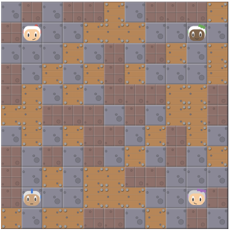
The image displays a 10x10 square grid, likely representing a game board, map, or simulation environment. The grid is composed of three distinct tile types, differentiated by color and a small embedded symbol. Four identical character icons are positioned at the four corners of the grid. There is no textual information, labels, axes, or legends present in the image.
### Components/Axes
* **Grid Structure:** A 10x10 matrix of square tiles.
* **Tile Types (by color and symbol):**
1. **Brown Tiles:** Feature a small, green, plant-like or sprout symbol in their center.
2. **Gray Tiles:** Feature a small, gray, rock-like or mineral symbol in their center.
3. **Orange/Tan Tiles:** Feature a small, brown, log-like or wood symbol in their center.
* **Character Icons:** Four identical icons depicting a cartoonish face with light skin, dark hair, and a neutral expression. They are placed directly on the grid at the following positions (using matrix notation [row, column], 1-indexed from top-left):
* Top-Left Corner: Position [1, 1]
* Top-Right Corner: Position [1, 10]
* Bottom-Left Corner: Position [10, 1]
* Bottom-Right Corner: Position [10, 10]
### Detailed Analysis
**Tile Distribution and Pattern:**
The tiles are arranged in a repeating, diagonal pattern. The sequence of colors (Brown, Gray, Orange) repeats every three tiles along both rows and columns, creating a consistent, woven texture across the entire board. This results in an approximately equal distribution of the three resource types.
**Spatial Grounding & Layout:**
The four character icons are placed symmetrically at the extreme corners of the grid, suggesting they are starting positions for players or units. The grid itself fills the entire image frame with no external borders or annotations.
### Key Observations
1. **Perfect Symmetry:** The board layout and character placement exhibit perfect rotational and reflective symmetry.
2. **Patterned Resource Distribution:** The resources (tile types) are not randomly scattered but follow a strict, repeating diagonal pattern. This suggests a designed, balanced environment.
3. **Identical Start Units:** All four corner characters are visually identical, indicating they represent the same type of entity or player with equal starting conditions.
4. **Absence of Text:** The diagram conveys all information purely through visual symbols and spatial arrangement.
### Interpretation
This image is a schematic for a symmetric, turn-based strategy game or simulation map. The three tile types (Plant, Rock, Wood) almost certainly represent different collectible resources or terrain types that influence movement or production. The strict diagonal pattern ensures that each starting position (corner) has immediate and equal access to a mix of all three resources, promoting game balance.
The design prioritizes fairness and strategic depth through symmetry. Players must navigate the grid to control territory and gather resources, with the patterned layout creating predictable yet complex strategic choices about expansion paths. The lack of text makes the diagram language-agnostic and reliant on universal symbolic understanding (plant, rock, wood). The four identical starting points imply a multiplayer scenario for up to four participants.