## Screenshot: Grid-Based Game Board
### Overview
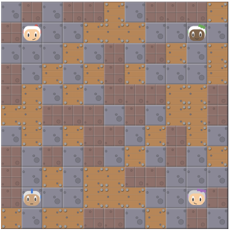
The image depicts a 10x10 grid-based game board with alternating colored tiles (brown, gray, and orange) and four distinct character icons positioned at specific grid intersections. The board appears to be part of a puzzle or strategy game, with no visible text or numerical data.
### Components/Axes
- **Grid Structure**:
- 10x10 square tiles arranged in a checkerboard pattern.
- Tile colors:
- **Brown**: Dominant color, forming irregular clusters.
- **Gray**: Secondary color, interspersed between brown tiles.
- **Orange**: Tertiary color, appearing in smaller, isolated blocks.
- Each tile features a circular pattern with a central dot (possibly indicating interactivity or resource points).
- **Character Icons**:
- **Top-Left**: White-haired character (position: row 1, column 2).
- **Top-Right**: Brown-haired character (position: row 1, column 9).
- **Bottom-Left**: Blue-haired character (position: row 9, column 1).
- **Bottom-Right**: Pink-haired character (position: row 9, column 10).
- **Legend**: No explicit legend present; color coding inferred from tile distribution.
### Detailed Analysis
- **Tile Distribution**:
- Brown tiles occupy ~60% of the grid, forming large contiguous blocks and isolated clusters.
- Gray tiles (~30%) act as separators between brown regions.
- Orange tiles (~10%) are sparsely distributed, often adjacent to brown clusters.
- **Character Placement**:
- Characters are positioned at the four corners of the grid, each on a distinct colored tile:
- White-haired character: Gray tile (top-left).
- Brown-haired character: Orange tile (top-right).
- Blue-haired character: Brown tile (bottom-left).
- Pink-haired character: Brown tile (bottom-right).
- **Spatial Patterns**:
- No discernible symmetry in tile color distribution.
- Characters are evenly spaced along the grid's perimeter but occupy tiles of varying colors.
### Key Observations
1. **Color Dominance**: Brown tiles dominate the board, suggesting they may represent a primary resource or terrain type.
2. **Character Roles**: The placement of characters on different-colored tiles might indicate unique abilities or objectives tied to tile types (e.g., brown tiles for movement, orange for special actions).
3. **Grid Complexity**: The irregular clustering of brown tiles implies a non-uniform movement or interaction mechanic.
### Interpretation
The board likely requires strategic navigation or resource management, with characters positioned to interact with specific tile types. The absence of text or numerical labels suggests the game relies on visual cues (color, position) for gameplay mechanics. The sparse orange tiles may serve as critical nodes or objectives, given their rarity and placement near brown clusters. The characters' corner positions could imply starting points for exploration or turn-based movement. Further analysis would require gameplay context to confirm hypotheses about tile interactions and character roles.