## Bar Chart: Number of Basis Functions
### Overview
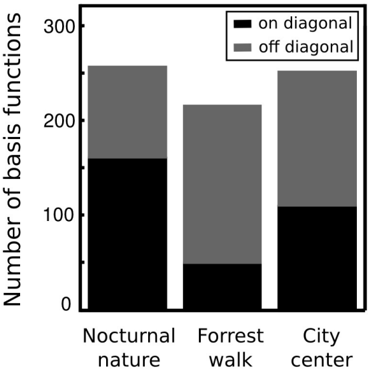
The image is a stacked bar chart comparing the number of basis functions used in three different scenarios: "Nocturnal nature", "Forrest walk", and "City center". Each bar is divided into two segments representing "on diagonal" and "off diagonal" basis functions.
### Components/Axes
* **Y-axis:** "Number of basis functions", ranging from 0 to 300 in increments of 100.
* **X-axis:** Categorical labels: "Nocturnal nature", "Forrest walk", and "City center".
* **Legend:** Located in the top-right corner:
* Black: "on diagonal"
* Gray: "off diagonal"
### Detailed Analysis
* **Nocturnal nature:**
* "on diagonal": Approximately 160
* "off diagonal": Approximately 90
* Total: Approximately 250
* **Forrest walk:**
* "on diagonal": Approximately 50
* "off diagonal": Approximately 170
* Total: Approximately 220
* **City center:**
* "on diagonal": Approximately 110
* "off diagonal": Approximately 140
* Total: Approximately 250
### Key Observations
* "Nocturnal nature" and "City center" have the same total number of basis functions (approximately 250).
* "Forrest walk" has the lowest total number of basis functions (approximately 220).
* "Nocturnal nature" has the highest number of "on diagonal" basis functions.
* "Forrest walk" has the highest number of "off diagonal" basis functions.
### Interpretation
The chart compares the complexity of representing different environments using basis functions, distinguishing between "on diagonal" and "off diagonal" components. The "Forrest walk" scenario requires fewer total basis functions than "Nocturnal nature" or "City center". However, "Forrest walk" relies more heavily on "off diagonal" basis functions, suggesting a different type of complexity or structure in that environment compared to the others. The "Nocturnal nature" scenario relies more on "on diagonal" basis functions. The "City center" scenario has a more balanced distribution of "on diagonal" and "off diagonal" basis functions.