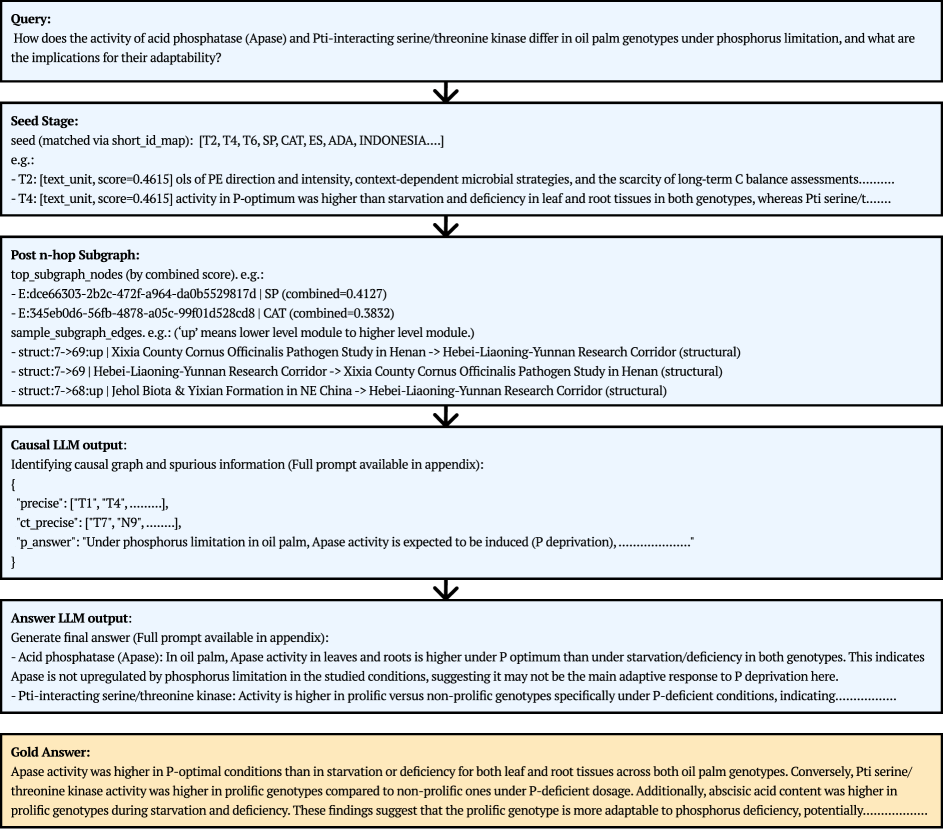
## Flowchart: Analysis of Acid Phosphatase and Pti-Serine/Threonine Kinase Activity in Oil Palm Genotypes Under Phosphorus Limitation
### Overview
The image depicts a multi-stage analytical workflow for studying enzyme activity differences in oil palm genotypes under phosphorus limitation. It includes seed selection criteria, subgraph analysis, causal reasoning, and final answer generation. Key components involve text unit scoring, study subgraph construction, and LLM-based causal inference.
### Components/Axes
1. **Query Section**
- Text: "How does the activity of acid phosphatase (Apase) and Pti-interacting serine/threonine kinase differ in oil palm genotypes under phosphorus limitation, and what are the implications for their adaptability?"
- Language: English
2. **Seed Stage**
- Seed IDs: `[T2, T4, T6, SP, CAT, ES, ADA, INDONESIA...]`
- Text Units:
- T2: `[text_unit, score=0.4615]` (PE direction/intensity, microbial strategies, C balance assessments)
- T4: `[text_unit, score=0.4615]` (P-optimum activity vs. starvation, leaf/root tissue deficiency)
- Language: English
3. **Post n-hop Subgraph**
- Study Nodes (combined scores):
- E: `dce66303-2b2c-472f-a964-da0b5529817d` (SP, combined=0.4127)
- E: `345eb0d6-56fb-4878-a05c-99f01d528c8` (CAT, combined=0.3832)
- Structural Subgraphs:
- `struc7:7>69↑` (Xixia County Cornus Pathogen Study in Henan)
- `struc7:7>69` (Hebei-Liaoning-Yunnan Research Corridor)
- `struc7:7>68↑` (Jehoi Biota & Xixian Formation in NE China)
- Language: English
4. **Causal LLM Output**
- Code-like structures:
```json
{
"precise": ["T1", "T4", ...],
"ct_precise": ["T7", "N9", ...],
"p_answer": "Under phosphorus limitation in oil palm, Apase activity is expected to be induced (P deprivation), ..."
}
```
- Language: English
5. **Answer LLM Output**
- Text:
- Apase activity higher under P-optimum than starvation/deficiency in both genotypes.
- Pti serine/threonine kinase activity higher in prolific genotypes under P-deficient conditions.
- Abscisic acid content higher in prolific genotypes during starvation/deficiency.
- Language: English
6. **Gold Answer**
- Text:
- Apase activity higher in P-optimum conditions across genotypes.
- Pti serine/threonine kinase activity higher in prolific genotypes under P-deficient conditions.
- Abscisic acid content higher in prolific genotypes during stress.
- Prolific genotypes more adaptable to phosphorus deficiency.
- Language: English
### Detailed Analysis
- **Seed Stage**: Focuses on genotype selection (T2, T4, etc.) and text units with scores (0.4615) related to phosphorus efficiency and stress responses.
- **Post n-hop Subgraph**: Connects studies on pathogen research (Xixia County, Hebei-Liaoning-Yunnan Corridor) with combined scores (0.4127, 0.3832).
- **Causal LLM Output**: Uses structured logic (`precise`, `ct_precise`, `p_answer`) to infer enzyme activity trends under phosphorus limitation.
- **Answer LLM Output**: Synthesizes findings into genotype-specific responses:
- Apase: P-optimum > starvation/deficiency.
- Pti kinase: Prolific genotypes > non-prolific under P-deficient conditions.
- **Gold Answer**: Concise summary emphasizing genotype adaptability linked to enzyme and hormone activity.
### Key Observations
- **Enzyme Activity Trends**:
- Apase activity is consistently higher under phosphorus-rich conditions.
- Pti kinase activity correlates with genotype proficiency under phosphorus stress.
- **Structural Relationships**:
- Seed stage text units (T2, T4) inform subgraph construction.
- Causal LLM output bridges subgraph data to final conclusions.
- **Notable Patterns**:
- Prolific genotypes show stress-specific enzyme/hormone upregulation.
- Abscisic acid content acts as a biomarker for phosphorus deficiency adaptation.
### Interpretation
The workflow demonstrates that oil palm genotypes with higher phosphorus efficiency (Prolific) exhibit adaptive responses to phosphorus limitation through:
1. **Apase Regulation**: Maintained activity under P-optimum conditions, suggesting constitutive phosphorus mobilization.
2. **Pti Kinase Specificity**: Enhanced activity in Prolific genotypes under P-deficient conditions, indicating targeted stress response pathways.
3. **Abscisic Acid Correlation**: Higher stress hormone levels in Prolific genotypes during deficiency, linking hormonal signaling to adaptive capacity.
These findings suggest that Prolific genotypes prioritize phosphorus conservation and stress signaling over general enzyme upregulation, making them more resilient to phosphorus scarcity. The structured LLM analysis effectively maps genotype-specific molecular mechanisms to phenotypic adaptability.