## Screenshot: Biology Quiz Interface
### Overview
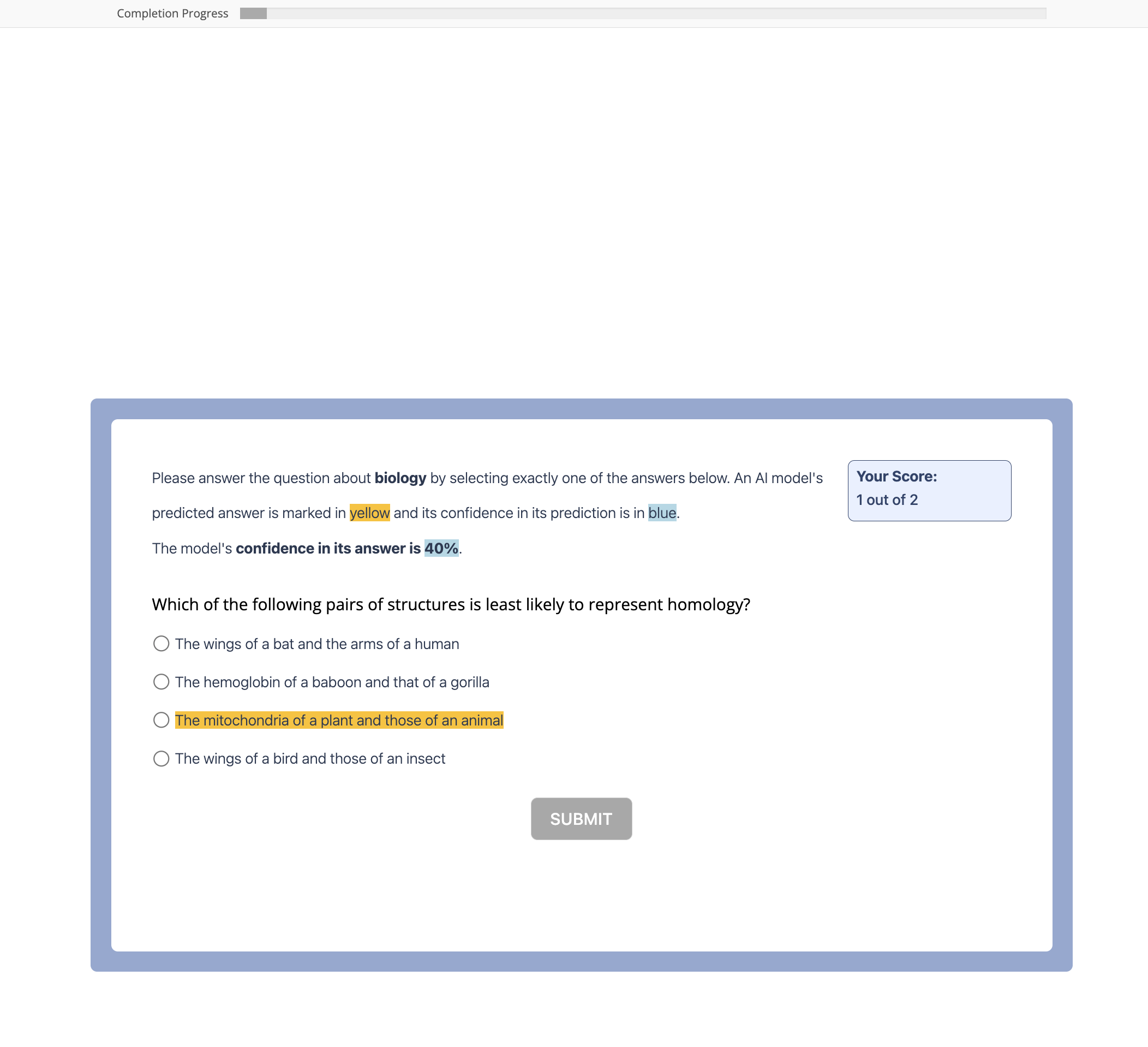
The image depicts a quiz interface focused on a biology question about homology. The interface includes a progress bar, a question with multiple-choice options, a highlighted predicted answer, model confidence, and a user score display.
### Components/Axes
- **Header**:
- "Completion Progress" bar (partially filled, ~20% completion).
- **Main Content**:
- **Question**: "Which of the following pairs of structures is least likely to represent homology?"
- **Options**:
1. The wings of a bat and the arms of a human
2. The hemoglobin of a baboon and that of a gorilla
3. **The mitochondria of a plant and those of an animal** (highlighted in yellow)
4. The wings of a bird and those of an insect
- **Model Prediction**: Option 3 (highlighted in yellow).
- **Confidence**: "The model's confidence in its answer is 40%" (text in blue).
- **User Score**: "Your Score: 1 out of 2" (displayed in a light blue box).
- **Footer**:
- "SUBMIT" button (gray, centered).
### Detailed Analysis
- **Question Structure**:
- Four options are presented as radio buttons.
- Option 3 is explicitly highlighted in yellow, indicating the model's predicted answer.
- **Confidence and Score**:
- Model confidence is stated as 40%, suggesting low certainty in the prediction.
- User score shows 1 correct answer out of 2 total questions, implying partial accuracy.
### Key Observations
- The highlighted option (mitochondria of plants and animals) is the model's prediction, but the low confidence (40%) raises questions about its reliability.
- The user’s score (1/2) suggests they answered one question correctly, though the interface does not specify which question.
- The progress bar indicates the quiz is in early stages (~20% completion).
### Interpretation
- The interface is designed for educational assessment, testing knowledge of homology (shared ancestry of structures).
- The model’s prediction (Option 3) is biologically questionable: mitochondria are organelles with endosymbiotic origins, making them homologous across plants and animals. This may indicate a flaw in the model’s training data or logic.
- The user’s partial score (1/2) implies they correctly identified one homologous pair (e.g., bat wings and human arms, which are homologous as forelimbs) but may have struggled with others.
- The low model confidence (40%) contrasts with the highlighted prediction, suggesting potential misalignment between the model’s output and its certainty.
## Notes
- No non-English text is present.
- All textual elements are transcribed verbatim, including formatting (bold, colors).
- Spatial grounding: Elements are arranged vertically (progress bar → question → options → score → submit button).