\n
## Screenshot: Biology Quiz Interface with AI Prediction
### Overview
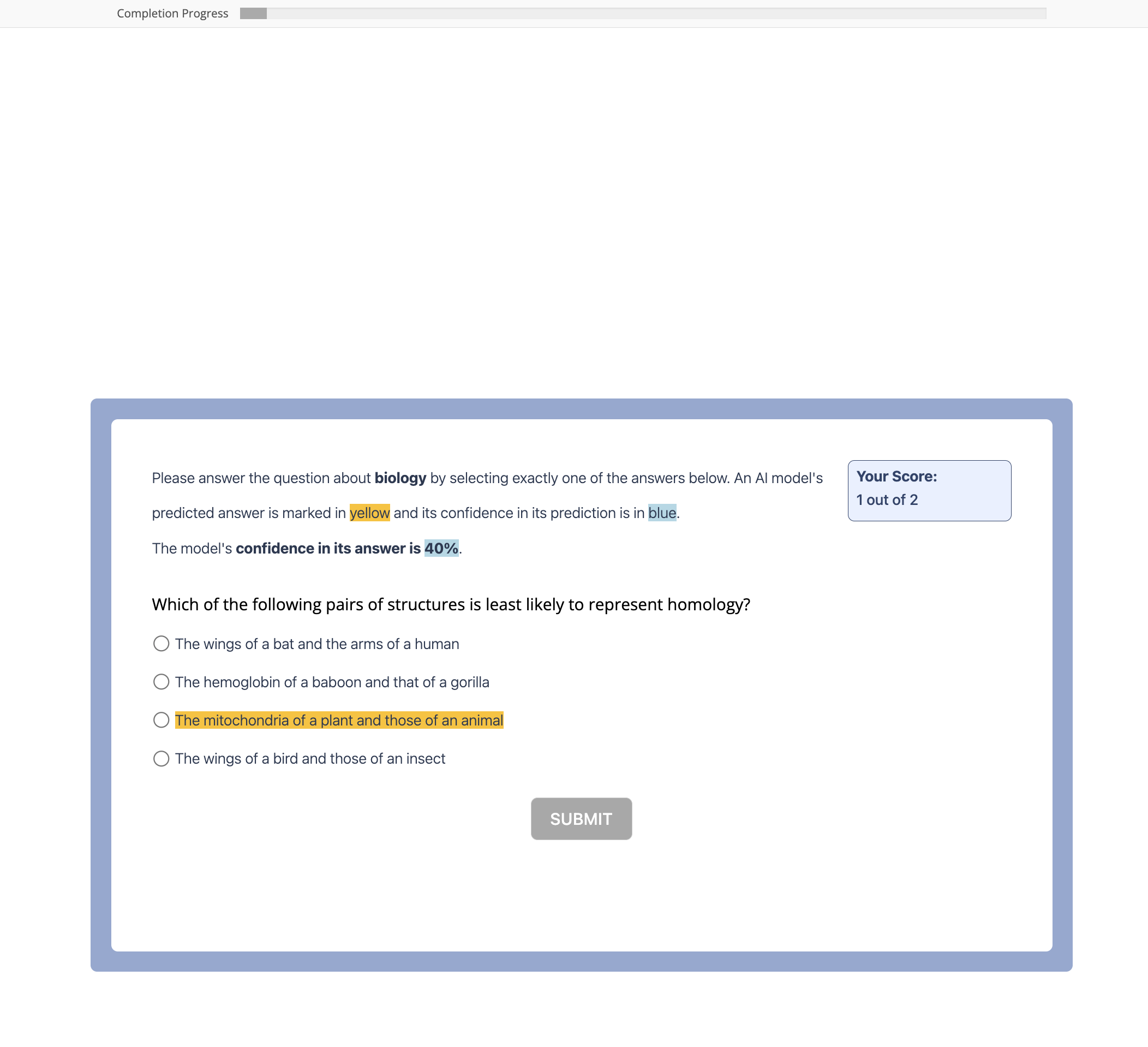
This image is a screenshot of an online quiz or testing interface. It displays a multiple-choice biology question about homology, along with an AI model's predicted answer and confidence score. The interface includes a progress bar, instructional text, the question with four options, a score display, and a submit button.
### Components/Axes
The interface is structured as follows:
1. **Top Bar (Header Region):**
* **Element:** A horizontal progress bar.
* **Label:** "Completion Progress" (text located to the left of the bar).
* **Visual:** A gray bar indicating partial completion (approximately 15-20% filled).
2. **Main Content Box (Center Region):**
* A large rectangular box with a light blue border and white background.
* **Instructional Text Block (Top of box):**
* "Please answer the question about **biology** by selecting exactly one of the answers below. An AI model's predicted answer is marked in **yellow** and its confidence in its prediction is in **blue**."
* "The model's **confidence in its answer is 40%**." (The "40%" is highlighted with a light blue background).
* **Score Box (Top-right of main box):**
* A smaller, light gray box with the text: "Your Score: 1 out of 2".
* **Question:**
* "Which of the following pairs of structures is least likely to represent homology?"
* **Answer Options (Listed vertically, each with a radio button):**
1. "The wings of a bat and the arms of a human"
2. "The hemoglobin of a baboon and that of a gorilla"
3. "The mitochondria of a plant and those of an animal" (This entire line is highlighted with a yellow background, indicating the AI's predicted answer).
4. "The wings of a bird and those of an insect"
* **Submit Button (Bottom-center of main box):**
* A gray rectangular button with the text "SUBMIT".
### Detailed Analysis
* **Text Transcription:** All text is in English. The complete transcription is provided in the Components section above.
* **AI Prediction Details:**
* **Predicted Answer:** Option 3: "The mitochondria of a plant and those of an animal".
* **Confidence Level:** 40% (displayed in blue).
* **User State:** The score "1 out of 2" suggests this is the second question in a set, and the user has answered one correctly so far.
* **Spatial Layout:** The instructional text and question are left-aligned within the main box. The score box is positioned in the top-right corner, separate from the main flow. The submit button is centered at the bottom.
### Key Observations
1. The AI model's confidence (40%) is relatively low for a multiple-choice question, suggesting uncertainty.
2. The highlighted answer (plant vs. animal mitochondria) is being presented as the model's prediction, not necessarily the correct answer.
3. The interface is designed to show the user both the AI's guess and its confidence level before they submit their own answer.
### Interpretation
This screenshot captures a moment in a human-AI collaborative or evaluative testing scenario. The system is not just presenting a quiz; it's providing meta-information about an AI's performance on the same question. The low confidence score (40%) for the predicted answer about mitochondria is notable. Biologically, mitochondria in plants and animals are homologous structures (both derived from an ancestral alpha-proteobacterium via endosymbiosis). Therefore, the AI's prediction that this pair is "least likely to represent homology" is likely incorrect, which aligns with its low confidence. The other options include clear examples of homology (bat wing/human arm, hemoglobin sequences) and one clear example of analogy (bird wing/insect wing). The interface seems designed to test or demonstrate the AI's reasoning capabilities and to allow a human to compare their own judgment against the model's.