## Image Comparison: Training Level vs. Scale Constraint
### Overview
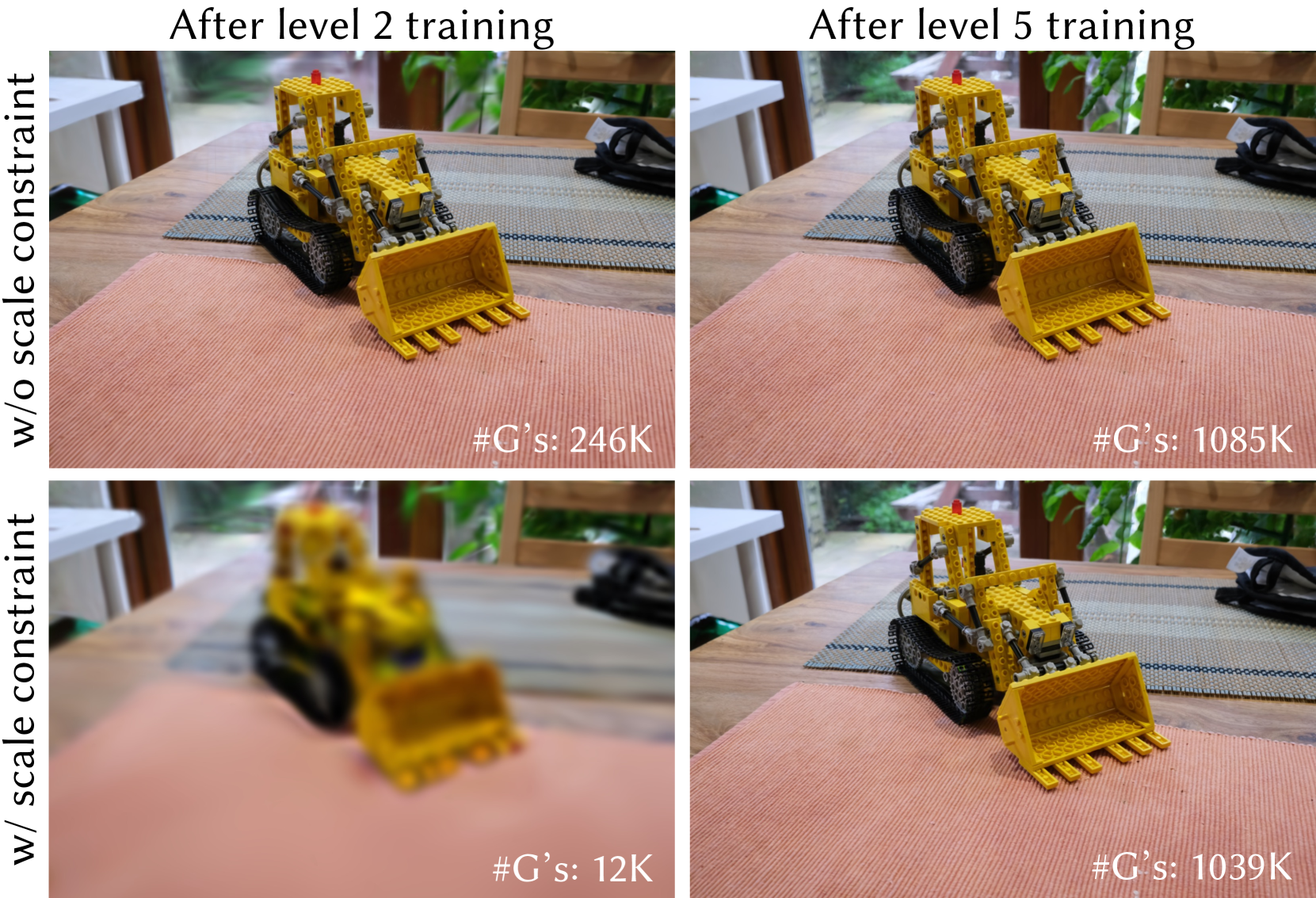
The image presents a 2x2 grid of photographs, comparing the visual quality of a yellow toy bulldozer after different levels of training (level 2 and level 5) and with/without a scale constraint. Each image also includes a "#G's" value, presumably representing a metric related to the image generation or processing.
### Components/Axes
* **Titles:**
* Top-Left: "After level 2 training"
* Top-Right: "After level 5 training"
* Left-Column: "w/o scale constraint" (top), "w/ scale constraint" (bottom)
* **Metrics:**
* "#G's" values are displayed in the bottom-right corner of each image.
### Detailed Analysis
* **Top-Left (After level 2 training, w/o scale constraint):**
* Image is clear and focused.
* #G's: 246K
* **Top-Right (After level 5 training, w/o scale constraint):**
* Image is clear and focused.
* #G's: 1085K
* **Bottom-Left (After level 2 training, w/ scale constraint):**
* Image is blurry and out of focus.
* #G's: 12K
* **Bottom-Right (After level 5 training, w/ scale constraint):**
* Image is clear and focused.
* #G's: 1039K
### Key Observations
* Increasing the training level (from 2 to 5) generally improves the image quality, especially when a scale constraint is applied.
* Applying a scale constraint at level 2 training results in a significantly blurry image.
* The "#G's" value varies significantly across the images, potentially indicating the complexity or resources required to generate each image.
### Interpretation
The image demonstrates the impact of training level and scale constraints on the visual quality of a generated or processed image. Without a scale constraint, increasing the training level improves the image and increases the #G's value. With a scale constraint, a low training level results in a poor image, but a higher training level can still produce a good image with a high #G's value. This suggests that scale constraints may require more training to achieve comparable results to unconstrained methods, but can still be effective with sufficient training. The "#G's" metric likely represents a measure of computational cost or complexity, which increases with both training level and the application of scale constraints (when the training level is sufficient).