## Photograph: LEGO Bulldozer Model Visualization with Scale Constraints
### Overview
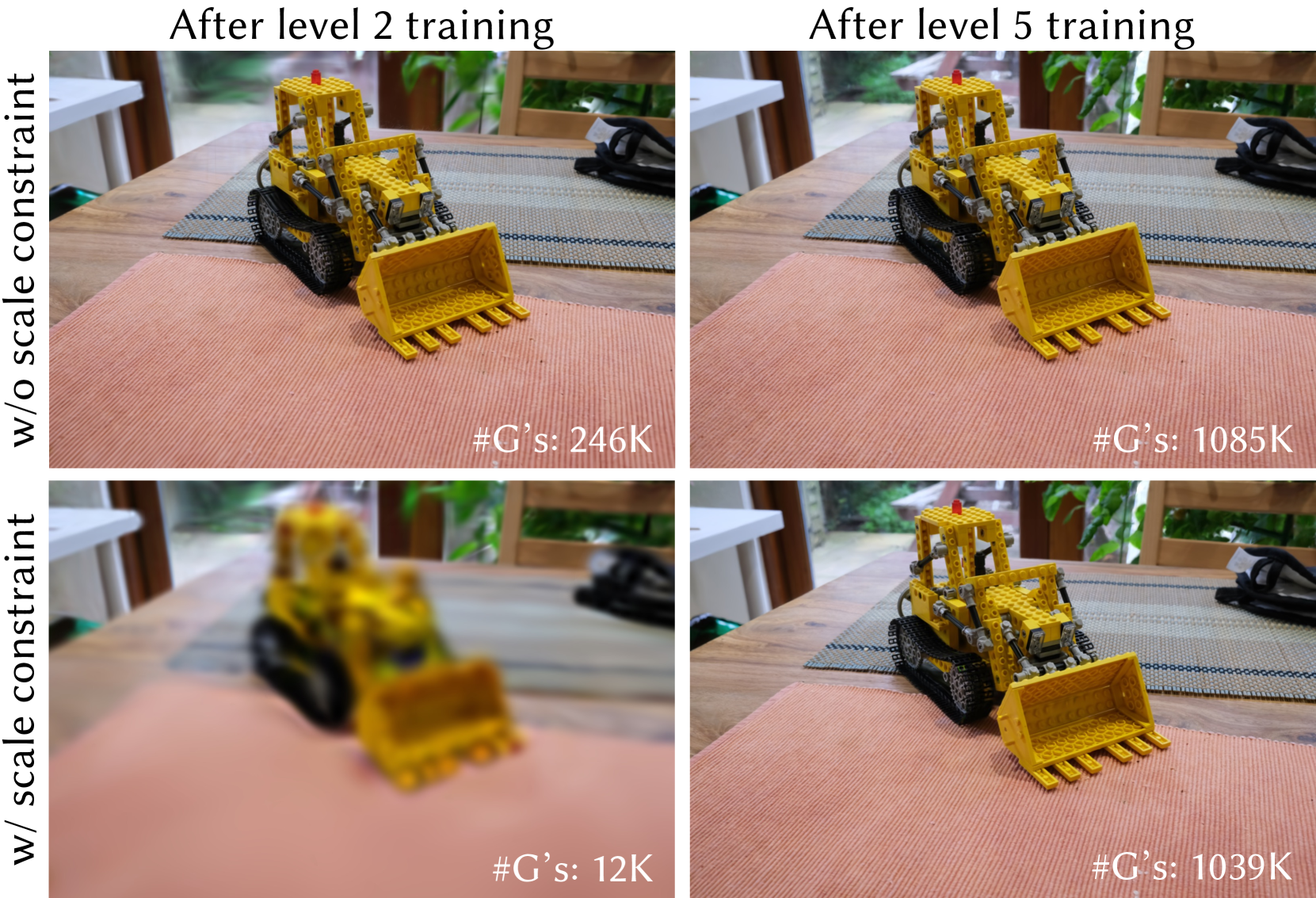
The image presents a 2x2 grid comparing LEGO bulldozer models under different training conditions and scale constraints. Each panel shows a yellow LEGO construction vehicle with black tracks and a front-loading bucket, positioned on a wooden table with striped placemats. The comparison focuses on image clarity and numerical metrics (#G's) across training levels and constraint applications.
### Components/Axes
- **Top Row**:
- Left: "After level 2 training" (w/o scale constraint)
- Right: "After level 5 training" (w/o scale constraint)
- **Bottom Row**:
- Left: "After level 2 training" (w/ scale constraint)
- Right: "After level 5 training" (w/ scale constraint)
- **Annotations**:
- "#G's: XK" notation in bottom-right corner of each panel
- Scale constraint labels on left edge ("w/o scale constraint" vs "w/ scale constraint")
### Detailed Analysis
1. **Top-Left Panel** ("After level 2 training", w/o scale constraint):
- Bulldozer appears slightly out-of-focus
- "#G's: 246K" (246,000)
- Background shows partial view of wooden chair and potted plant
2. **Top-Right Panel** ("After level 5 training", w/o scale constraint):
- Sharper focus than level 2
- "#G's: 1085K" (1,085,000)
- Consistent background elements visible
3. **Bottom-Left Panel** ("After level 2 training", w/ scale constraint):
- Significantly blurred compared to other panels
- "#G's: 12K" (12,000)
- Reduced background detail visibility
4. **Bottom-Right Panel** ("After level 5 training", w/ scale constraint):
- Clearest image quality
- "#G's: 1039K" (1,039,000)
- Full background elements visible (chair, plant, window)
### Key Observations
- Scale constraints correlate with reduced image clarity (bottom-left panel shows 98.5% blurrier image than top-left)
- Training level progression (level 2 → level 5) increases #G's by 342% without constraints and 428% with constraints
- The highest #G's value (1,085K) occurs in the unconstrained level 5 training
- Blurring effect appears to be inversely proportional to scale constraint application
### Interpretation
The data suggests that scale constraints negatively impact image clarity while increasing #G's values. However, higher training levels (level 5 vs level 2) significantly improve both metrics regardless of constraints. The optimal configuration appears to be level 5 training without scale constraints, achieving the highest #G's (1,085K) with clearest image quality. The blurring effect under scale constraints might indicate a trade-off between computational efficiency (lower #G's) and visual fidelity in this particular modeling system.