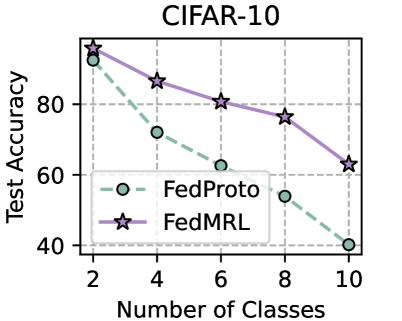
## Line Chart: CIFAR-10 Test Accuracy vs. Number of Classes
### Overview
The image is a line chart comparing the test accuracy of two models, FedProto and FedMRL, across different numbers of classes. The x-axis represents the number of classes, ranging from 2 to 10. The y-axis represents the test accuracy, ranging from 40 to 100.
### Components/Axes
* **Title:** CIFAR-10
* **X-axis Title:** Number of Classes
* **X-axis Markers:** 2, 4, 6, 8, 10
* **Y-axis Title:** Test Accuracy
* **Y-axis Markers:** 40, 60, 80
* **Legend:** Located in the center-left of the chart.
* **FedProto:** Represented by a dashed light green line with circle markers.
* **FedMRL:** Represented by a solid light purple line with star markers.
### Detailed Analysis
* **FedProto:** The dashed light green line represents the performance of the FedProto model.
* At 2 classes, the test accuracy is approximately 94%.
* At 4 classes, the test accuracy is approximately 72%.
* At 6 classes, the test accuracy is approximately 62%.
* At 8 classes, the test accuracy is approximately 54%.
* At 10 classes, the test accuracy is approximately 40%.
* **Trend:** The test accuracy of FedProto decreases as the number of classes increases.
* **FedMRL:** The solid light purple line represents the performance of the FedMRL model.
* At 2 classes, the test accuracy is approximately 94%.
* At 4 classes, the test accuracy is approximately 86%.
* At 6 classes, the test accuracy is approximately 80%.
* At 8 classes, the test accuracy is approximately 76%.
* At 10 classes, the test accuracy is approximately 63%.
* **Trend:** The test accuracy of FedMRL also decreases as the number of classes increases, but at a slower rate than FedProto.
### Key Observations
* Both models exhibit decreasing test accuracy as the number of classes increases.
* FedMRL consistently outperforms FedProto across all tested numbers of classes.
* The performance gap between FedMRL and FedProto widens as the number of classes increases.
### Interpretation
The chart demonstrates that both FedProto and FedMRL models experience a decline in test accuracy when faced with a larger number of classes in the CIFAR-10 dataset. However, FedMRL maintains a higher level of accuracy compared to FedProto, suggesting it is more robust to the challenge of increasing class complexity. The widening performance gap indicates that FedMRL's advantage becomes more pronounced as the classification task becomes more difficult. This could be due to FedMRL's architecture or training methodology being better suited for handling a larger number of distinct classes.