\n
## Code Screenshot: Lean Theorem Proofs for Scalar Norms
### Overview
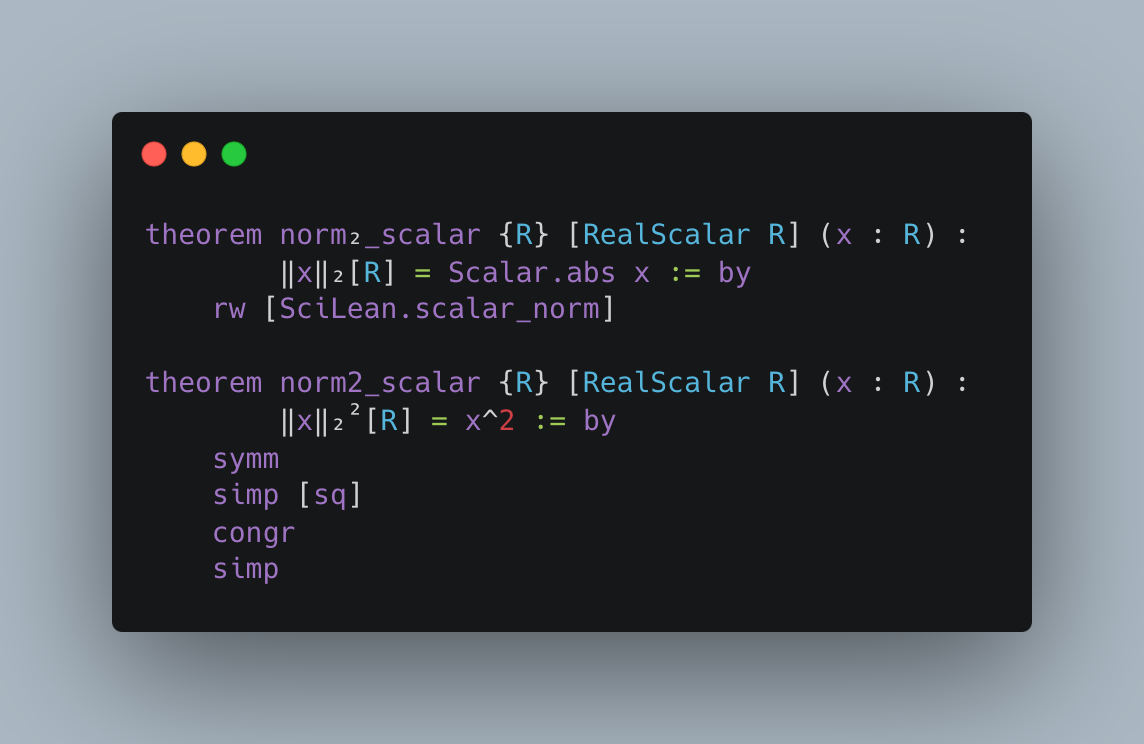
The image is a screenshot of a code editor window (with macOS-style window controls) displaying two Lean theorem proofs. The code defines and proves two related properties about the norm of a scalar value within a type class `RealScalar`. The syntax highlighting suggests a modern Lean development environment, likely using the SciLean library.
### Components/Axes
* **Window Frame**: A dark-themed editor window with three colored dots (red, yellow, green) in the top-left corner, typical of a macOS interface.
* **Code Content**: Two distinct theorem blocks written in the Lean programming language/proof assistant.
* **Syntax Highlighting**:
* Keywords (`theorem`, `by`, `rw`, `symm`, `simp`, `congr`): Purple.
* Type classes and some identifiers (`RealScalar`, `Scalar`): Teal.
* Variables and standard text (`R`, `x`): White.
* Operators and symbols (`:=`, `^`, `₂`): Various colors including yellow and red.
* Library/Module names (`SciLean`): Light blue.
### Detailed Analysis
The code contains two theorems with identical names and signatures, which is unusual and may indicate an overload or a specific pedagogical example.
**Theorem 1 (Lines 1-3):**
```lean
theorem norm2_scalar {R} [RealScalar R] (x : R) :
‖x‖₂[R] = Scalar.abs x := by
rw [SciLean.scalar_norm]
```
* **Statement**: For a type `R` which is an instance of `RealScalar`, and an element `x` of type `R`, the L2 norm of `x` (denoted `‖x‖₂[R]`) is equal to the absolute value of `x` as defined in the `Scalar` structure (`Scalar.abs x`).
* **Proof**: The proof is a single tactic `rw` (rewrite) that applies a lemma named `scalar_norm` from the `SciLean` library. This suggests the library already contains a fundamental definition or lemma connecting the norm notation to the `Scalar.abs` function.
**Theorem 2 (Lines 5-10):**
```lean
theorem norm2_scalar {R} [RealScalar R] (x : R) :
‖x‖₂²[R] = x^2 := by
symm
simp [sq]
congr
simp
```
* **Statement**: For the same type `R` and element `x`, the *square* of the L2 norm of `x` (denoted `‖x‖₂²[R]`) is equal to `x` squared (`x^2`).
* **Proof**: The proof uses a sequence of tactics:
1. `symm`: Symmetrizes the goal, likely changing `‖x‖₂²[R] = x^2` to `x^2 = ‖x‖₂²[R]`.
2. `simp [sq]`: Simplifies the goal using the definition of `sq` (square).
3. `congr`: Applies congruence, breaking the goal into simpler subgoals based on the structure of the equality.
4. `simp`: Performs general simplification to close the remaining goal(s).
### Key Observations
1. **Duplicate Theorem Name**: Both theorems are named `norm2_scalar`. In Lean, this would typically cause an error unless they are in different namespaces or one is a local instance. This might be a simplified example for illustration.
2. **Proof Complexity**: The first proof is a direct rewrite, indicating a foundational lemma. The second proof is more involved, using symmetry and simplification, suggesting it derives the squared norm property from more basic principles (possibly including the first theorem).
3. **Notation**: The code uses specialized Unicode notation for norms (`‖...‖₂`) and subscripts (`₂`), common in mathematical formalization.
4. **Library Dependency**: The proof explicitly relies on the `SciLean` library, indicating this code is part of a larger scientific computing or formal mathematics project.
### Interpretation
This code snippet formalizes basic properties of scalar norms within a type-class-based algebraic hierarchy (`RealScalar`). The theorems establish that for a "real scalar" type, the L2 norm behaves as expected: its value is the absolute value, and its square is the square of the element.
The first theorem (`‖x‖₂[R] = Scalar.abs x`) acts as a definitional bridge, connecting the abstract norm notation to a concrete function (`Scalar.abs`). The second theorem builds upon this to prove a computationally useful property (`‖x‖₂²[R] = x^2`), which is fundamental in areas like optimization, physics, and machine learning where squared norms are frequently used.
The presence of the `SciLean` library suggests this is not just a theoretical exercise but part of a practical framework for verified scientific computing. The concise proofs demonstrate the power of tactic-based theorem proving: leveraging existing library lemmas (`scalar_norm`) and automated simplifiers (`simp`) to establish results with minimal manual effort. The duplicate naming, while potentially problematic in a real codebase, might be intentional here to show two different proof strategies for closely related statements.