## Chart: Age-Related Trends in Data
### Overview
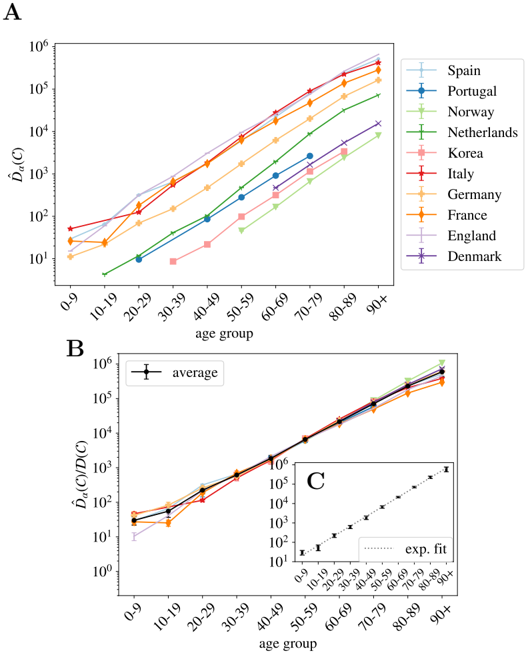
The image presents three line charts (A, B, and C) that explore age-related trends in some data, likely related to a disease or condition. Chart A compares trends across different countries, Chart B shows an average trend, and Chart C provides a zoomed-in view with an exponential fit. The y-axis is logarithmic in all charts.
### Components/Axes
**Chart A:**
* **Title:** Implicit, but the chart compares data across different countries by age group.
* **X-axis:** "age group" with categories: 0-9, 10-19, 20-29, 30-39, 40-49, 50-59, 60-69, 70-79, 80-89, 90+
* **Y-axis:** "$\hat{D}_a(C)$" (logarithmic scale from 10^1 to 10^6)
* **Legend (top-right):**
* Spain (light blue)
* Portugal (dark blue)
* Norway (green)
* Netherlands (light pink)
* Korea (dark green)
* Italy (red)
* Germany (orange)
* France (light orange)
* England (pink)
* Denmark (purple)
**Chart B:**
* **Title:** Implicit, shows the average trend across all countries.
* **X-axis:** "age group" with categories: 0-9, 10-19, 20-29, 30-39, 40-49, 50-59, 60-69, 70-79, 80-89, 90+
* **Y-axis:** "$\hat{D}_a(C)/D(C)$" (logarithmic scale from 10^0 to 10^6)
* **Legend (top-left):** average (black) with error bars.
**Chart C (inset):**
* **Title:** Implicit, zoomed-in view of the average trend.
* **X-axis:** "age group" with categories: 0-9, 10-19, 20-29, 30-39, 40-49, 50-59, 60-69, 70-79, 80-89, 90+
* **Y-axis:** Logarithmic scale from 10^1 to 10^6
* **Legend:** exp. fit (dotted line)
### Detailed Analysis
**Chart A:**
* **Spain (light blue):** Starts around 10^1.5 for the 0-9 age group and increases to approximately 10^3.5 for the 90+ age group.
* **Portugal (dark blue):** Starts around 10^1 for the 0-9 age group and increases to approximately 10^4 for the 90+ age group.
* **Norway (green):** Starts around 10^1 for the 0-9 age group and increases to approximately 10^4.5 for the 90+ age group.
* **Netherlands (light pink):** Starts around 10^1 for the 0-9 age group and increases to approximately 10^3 for the 90+ age group.
* **Korea (dark green):** Starts around 10^1.5 for the 0-9 age group and increases to approximately 10^4.5 for the 90+ age group.
* **Italy (red):** Starts around 10^2 for the 0-9 age group and increases to approximately 10^5.5 for the 90+ age group.
* **Germany (orange):** Starts around 10^1.5 for the 0-9 age group and increases to approximately 10^5 for the 90+ age group.
* **France (light orange):** Starts around 10^1.5 for the 0-9 age group and increases to approximately 10^5 for the 90+ age group.
* **England (pink):** Starts around 10^1 for the 0-9 age group and increases to approximately 10^3 for the 90+ age group.
* **Denmark (purple):** Starts around 10^2 for the 0-9 age group and increases to approximately 10^3.5 for the 90+ age group.
**Chart B:**
* **Average (black):** Starts around 10^1.5 for the 0-9 age group and increases to approximately 10^5.5 for the 90+ age group. The error bars are relatively small, indicating consistent trends across the averaged data.
**Chart C:**
* The data points are the same as the average in Chart B, but the scale is smaller. The dotted line represents an exponential fit to the data.
### Key Observations
* All countries show an increasing trend of $\hat{D}_a(C)$ with age.
* Italy, Germany, and France have the highest values of $\hat{D}_a(C)$ across all age groups.
* Spain, Netherlands, England, and Denmark have the lowest values of $\hat{D}_a(C)$ across all age groups.
* The average trend in Chart B closely follows an exponential pattern, as indicated by the exponential fit in Chart C.
### Interpretation
The charts suggest a strong correlation between age and the value of $\hat{D}_a(C)$. The exponential increase observed in the average trend indicates that the rate of increase accelerates with age. The differences between countries in Chart A could be due to various factors, such as healthcare systems, environmental factors, or genetic predispositions. The exponential fit in Chart C suggests that the underlying process may be related to exponential growth, such as cell division or accumulation of damage over time. The data suggests that age is a significant risk factor, and further research is needed to understand the underlying mechanisms and the reasons for the differences between countries.