## Line Charts: Age-Group Diversity Measures Across Countries
### Overview
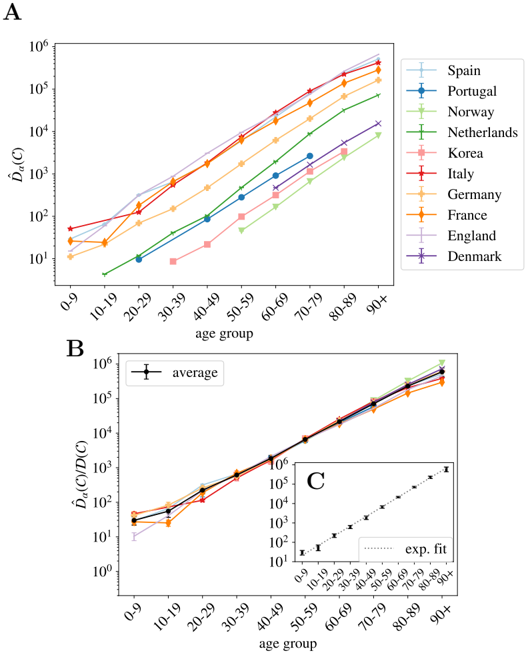
The image contains two primary line charts (labeled A and B) and one inset chart (C). Both main charts plot a diversity measure (on a logarithmic scale) against age groups for multiple countries. Chart A shows the raw measure, while Chart B shows a conditional measure, with an inset (C) displaying an exponential fit to the average data from Chart B.
### Components/Axes
**Chart A (Top Panel):**
* **Y-axis:** Label is "$\hat{D}_A(C)$". Scale is logarithmic, ranging from $10^0$ to $10^6$.
* **X-axis:** Label is "age group". Categories are: 0-9, 10-19, 20-29, 30-39, 40-49, 50-59, 60-69, 70-79, 80-89, 90+.
* **Legend (Top-right):** Lists 10 countries with corresponding line colors and markers:
* Spain (light blue, '+')
* Portugal (blue, circle)
* Norway (light green, downward triangle)
* Netherlands (green, 'x')
* Korea (pink, square)
* Italy (red, diamond)
* Germany (orange, upward triangle)
* France (orange, downward triangle)
* England (purple, '+')
* Denmark (purple, 'x')
**Chart B (Bottom Panel):**
* **Y-axis:** Label is "$\hat{D}_A(C|D(C))$". Scale is logarithmic, ranging from $10^0$ to $10^6$.
* **X-axis:** Label is "age group". Same categories as Chart A.
* **Legend (Top-left):** Contains a single entry: "average" represented by a black line with error bars.
* **Inset Chart C (Bottom-right of Chart B):**
* **Y-axis:** Logarithmic scale from $10^1$ to $10^6$.
* **X-axis:** Same age group categories as the main charts.
* **Data:** Black points with error bars, labeled "exp. fit" with a dotted trend line.
### Detailed Analysis
**Chart A - $\hat{D}_A(C)$ by Country:**
* **Trend Verification:** All 10 country lines show a strong, consistent upward trend from the youngest to the oldest age groups. The slope is steep and approximately linear on the log-linear plot, indicating exponential growth with age.
* **Data Points (Approximate Values):**
* **0-9 age group:** Values cluster between ~$10^1$ and ~$10^2$. Korea (~$10^1$) and Portugal (~$10^1$) are among the lowest. Italy (~$5 \times 10^1$) and Germany (~$3 \times 10^1$) are among the highest.
* **90+ age group:** Values range from ~$10^4$ to ~$5 \times 10^5$. England and Denmark (purple lines) are the highest, near $5 \times 10^5$. Norway and the Netherlands (green lines) are the lowest, near $10^4$.
* **Cross-Reference:** The ordering of countries is not perfectly consistent across age groups, but a general pattern holds. For example, the purple lines (England, Denmark) start in the middle range but end at the top. The green lines (Norway, Netherlands) start low and remain relatively low.
**Chart B - $\hat{D}_A(C|D(C))$ and Inset C:**
* **Trend Verification:** The individual country lines (faintly visible) and the black "average" line all show a strong upward trend, similar to Chart A.
* **Key Difference:** The spread between country lines is dramatically reduced compared to Chart A. All lines converge tightly around the average line, especially for older age groups.
* **Average Line:** The black line with error bars represents the average across countries. It starts at ~$3 \times 10^1$ for age 0-9 and rises to ~$5 \times 10^5$ for age 90+. The error bars (standard deviation or error) are relatively small, indicating low variance between countries for this conditional measure.
* **Inset Chart C:** This plots the average data points from Chart B against an exponential fit ("exp. fit"). The data points align very closely with the dotted fit line across all age groups, confirming the exponential relationship.
### Key Observations
1. **Exponential Growth:** Both diversity measures ($\hat{D}_A(C)$ and $\hat{D}_A(C|D(C))$) increase exponentially with age group.
2. **Country Variance Reduction:** The primary difference between Chart A and Chart B is the massive reduction in variance between countries. Chart A shows significant spread, while Chart B shows tight clustering. This suggests that the conditional measure $\hat{D}_A(C|D(C))$ normalizes for a factor (likely population size or base diversity) that varies greatly between countries.
3. **Consistent Ranking in Chart A:** Despite some crossing, countries like England and Denmark consistently show higher raw diversity ($\hat{D}_A(C)$) in older age groups, while Norway and the Netherlands show lower values.
4. **Robust Average Trend:** The exponential fit in Inset C is excellent, indicating a universal, predictable pattern in the conditional diversity measure across the studied populations.
### Interpretation
The data demonstrates a fundamental pattern: the measured diversity ($\hat{D}_A(C)$) within age cohorts grows exponentially as the population ages. This is likely driven by cumulative processes over a lifetime.
The critical insight comes from comparing Chart A and Chart B. The raw diversity (Chart A) varies substantially between countries, reflecting differences in population structure, size, or other demographic factors. However, when the measure is conditioned on $D(C)$ (Chart B), which likely represents the total diversity or size of the country's population, the differences between nations largely disappear. This reveals a **universal scaling law**: the age-dependent growth of conditional diversity follows the same exponential trajectory across all 10 countries studied.
Therefore, while the absolute level of age-cohort diversity is country-specific, the *relative growth pattern* with age is a shared characteristic. The exponential fit in Inset C quantifies this universal relationship. This finding suggests that the underlying mechanisms driving the increase in this diversity measure with age are consistent across different national populations.