## Line Chart: Pass@k Performance Comparison
### Overview
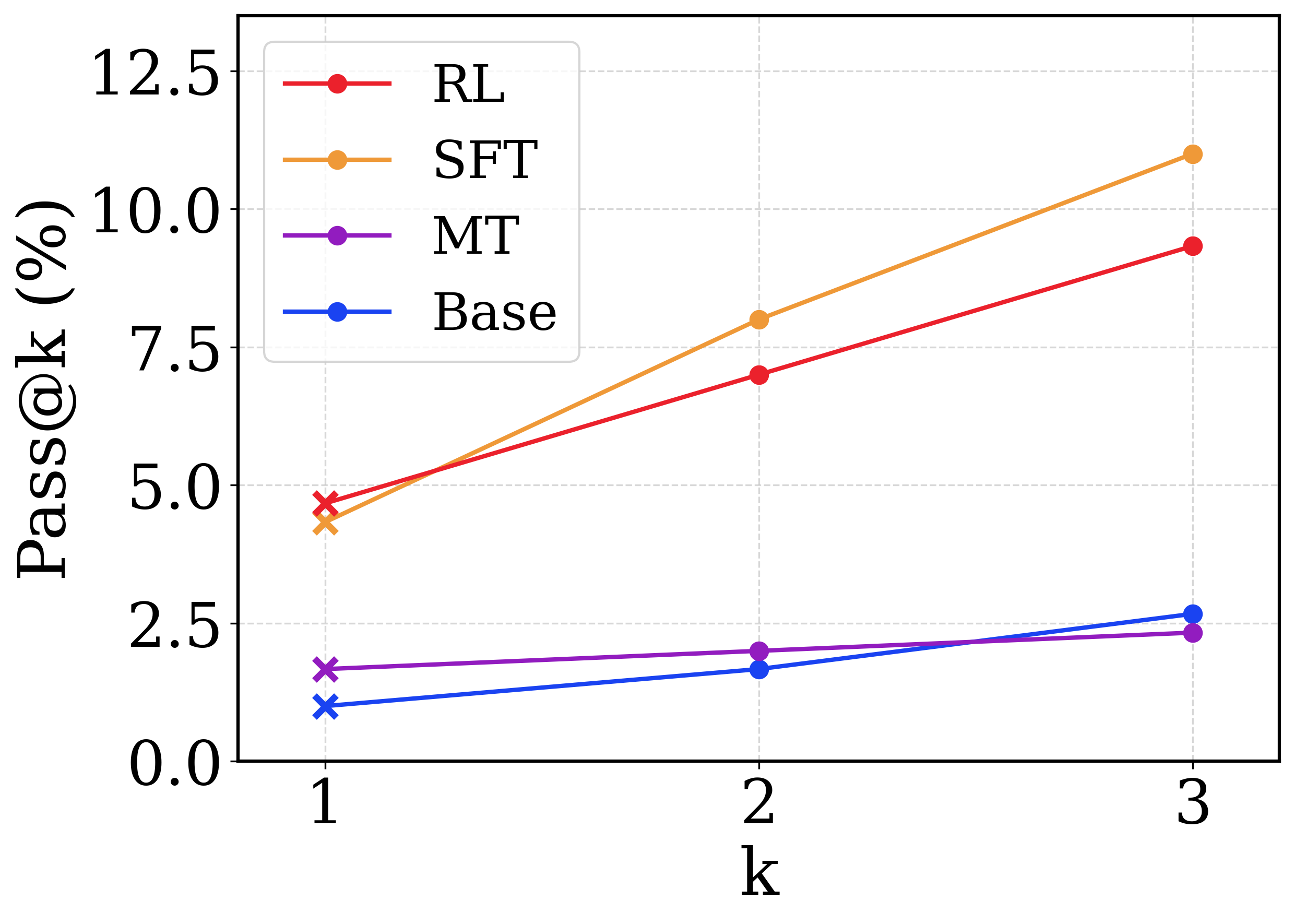
This image is a line chart comparing the performance of four different methods (RL, SFT, MT, Base) on a metric called "Pass@k (%)" as the parameter `k` increases from 1 to 3. The chart illustrates how the success rate (Pass@k) changes for each method with an increasing number of attempts or samples (`k`).
### Components/Axes
* **Chart Type:** Line chart with markers.
* **X-Axis:**
* **Label:** `k`
* **Scale:** Discrete values at 1, 2, and 3.
* **Y-Axis:**
* **Label:** `Pass@k (%)`
* **Scale:** Linear scale from 0.0 to 12.5, with major gridlines at intervals of 2.5 (0.0, 2.5, 5.0, 7.5, 10.0, 12.5).
* **Legend:** Located in the top-left corner of the plot area. It contains four entries, each with a colored line and marker:
* **RL:** Red line with circular markers.
* **SFT:** Orange line with circular markers.
* **MT:** Purple line with circular markers.
* **Base:** Blue line with circular markers.
* **Data Series:** Four distinct lines, each connecting data points at `k=1`, `k=2`, and `k=3`.
### Detailed Analysis
The following table reconstructs the approximate data points for each method, extracted by cross-referencing the line color and marker position with the legend and axis scales.
| Method (Color) | k=1 (Approx. %) | k=2 (Approx. %) | k=3 (Approx. %) | Visual Trend |
| :--- | :--- | :--- | :--- | :--- |
| **RL (Red)** | ~4.5 | ~7.0 | ~9.2 | Steep, consistent upward slope. |
| **SFT (Orange)** | ~4.0 | ~8.0 | ~11.0 | Steepest upward slope, surpassing RL after k=1. |
| **MT (Purple)** | ~1.5 | ~2.0 | ~2.3 | Very shallow upward slope, nearly flat. |
| **Base (Blue)** | ~1.0 | ~1.8 | ~2.6 | Shallow upward slope, starting lowest but slightly surpassing MT at k=3. |
**Spatial Grounding & Verification:**
* At `k=1`, the red (RL) and orange (SFT) markers are clustered near the 5.0 gridline, with RL slightly higher. The purple (MT) and blue (Base) markers are clustered near the bottom, with MT slightly higher than Base.
* At `k=2`, the orange (SFT) marker is clearly above the red (RL) marker. The blue (Base) marker has risen to be slightly below the purple (MT) marker.
* At `k=3`, the orange (SFT) marker is the highest point on the chart, above the 10.0 gridline. The red (RL) marker is below it. The blue (Base) marker is now slightly above the purple (MT) marker.
### Key Observations
1. **Performance Hierarchy:** For all values of `k`, the SFT and RL methods significantly outperform the MT and Base methods. The gap between the top two (SFT, RL) and bottom two (MT, Base) methods widens as `k` increases.
2. **Growth Rate:** SFT and RL show strong, positive growth in Pass@k as `k` increases. SFT exhibits the highest growth rate, starting slightly below RL at `k=1` but ending well above it at `k=3`.
3. **Low-Performance Cluster:** The MT and Base methods show minimal improvement with increasing `k`. Their performance lines are relatively flat and close together, with Base showing a slightly better rate of improvement, eventually overtaking MT at `k=3`.
4. **No Outliers:** All data series follow smooth, monotonic trends without unexpected dips or spikes.
### Interpretation
The chart demonstrates the effectiveness of different training or prompting strategies (RL, SFT, MT) compared to a Base model on a task measured by the Pass@k metric. Pass@k typically measures the probability that at least one of `k` generated samples is correct.
* **What the data suggests:** The Supervised Fine-Tuning (SFT) and Reinforcement Learning (RL) methods are highly effective, as their success rates increase substantially when allowed more attempts (`k`). This indicates these methods produce a higher density of correct solutions within their top `k` outputs. The Base model and the MT method (possibly "Multi-Task" or another baseline) show poor scalability with `k`, suggesting their output distributions are less likely to contain correct answers even with multiple samples.
* **Relationship between elements:** The steep slopes for SFT and RL directly correlate with the `k` parameter, showing a strong positive relationship between the number of attempts and the likelihood of success. The shallow slopes for MT and Base indicate a weak relationship.
* **Notable implication:** The crossover where SFT surpasses RL and Base surpasses MT highlights that the relative advantage of one method over another can depend on the operational constraint (`k`). If only one attempt is allowed (`k=1`), RL and SFT are comparable. If multiple attempts are feasible (`k>1`), SFT becomes the clear leader. Similarly, Base is the worst performer at `k=1` but marginally better than MT at `k=3`.