\n
## Chart: Knowledge System Classification
### Overview
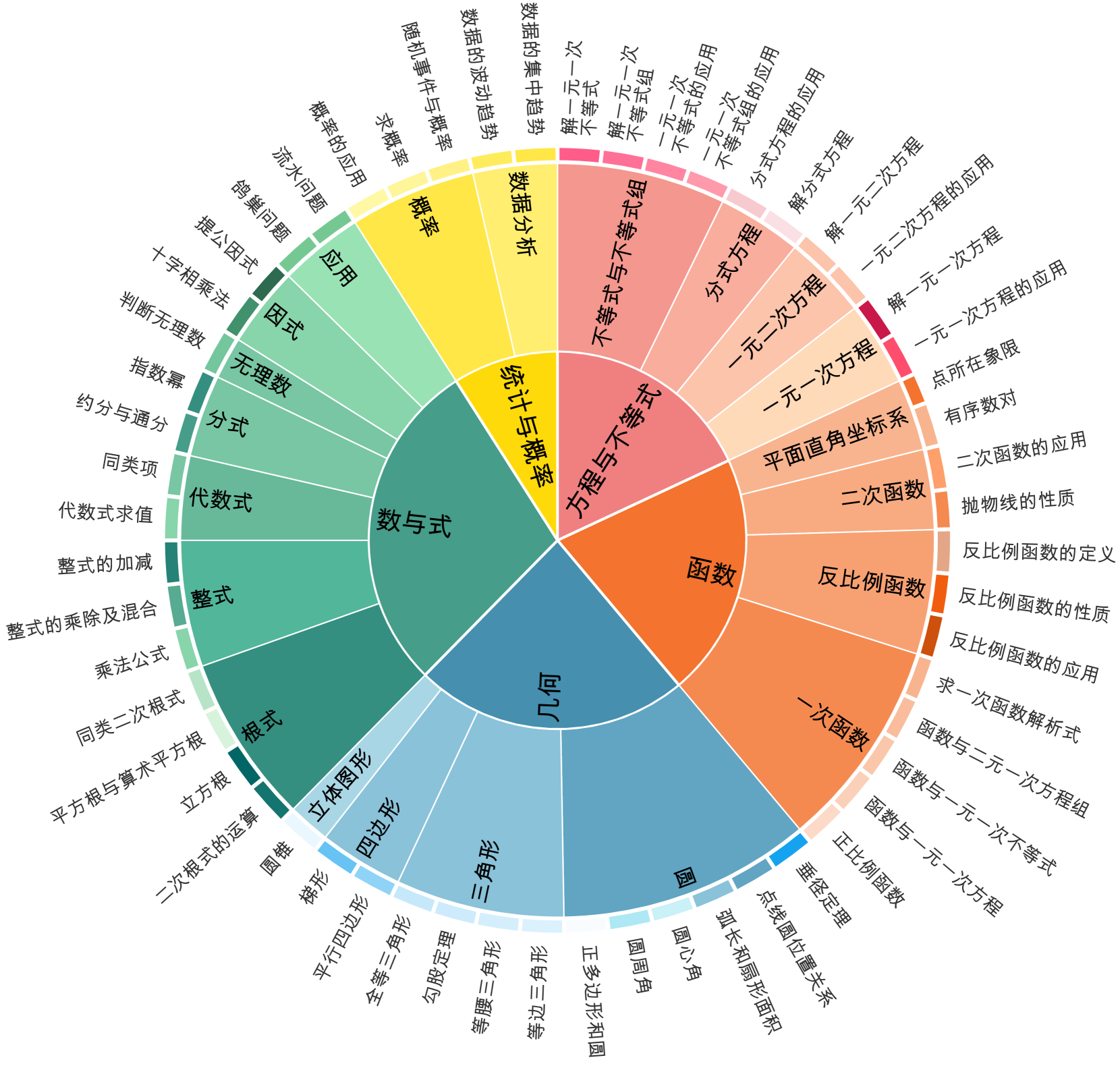
The image presents a circular diagram, resembling a radar chart or a sunburst chart, categorizing different aspects of a knowledge system. The diagram is divided into several concentric rings and sectors, with labels radiating outwards from the center. The primary language is Chinese.
### Components/Axes
The diagram is structured around a central point labeled “多维知识中心” (Duōwéi zhīshì zhōngxīn - Multidimensional Knowledge Center). The diagram is divided into 9 main categories radiating from the center:
1. 几何图形 (Jǐhé túxíng - Geometric Shapes)
2. 图表 (Túbiǎo - Charts/Diagrams)
3. 数式 (Shùshì - Formulas)
4. 方式 (Fāngshì - Methods)
5. 思想 (Sīxiǎng - Thoughts)
6. 应用 (Yìngyòng - Applications)
7. 规律 (Guīlǜ - Rules/Patterns)
8. 概念 (Gàiniàn - Concepts)
9. 三角形 (Sānjiǎoxíng - Triangles)
Each of these main categories is further subdivided into several sub-categories, with labels extending outwards. There is no explicit numerical scale or axis, but the radial distance from the center could potentially represent a degree of relatedness or importance, though this is not explicitly stated.
### Detailed Analysis or Content Details
Here's a transcription of the labels, organized by the main categories. Note that due to the radial arrangement and potential overlap, some labels are approximate.
**1. 几何图形 (Geometric Shapes):**
* 圆 (Yuán - Circle)
* 圆心角 (Yuánxīn jiǎo - Central Angle)
* 圆周角 (Yuánzhōujiǎo - Inscribed Angle)
* 弧长 (Húcháng - Arc Length)
* 扇形面积 (Shànxíng miànjī - Sector Area)
* 等弧 (Děng hú - Equal Arcs)
* 圆柱 (Yuánzhù - Cylinder)
* 圆锥 (Yuánzhuī - Cone)
* 球形 (Qiúxíng - Sphere)
* 等腰三角形 (Děngyāo sānjiǎoxíng - Isosceles Triangle)
* 平均四边形 (Píngjūn sìbiānxíng - Average Quadrilateral)
* 二次四边形 (Èrcì sìbiānxíng - Second-Order Quadrilateral)
* 其它图形 (Qítā túxíng - Other Shapes)
**2. 图表 (Charts/Diagrams):**
* 一次函数分析 (Yīcì hánshù fēnxī - Linear Function Analysis)
* 函数与一元二次方程 (Hánshù yǔ yīyuán èrcì fāngchéng - Functions and Quadratic Equations)
* 正比例函数 (Zhèng bǐlì hánshù - Direct Proportion Function)
* 反比例函数 (Fǎnbǐlì hánshù - Inverse Proportion Function)
* 反比例函数的定义 (Fǎnbǐlì hánshù de dìngyì - Definition of Inverse Proportion Function)
* 反比例函数的性质 (Fǎnbǐlì hánshù de xìngzhì - Properties of Inverse Proportion Function)
* 二次函数的应用 (Èrcì hánshù de yìngyòng - Application of Quadratic Function)
* 抛物线的性质 (Pāowùxiàn de xìngzhì - Properties of Parabola)
* 平面直角坐标系 (Píngmiàn zhíjiǎo zuòbiāo xì - Cartesian Coordinate System)
* 一次函数 (Yīcì hánshù - Linear Function)
* 二次函数 (Èrcì hánshù - Quadratic Function)
**3. 数式 (Formulas):**
* 代数式求值 (Dàishùshì qiúzhí - Evaluating Algebraic Expressions)
* 同类项 (Tónglèixiàng - Like Terms)
* 约分 (Yuēfēn - Simplification of Fractions)
* 百分之通过 (Bǎifēnzhī tōngguò - Percentage Pass Rate)
* 撇式加式 (Piěshì jiāshì - Addition and Subtraction of Fractions)
**4. 方式 (Methods):**
* 分类 (Fēnlèi - Classification)
* 公式方程 (Gōngshì fāngchéng - Formula Equation)
* 一元二次方程 (Yīyuán èrcì fāngchéng - Quadratic Equation)
* 解一元二次方程 (Jiě yīyuán èrcì fāngchéng - Solving Quadratic Equation)
* 解方程 (Jiě fāngchéng - Solving Equations)
* 解二次方程 (Jiě èrcì fāngchéng - Solving Quadratic Equations)
**5. 思想 (Thoughts):**
* 判断 (Pànduàn - Judgement)
* 判断推理 (Pànduàn tuīlǐ - Logical Reasoning)
* 判断题 (Pànduàntí - True/False Questions)
* 十字相乘法 (Shízì xiāngchéngfǎ - Cross Multiplication Method)
* 微小思通过 (Wēixiǎo sī tōngguò - Small Thought Passage)
**6. 应用 (Applications):**
* 概念问题 (Gàiniàn wèntí - Conceptual Problems)
* 概率问题 (Gàilǜ wèntí - Probability Problems)
* 概率的运用 (Gàilǜ de yùnyòng - Application of Probability)
* 求概率 (Qiú gàilǜ - Calculating Probability)
* 求概率的运用 (Qiú gàilǜ de yùnyòng - Application of Calculating Probability)
**7. 规律 (Rules/Patterns):**
* 整式的加减 (Zhěngshì de jiājiǎn - Addition and Subtraction of Polynomials)
* 整式的乘除 (Zhěngshì de chéngchú - Multiplication and Division of Polynomials)
* 整式的乘除及混合 (Zhěngshì de chéngchú jí hùnhé - Multiplication, Division and Combination of Polynomials)
**8. 概念 (Concepts):**
* 概念 (Gàiniàn - Concept)
* 公股定理 (Gōnggǔ dìnglǐ - Common Stock Theorem)
* 等差公式 (Děngchā gōngshì - Arithmetic Progression Formula)
* 等比公式 (Děngbǐ gōngshì - Geometric Progression Formula)
**9. 三角形 (Triangles):**
* 等边三角形 (Děngbiān sānjiǎoxíng - Equilateral Triangle)
* 等腰三角形 (Děngyāo sānjiǎoxíng - Isosceles Triangle)
* 直角三角形 (Zhíjiǎo sānjiǎoxíng - Right Triangle)
* 三角形的面积 (Sānjiǎoxíng de miànjī - Area of Triangle)
* 三角形与一元二次方程 (Sānjiǎoxíng yǔ yīyuán èrcì fāngchéng - Triangle and Quadratic Equation)
### Key Observations
The diagram appears to be a hierarchical classification of knowledge related to mathematics, particularly algebra and geometry. The central "Multidimensional Knowledge Center" suggests an attempt to integrate various aspects of mathematical understanding. The density of sub-categories varies across the main categories, potentially indicating the relative complexity or importance of those areas. The arrangement is radial, implying interconnectedness between the different categories.
### Interpretation
This diagram represents a conceptual map of mathematical knowledge, likely intended for educational purposes. It aims to illustrate the relationships between different concepts, methods, and applications. The use of a circular diagram suggests a holistic view, where all elements are interconnected. The diagram could be used as a learning tool to help students understand the broader context of their studies and identify areas where they need to strengthen their understanding. The emphasis on geometric shapes, formulas, and problem-solving methods indicates a focus on practical application of mathematical principles. The diagram's structure suggests a top-down approach to learning, starting with fundamental concepts and progressing to more complex applications. The Chinese language indicates the target audience is likely Chinese-speaking students or educators.