TECHNICAL ASSET FINGERPRINT
d1cc100a620e9f8cc85abcc4
Click to view fullscreen
Press ESC or click to close
FOUND IN PAPERS
EXPERT: healer-alpha-free VERSION 1
RUNTIME: free/openrouter/healer-alpha
INTEL_VERIFIED
## Sunburst Chart: Hierarchical Mathematics Curriculum Map
### Overview
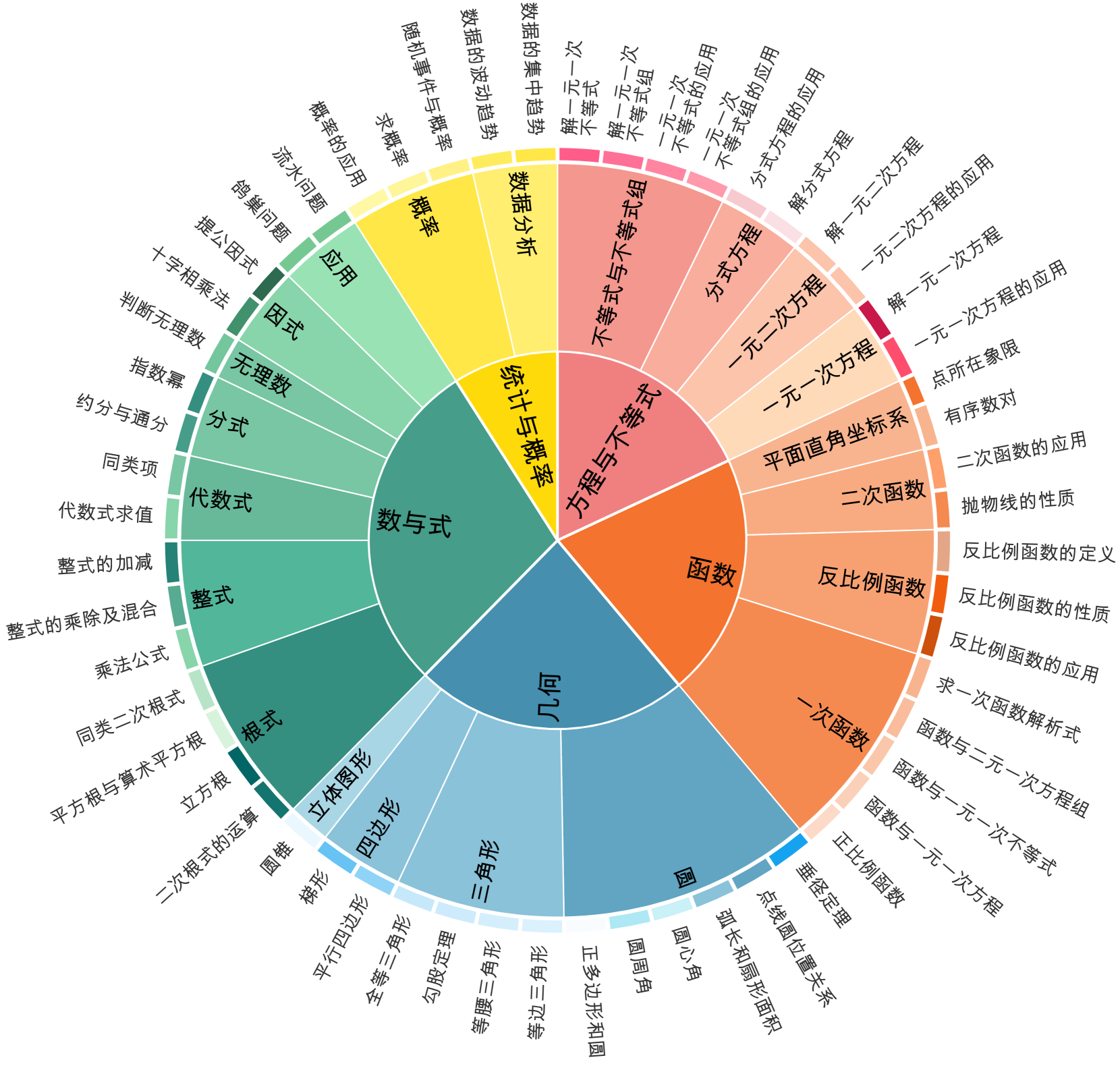
The image displays a multi-level sunburst chart (a radial hierarchical diagram) that visually organizes a comprehensive mathematics curriculum, likely for middle school or early high school level. The chart is structured in concentric rings, with the innermost ring representing broad mathematical domains, the middle ring representing major topic areas, and the outermost ring representing specific sub-topics or skills. All text is in Chinese. The chart uses a distinct color-coding scheme to group related domains.
### Components/Axes
* **Chart Type:** Sunburst Chart (Radial Treemap).
* **Structure:** Three concentric rings radiating from a central point.
* **Color-Coding:** Each major domain in the innermost ring has a unique color, which is maintained in varying shades for its sub-topics in the outer rings.
* **Text Orientation:** Labels are oriented radially, following the curve of their respective segments.
* **Spatial Layout:** The chart is divided into five primary colored sectors, each representing a core mathematical domain.
### Detailed Analysis
The hierarchical content is extracted below, moving from the center outward. The primary language is Chinese, with English translations provided.
#### **Innermost Ring (Core Domains)**
1. **数与式 (Numbers and Expressions)** - Dark Green sector (approx. 7 o'clock to 11 o'clock position).
2. **几何 (Geometry)** - Blue sector (approx. 4 o'clock to 7 o'clock position).
3. **函数 (Functions)** - Orange sector (approx. 1 o'clock to 4 o'clock position).
4. **方程与不等式 (Equations and Inequalities)** - Pink/Red sector (approx. 11 o'clock to 1 o'clock position).
5. **统计与概率 (Statistics and Probability)** - Yellow sector (approx. 11 o'clock, adjacent to the pink sector).
#### **Middle Ring (Major Topic Areas)**
* **Under 数与式 (Numbers and Expressions):**
* **根式 (Radicals)** - Darkest green segment.
* **整式 (Polynomials)** - Medium-dark green segment.
* **代数式 (Algebraic Expressions)** - Medium green segment.
* **分式 (Fractions/Rational Expressions)** - Light green segment.
* **无理数 (Irrational Numbers)** - Lighter green segment.
* **因式 (Factoring)** - Lightest green segment.
* **应用 (Applications)** - Pale green segment.
* **Under 几何 (Geometry):**
* **圆 (Circles)** - Dark blue segment.
* **三角形 (Triangles)** - Medium blue segment.
* **四边形 (Quadrilaterals)** - Light blue segment.
* **立体图形 (3D Shapes/Solid Figures)** - Lightest blue segment.
* **Under 函数 (Functions):**
* **一次函数 (Linear Functions)** - Dark orange segment.
* **反比例函数 (Inverse Proportional Functions)** - Medium orange segment.
* **二次函数 (Quadratic Functions)** - Light orange segment.
* **平面直角坐标系 (Cartesian Coordinate System)** - Lightest orange segment.
* **Under 方程与不等式 (Equations and Inequalities):**
* **一元一次方程 (Linear Equations in One Variable)** - Dark pink segment.
* **一元二次方程 (Quadratic Equations in One Variable)** - Medium pink segment.
* **分式方程 (Fractional Equations)** - Light pink segment.
* **不等式与不等式组 (Inequalities and Systems of Inequalities)** - Lightest pink segment.
* **Under 统计与概率 (Statistics and Probability):**
* **数据分析 (Data Analysis)** - Dark yellow segment.
* **概率 (Probability)** - Light yellow segment.
#### **Outermost Ring (Specific Sub-Topics/Skills)**
* **Under 根式 (Radicals):**
* 二次根式的运算 (Operations with Square Roots)
* 立方根 (Cube Roots)
* 平方根与算术平方根 (Square Roots and Arithmetic Square Roots)
* 同类二次根式 (Like Square Root Terms)
* **Under 整式 (Polynomials):**
* 乘法公式 (Multiplication Formulas)
* 整式的乘除及混合 (Multiplication, Division, and Mixed Operations of Polynomials)
* 整式的加减 (Addition and Subtraction of Polynomials)
* **Under 代数式 (Algebraic Expressions):**
* 代数式求值 (Evaluating Algebraic Expressions)
* 同类项 (Like Terms)
* **Under 分式 (Fractions/Rational Expressions):**
* 约分与通分 (Simplification and Finding Common Denominators)
* 指数幂 (Exponential Powers)
* **Under 无理数 (Irrational Numbers):**
* 判断无理数 (Identifying Irrational Numbers)
* **Under 因式 (Factoring):**
* 十字相乘法 (Cross Multiplication Method)
* 提公因式 (Factoring out the Common Factor)
* **Under 应用 (Applications):**
* 鸽巢问题 (Pigeonhole Principle)
* 流水问题 (Work/Flow Problems)
* **Under 圆 (Circles):**
* 垂径定理 (Perpendicular Chord Theorem)
* 点线圆位置关系 (Positional Relationships between Points, Lines, and Circles)
* 弧长和扇形面积 (Arc Length and Sector Area)
* 圆心角 (Central Angles)
* 圆周角 (Inscribed Angles)
* 正多边形和圆 (Regular Polygons and Circles)
* **Under 三角形 (Triangles):**
* 等边三角形 (Equilateral Triangles)
* 等腰三角形 (Isosceles Triangles)
* 勾股定理 (Pythagorean Theorem)
* 全等三角形 (Congruent Triangles)
* **Under 四边形 (Quadrilaterals):**
* 平行四边形 (Parallelograms)
* 梯形 (Trapezoids)
* **Under 立体图形 (3D Shapes/Solid Figures):**
* 圆锥 (Cones)
* **Under 一次函数 (Linear Functions):**
* 求一次函数解析式 (Finding the Analytic Expression of a Linear Function)
* 函数与二元一次方程组 (Functions and Systems of Linear Equations in Two Variables)
* 函数与一元一次不等式 (Functions and Linear Inequalities in One Variable)
* 函数与一元一次方程 (Functions and Linear Equations in One Variable)
* 正比例函数 (Direct Proportional Functions)
* **Under 反比例函数 (Inverse Proportional Functions):**
* 反比例函数的应用 (Applications of Inverse Proportional Functions)
* 反比例函数的性质 (Properties of Inverse Proportional Functions)
* 反比例函数的定义 (Definition of Inverse Proportional Functions)
* **Under 二次函数 (Quadratic Functions):**
* 抛物线的性质 (Properties of Parabolas)
* 二次函数的应用 (Applications of Quadratic Functions)
* **Under 平面直角坐标系 (Cartesian Coordinate System):**
* 有序数对 (Ordered Pairs)
* 点所在象限 (Quadrants of Points)
* **Under 一元一次方程 (Linear Equations in One Variable):**
* 解一元一次方程 (Solving Linear Equations in One Variable)
* 一元一次方程的应用 (Applications of Linear Equations in One Variable)
* **Under 一元二次方程 (Quadratic Equations in One Variable):**
* 解一元二次方程 (Solving Quadratic Equations in One Variable)
* 一元二次方程的应用 (Applications of Quadratic Equations in One Variable)
* **Under 分式方程 (Fractional Equations):**
* 解分式方程 (Solving Fractional Equations)
* **Under 不等式与不等式组 (Inequalities and Systems of Inequalities):**
* 一元一次不等式的应用 (Applications of Linear Inequalities in One Variable)
* 一元一次不等式组 (Systems of Linear Inequalities in One Variable)
* 解一元一次不等式组 (Solving Systems of Linear Inequalities in One Variable)
* 解一元一次不等式 (Solving Linear Inequalities in One Variable)
* **Under 数据分析 (Data Analysis):**
* 数据的集中趋势 (Central Tendency of Data)
* 数据的波动趋势 (Dispersion/Variation of Data)
* **Under 概率 (Probability):**
* 随机事件与概率 (Random Events and Probability)
* 求概率 (Calculating Probability)
* 概率的应用 (Applications of Probability)
### Key Observations
1. **Hierarchical Depth:** The curriculum is organized into three clear levels of granularity: Domains > Topics > Specific Skills.
2. **Color Consistency:** Each domain's color theme is consistently applied across all its sub-topics, aiding visual grouping.
3. **Content Balance:** The "Numbers and Expressions" and "Geometry" domains appear to have the largest number of specific sub-topics in the outermost ring, suggesting a significant focus on foundational algebraic manipulation and geometric properties.
4. **Skill Progression:** The outermost ring often lists skills in a logical order, such as moving from definitions to properties to applications (e.g., under "Inverse Proportional Functions").
5. **Applied Focus:** Several sub-topics explicitly mention "应用" (Applications), indicating an emphasis on applying theoretical concepts to solve problems (e.g., Applications of Quadratic Functions, Applications of Probability).
### Interpretation
This sunburst chart serves as a comprehensive visual taxonomy of a secondary mathematics curriculum. It effectively communicates the structure and scope of the subject matter.
* **Relationships:** The radial hierarchy clearly shows dependency and belonging. For instance, understanding "Parabola Properties" is a sub-skill within "Quadratic Functions," which itself is a major topic under the core domain of "Functions." This helps educators and students see how discrete skills fit into the larger mathematical landscape.
* **Curriculum Design:** The chart reveals a curriculum that balances pure mathematics (e.g., "Properties of Parabolas") with applied problem-solving (e.g., "Work/Flow Problems"). The inclusion of the "Pigeonhole Principle" under "Applications" suggests an intent to introduce logical reasoning and combinatorial thinking.
* **Learning Pathway:** While not explicitly sequential, the structure implies a potential learning pathway from the center outward: master the core domains, then the major topics within them, and finally the specific skills. The grouping of related skills (like all the "Functions and..." topics under Linear Functions) highlights conceptual clusters that are taught together.
* **Utility:** This diagram is a powerful tool for curriculum mapping, textbook design, or student review. It allows one to quickly identify all components of a subject area, check for coverage, and understand the relationships between different mathematical concepts. The absence of numerical data means its value is purely structural and organizational, not quantitative.
DECODING INTELLIGENCE...