## Diagram: Game Theory Process Flow
### Overview
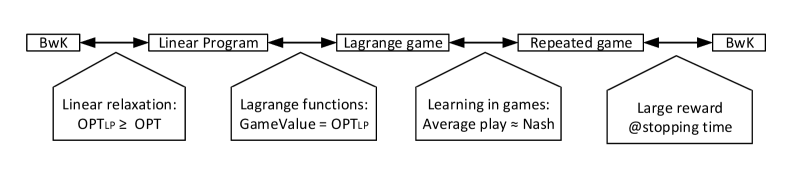
The image is a diagram illustrating a process flow involving concepts from linear programming, Lagrange games, and repeated games, ultimately leading to a large reward at a stopping time. The diagram consists of rectangular boxes representing processes and pentagonal boxes representing states or conditions. Arrows indicate the flow of the process.
### Components/Axes
* **Rectangular Boxes (Processes):**
* BwK (appears at the start and end)
* Linear Program
* Lagrange game
* Repeated game
* **Pentagonal Boxes (States/Conditions):**
* Linear relaxation: OPTLP ≥ OPT
* Lagrange functions: GameValue = OPTLP
* Learning in games: Average play ≈ Nash
* Large reward @stopping time
* **Arrows:** Double-headed arrows connect BwK to Linear Program, Linear Program to Lagrange game, and Repeated game to BwK. A single-headed arrow connects Lagrange game to Repeated game.
### Detailed Analysis
* **BwK (Left):** The process starts with "BwK".
* **Linear Program:** A double-headed arrow connects "BwK" to "Linear Program". Below this box is a pentagonal box stating "Linear relaxation: OPTLP ≥ OPT".
* **Lagrange game:** A double-headed arrow connects "Linear Program" to "Lagrange game". Below this box is a pentagonal box stating "Lagrange functions: GameValue = OPTLP".
* **Repeated game:** A single-headed arrow connects "Lagrange game" to "Repeated game". Below this box is a pentagonal box stating "Learning in games: Average play ≈ Nash".
* **BwK (Right):** A double-headed arrow connects "Repeated game" to "BwK". Below this box is a pentagonal box stating "Large reward @stopping time".
### Key Observations
* The diagram shows a cyclical process, starting and ending with "BwK".
* The double-headed arrows suggest a bidirectional relationship or feedback loop between certain stages.
* The pentagonal boxes provide additional information or conditions associated with each stage of the process.
### Interpretation
The diagram represents a game-theoretic process that leverages linear programming and Lagrange game concepts to model repeated interactions. The process begins and ends with "BwK", suggesting a cyclical or iterative nature. The double-headed arrows between "BwK", "Linear Program", "Lagrange game", and "Repeated game" indicate a feedback mechanism or interdependence between these stages. The pentagonal boxes provide context for each stage: linear relaxation in the linear program, Lagrange functions in the Lagrange game, learning in games leading to Nash equilibrium in the repeated game, and a large reward at the stopping time. The overall process seems to model a system where repeated interactions and learning lead to an optimal outcome or reward. The "≈" symbol suggests an approximation, and the "≥" symbol indicates an inequality.