# Technical Document Extraction: BwK Theoretical Framework Diagram
## 1. Image Overview
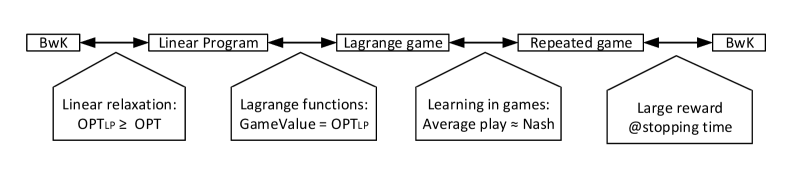
This image is a technical flow diagram illustrating the theoretical connections and reductions between "Bandits with Knapsacks" (BwK) and various mathematical frameworks, including Linear Programming and Game Theory. The diagram uses a horizontal pipeline structure with bidirectional arrows and explanatory callout boxes.
## 2. Component Analysis
### A. Main Pipeline (Header Row)
The top section consists of five rectangular nodes connected by double-headed (bidirectional) horizontal arrows, indicating equivalence or bidirectional reduction between the concepts.
| Sequence (Left to Right) | Text Label |
| :--- | :--- |
| Node 1 | **BwK** |
| Node 2 | **Linear Program** |
| Node 3 | **Lagrange game** |
| Node 4 | **Repeated game** |
| Node 5 | **BwK** |
### B. Explanatory Callouts (Lower Row)
Beneath the arrows connecting the main nodes are four pentagonal "house-shaped" callout boxes. These boxes provide the mathematical justification or the specific mechanism that links the two nodes above them.
| Position (Between Nodes) | Transcribed Text | Mathematical/Technical Content |
| :--- | :--- | :--- |
| Between **BwK** & **Linear Program** | Linear relaxation: $OPT_{LP} \geq OPT$ | Describes the relationship where the Linear Programming relaxation provides an upper bound for the optimal solution. |
| Between **Linear Program** & **Lagrange game** | Lagrange functions: $GameValue = OPT_{LP}$ | Establishes the equivalence between the value of the Lagrange game and the LP optimum. |
| Between **Lagrange game** & **Repeated game** | Learning in games: $Average\ play \approx Nash$ | Indicates that iterative learning in a repeated game converges toward a Nash equilibrium. |
| Between **Repeated game** & **BwK** | Large reward @stopping time | Relates the cumulative rewards of the game back to the original BwK problem constraints. |
## 3. Logical Flow and Trends
The diagram represents a circular or "full-circle" reduction proof.
1. **Trend:** The flow starts at **BwK** (left) and moves through increasingly abstract mathematical formulations (**Linear Programming** $\rightarrow$ **Lagrange Game** $\rightarrow$ **Repeated Game**) before returning to the original **BwK** problem (right).
2. **Bidirectionality:** Every connection is marked with a double-headed arrow, signifying that the properties of one domain can be mapped directly onto the next.
3. **Key Insight:** The diagram suggests that solving a Bandits with Knapsacks problem can be approached by treating it as a Linear Program, converting that LP into a Lagrange game, solving that game via repeated play (learning), and then interpreting those results back in the context of the original BwK rewards and stopping times.
## 4. Spatial Grounding
* **Header Region:** Contains the primary nodes [BwK, Linear Program, Lagrange game, Repeated game, BwK].
* **Transition Region:** Contains the bidirectional arrows and the pentagonal callouts centered under the spaces between the header nodes.
* **Language:** All text is in **English**, utilizing standard mathematical notation (subscripts, Greek/Latin abbreviations like OPT and LP, and symbols like $\geq$ and $\approx$).