\n
## Diagram: Process Flow - BwK to BwK via Intermediate Steps
### Overview
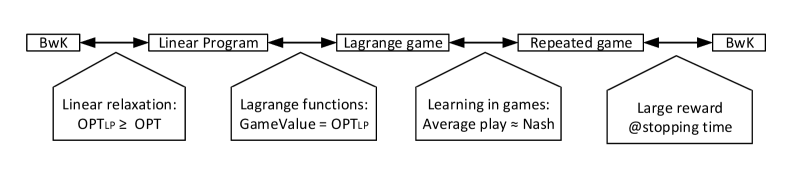
The image depicts a sequential process flow diagram illustrating a series of transformations starting and ending with "BwK". The process involves intermediate steps: "Linear Program", "Lagrange game", and "Repeated game". Each step is represented by a rectangular box with an arrow indicating the direction of the process. Below each box is a short textual description of the concept associated with that step.
### Components/Axes
The diagram consists of five components:
1. **BwK (Start)**: Located at the far left.
2. **Linear Program**: Positioned to the right of BwK, connected by an arrow.
3. **Lagrange game**: Positioned to the right of Linear Program, connected by an arrow.
4. **Repeated game**: Positioned to the right of Lagrange game, connected by an arrow.
5. **BwK (End)**: Located at the far right, connected by an arrow from Repeated game.
Each component has a corresponding text label below it:
* **Linear Program**: "Linear relaxation: OPT<sub>LP</sub> ≥ OPT"
* **Lagrange game**: "Lagrange functions: GameValue = OPT<sub>LP</sub>"
* **Repeated game**: "Learning in games: Average play ≈ Nash"
* **BwK (End)**: "Large reward @stopping time"
### Detailed Analysis or Content Details
The diagram shows a linear progression of steps. The text labels provide insights into the mathematical or conceptual transformation occurring at each stage:
1. **BwK to Linear Program**: The initial step involves transforming "BwK" into a "Linear Program". The associated text states that this involves a "Linear relaxation" where the optimal value of the Linear Program (OPT<sub>LP</sub>) is greater than or equal to the optimal value of the original problem (OPT).
2. **Linear Program to Lagrange game**: The "Linear Program" is then transformed into a "Lagrange game". The text indicates that "Lagrange functions" are used, and the "GameValue" is equal to OPT<sub>LP</sub>.
3. **Lagrange game to Repeated game**: The "Lagrange game" is transformed into a "Repeated game". The text suggests that "Learning in games" is applied, and the "Average play" approximates the "Nash" equilibrium.
4. **Repeated game to BwK**: Finally, the "Repeated game" is transformed back into "BwK". The text states that this results in a "Large reward @stopping time".
### Key Observations
The diagram illustrates a cyclical or iterative process where "BwK" is transformed through a series of mathematical or game-theoretic concepts and ultimately returns to "BwK" with an associated reward. The use of subscripts (LP) suggests a mathematical formulation. The approximation symbol (≈) in the "Repeated game" step indicates that the Nash equilibrium is not necessarily reached exactly, but is approximated through the learning process.
### Interpretation
This diagram likely represents a theoretical framework for solving a problem (represented by "BwK") using a sequence of mathematical and game-theoretic techniques. The process starts with a relaxation of the original problem into a linear program, then utilizes Lagrange duality to formulate a game, and finally employs repeated game dynamics to achieve a solution that approximates a Nash equilibrium, resulting in a reward. The diagram suggests that the iterative process is designed to converge towards an optimal solution or a desirable outcome. The use of "BwK" at both the beginning and end suggests that the process is not merely a transformation, but a refinement or optimization of the initial state. The diagram is a high-level conceptual overview and does not provide specific details about the algorithms or methods used at each step.