## Flowchart: Optimization and Game Theory Framework
### Overview
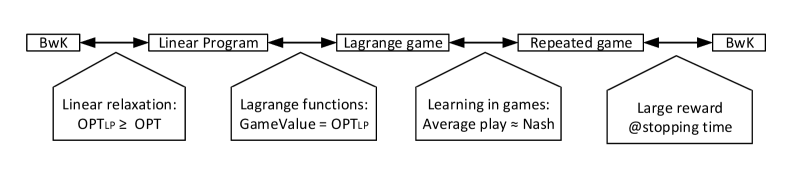
The image depicts a sequential process involving optimization techniques, game theory, and reinforcement learning concepts. Four core components are interconnected via bidirectional arrows, with explanatory text boxes beneath each element.
### Components/Axes
1. **Leftmost Component**:
- Label: `BwK`
- House Text: `Linear relaxation: OPTLP ≥ OPT`
2. **Second Component**:
- Label: `Linear Program`
- House Text: `Lagrange functions: GameValue = OPTLP`
3. **Third Component**:
- Label: `Lagrange game`
- House Text: `Learning in games: Average play ≈ Nash`
4. **Rightmost Component**:
- Label: `Repeated game`
- House Text: `Large reward @ stopping time`
### Detailed Analysis
- **Arrows**:
- Bidirectional arrows connect `BwK` ↔ `Linear Program` ↔ `Lagrange game` ↔ `Repeated game` ↔ `BwK`, forming a cyclical relationship.
- **Textual Relationships**:
- `Linear relaxation` establishes a bound (`OPTLP ≥ OPT`), where the relaxed problem's optimal value (`OPTLP`) dominates the original problem's optimal value (`OPT`).
- `Lagrange functions` equate the game value (`GameValue`) to the linear program's optimal value (`OPTLP`).
- `Learning in games` links repeated gameplay to Nash equilibrium (`Average play ≈ Nash`).
- `Large reward @ stopping time` suggests a termination strategy yielding high rewards.
### Key Observations
- The cyclical flow implies iterative refinement between optimization and game-theoretic methods.
- `BwK` appears twice, acting as both a starting point and a terminal state, possibly indicating a feedback loop.
- The final `BwK` node emphasizes reward maximization at termination, contrasting with earlier steps focused on theoretical bounds.
### Interpretation
This diagram illustrates a framework for solving complex problems by:
1. **Relaxing constraints** (`Linear relaxation`) to derive bounds.
2. **Dualizing via Lagrange functions** to connect optimization and game theory.
3. **Simulating repeated interactions** to approximate Nash equilibrium.
4. **Optimizing termination timing** to maximize rewards.
The cyclical structure suggests that insights from later stages (e.g., Nash approximation) could inform earlier optimization steps, while the final `BwK` node highlights practical deployment considerations. The absence of numerical data implies a conceptual rather than empirical analysis, focusing on methodological relationships.