## Table: Comparison of Truth Discovery Algorithms
### Overview
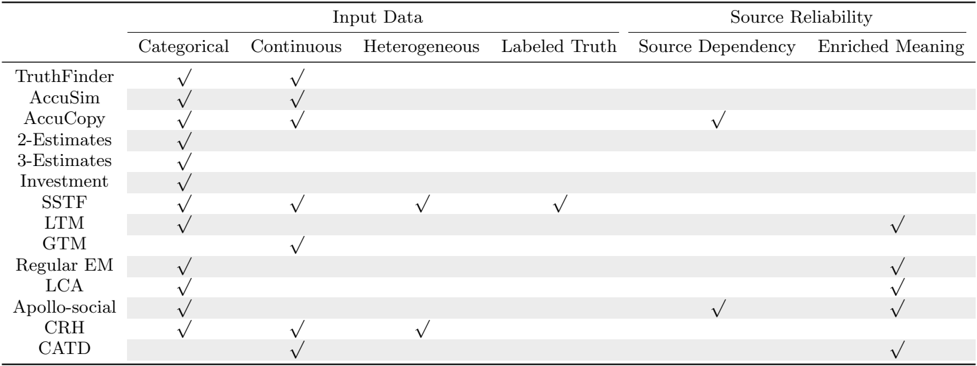
The image presents a classification table comparing various "Truth Discovery" algorithms. It categorizes these algorithms based on the types of input data they can process (Categorical, Continuous, Heterogeneous, Labeled Truth) and the specific source reliability features they incorporate (Source Dependency, Enriched Meaning). The presence of a feature is indicated by a checkmark ($\checkmark$).
### Components/Axes
* **Rows (Algorithms):** TruthFinder, AccuSim, AccuCopy, 2-Estimates, 3-Estimates, Investment, SSTF, LTM, GTM, Regular EM, LCA, Apollo-social, CRH, CATD.
* **Columns (Categories):**
* **Input Data:** Categorical, Continuous, Heterogeneous, Labeled Truth.
* **Source Reliability:** Source Dependency, Enriched Meaning.
### Content Details
The following table reconstructs the data presented in the image:
| Algorithm | Categorical | Continuous | Heterogeneous | Labeled Truth | Source Dependency | Enriched Meaning |
| :--- | :---: | :---: | :---: | :---: | :---: | :---: |
| **TruthFinder** | $\checkmark$ | $\checkmark$ | | | | |
| **AccuSim** | $\checkmark$ | $\checkmark$ | | | | |
| **AccuCopy** | $\checkmark$ | $\checkmark$ | | | | $\checkmark$ |
| **2-Estimates** | $\checkmark$ | | | | | |
| **3-Estimates** | $\checkmark$ | | | | | |
| **Investment** | $\checkmark$ | | | | | |
| **SSTF** | $\checkmark$ | $\checkmark$ | $\checkmark$ | $\checkmark$ | | |
| **LTM** | $\checkmark$ | | | | | $\checkmark$ |
| **GTM** | | $\checkmark$ | | | | |
| **Regular EM** | $\checkmark$ | | | | | $\checkmark$ |
| **LCA** | $\checkmark$ | | | | | $\checkmark$ |
| **Apollo-social** | $\checkmark$ | | | | $\checkmark$ | $\checkmark$ |
| **CRH** | $\checkmark$ | $\checkmark$ | $\checkmark$ | | | |
| **CATD** | | $\checkmark$ | | | | $\checkmark$ |
*(Note: The checkmark for AccuCopy under "Source Dependency" is located in the column header "Source Dependency" in the original image, though it is visually aligned slightly to the left of the column center. Based on the grid layout, it corresponds to Source Dependency.)*
### Key Observations
* **Dominance of Categorical Data:** The vast majority of listed algorithms (12 out of 14) support "Categorical" input data, making it the standard baseline for these methods.
* **Versatility of SSTF:** SSTF is the most comprehensive algorithm listed, supporting all four "Input Data" types (Categorical, Continuous, Heterogeneous, and Labeled Truth).
* **Rarity of Advanced Input Features:** "Heterogeneous" and "Labeled Truth" are the least supported features, appearing only in SSTF and CRH (for Heterogeneous) and only in SSTF (for Labeled Truth).
* **Source Reliability Trends:** "Enriched Meaning" is a common feature among later-generation algorithms (LTM, Regular EM, LCA, Apollo-social, CATD), suggesting a trend toward incorporating more complex semantic understanding in truth discovery.
### Interpretation
This table functions as a taxonomy for researchers or engineers selecting a truth discovery method. It demonstrates a clear evolution in the field:
1. **Foundational Methods:** Early methods (like 2-Estimates, 3-Estimates, Investment) focused almost exclusively on simple categorical data.
2. **Expansion of Data Types:** Methods like TruthFinder, AccuSim, and AccuCopy expanded capabilities to include continuous data, which is essential for real-world applications where data is not just discrete labels.
3. **Advanced Modeling:** The inclusion of "Heterogeneous" and "Labeled Truth" (SSTF) indicates a move toward handling complex, multi-modal, or supervised datasets.
4. **Semantic Shift:** The prevalence of "Enriched Meaning" in the latter half of the list suggests that modern truth discovery is moving beyond simple statistical aggregation of source claims and toward understanding the *context* or *meaning* behind the data provided by sources.
The table effectively highlights that there is no "one-size-fits-all" algorithm; the choice depends heavily on whether the input is categorical or continuous, and whether the system requires advanced features like source dependency modeling or enriched semantic meaning.