## Table: Comparison of Methods by Input Data and Source Reliability Features
### Overview
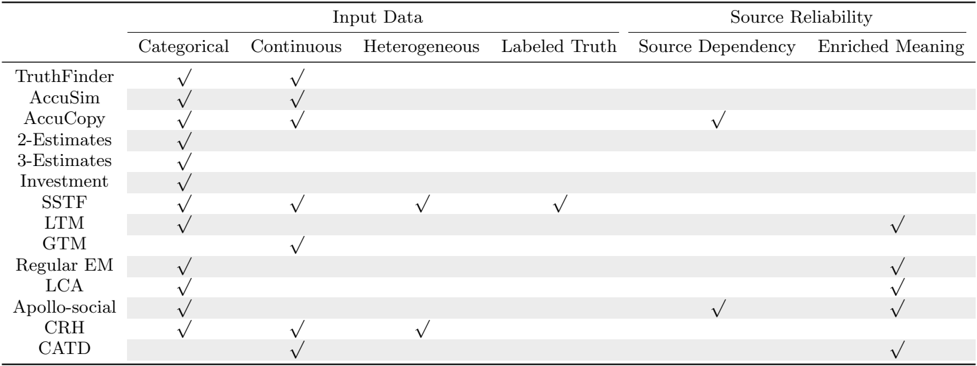
The image displays a comparison table evaluating various computational methods or algorithms against their capabilities in handling different types of input data and addressing source reliability. The table uses checkmarks (✓) to indicate the presence of a feature for a given method.
### Components/Axes
The table is structured with rows representing distinct methods and columns grouped into two primary categories:
1. **Input Data** (Left Group):
* **Categorical**
* **Continuous**
* **Heterogeneous**
* **Labeled Truth**
2. **Source Reliability** (Right Group):
* **Source Dependency**
* **Enriched Meaning**
The methods listed in the rows are: TruthFinder, AccuSim, AccuCopy, 2-Estimates, 3-Estimates, Investment, SSTF, LTM, GTM, Regular EM, LCA, Apollo-social, CRH, and CATD.
### Detailed Analysis
The following details the feature support for each method, based on the checkmarks (✓) in the corresponding cells.
| Method | Input Data: Categorical | Input Data: Continuous | Input Data: Heterogeneous | Input Data: Labeled Truth | Source Reliability: Source Dependency | Source Reliability: Enriched Meaning |
| :--- | :---: | :---: | :---: | :---: | :---: | :---: |
| **TruthFinder** | ✓ | ✓ | | | | |
| **AccuSim** | ✓ | | | | | |
| **AccuCopy** | ✓ | ✓ | | | ✓ | |
| **2-Estimates** | ✓ | | | | | |
| **3-Estimates** | ✓ | | | | | |
| **Investment** | ✓ | | | | | |
| **SSTF** | ✓ | ✓ | ✓ | ✓ | | |
| **LTM** | ✓ | | | | | ✓ |
| **GTM** | | ✓ | | | | |
| **Regular EM** | ✓ | | | | | ✓ |
| **LCA** | ✓ | | | | | ✓ |
| **Apollo-social** | ✓ | | | | ✓ | ✓ |
| **CRH** | ✓ | ✓ | ✓ | | | |
| **CATD** | | ✓ | | | | ✓ |
### Key Observations
1. **Input Data Focus**: The "Categorical" input type is the most widely supported feature, with 11 out of 14 methods (79%) indicating capability. "Continuous" is the second most common (7 methods, 50%).
2. **Specialized Methods**: Only one method, **SSTF**, supports "Heterogeneous" data and "Labeled Truth." It is also the only method to support all four Input Data categories.
3. **Source Reliability**: The "Enriched Meaning" feature is supported by 6 methods (LTM, Regular EM, LCA, Apollo-social, CATD, and indirectly by SSTF via Labeled Truth). "Source Dependency" is a rarer feature, supported only by **AccuCopy** and **Apollo-social**.
4. **Method Profiles**:
* **Broad Input Handlers**: SSTF and CRH support the most input types (4 and 3, respectively).
* **Source Reliability Specialists**: LTM, Regular EM, LCA, and CATD focus on "Enriched Meaning" but have limited input data support (mostly Categorical or Continuous).
* **Dual-Focus Methods**: Apollo-social and AccuCopy are the only methods that address both "Source Dependency" and other features.
* **Minimalist Methods**: AccuSim, 2-Estimates, 3-Estimates, and Investment support only the "Categorical" input type.
### Interpretation
This table provides a feature-based taxonomy for comparing algorithms, likely in the domain of data fusion, truth discovery, or information integration from multiple sources.
* **What the data suggests**: The landscape of methods is specialized. No single method dominates all features. There is a clear trade-off: methods that handle complex or diverse input data (like SSTF) are rare, while many methods focus on the fundamental "Categorical" input. Similarly, advanced source reliability modeling ("Source Dependency," "Enriched Meaning") is not a universal feature.
* **How elements relate**: The grouping implies that a method's value is assessed along two independent axes: the *type of data it can process* and *how it models the reliability of the sources providing that data*. A comprehensive solution would need to address both.
* **Notable patterns/anomalies**: The absence of checks is as informative as their presence. For example, the fact that only SSTF supports "Labeled Truth" suggests it may be a supervised or semi-supervised method, while others are likely unsupervised. The concentration of "Enriched Meaning" support in a subset of methods (LTM, Regular EM, LCA, CATD) might indicate a common underlying theoretical approach or a shared research lineage among those algorithms.