## Diagram: Visual Reasoning and Commonsense Analysis
### Overview
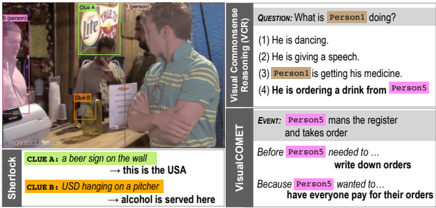
This image is a composite technical document used for training or evaluating artificial intelligence models in the fields of Visual Commonsense Reasoning (VCR) and VisualCOMET. It consists of a primary visual scene on the left, annotated with bounding boxes, and two text-based reasoning modules on the right. The image demonstrates how visual inputs are grounded in textual logic, temporal reasoning, and social context.
### Components/Axes
The image is divided into three distinct functional regions:
1. **Visual Scene (Left):** A photograph of a bar/restaurant interior. It contains four bounding boxes with labels:
* **"5 (person)"**: A pink bounding box surrounding a person in a pink shirt behind a counter.
* **"1 (person)"**: A red bounding box surrounding a person in a dark shirt behind the counter.
* **"Clue A"**: A green bounding box surrounding a "Miller Lite" sign on the wall.
* **"Clue B"**: An orange bounding box surrounding a pitcher on the counter.
* **Watermark**: "MOVIECLIPS.com" in the bottom-left corner.
2. **Sherlock Module (Bottom-Left):** A reasoning block that links visual clues to environmental context.
* **"CLUE A" (Green background)**: "a beer sign on the wall" $\rightarrow$ "this is the USA"
* **"CLUE B" (Orange background)**: "USD hanging on a pitcher" $\rightarrow$ "alcohol is served here"
3. **Reasoning Modules (Right):**
* **Visual Commonsense Reasoning (VCR) (Top-Right)**: A multiple-choice question regarding the scene.
* **VisualCOMET (Bottom-Right)**: A temporal and causal reasoning block regarding the event.
### Detailed Analysis
#### Visual Scene (Left)
* **Spatial Grounding**: The scene depicts a service counter. Person 5 (pink box) is positioned on the left, facing the counter. Person 1 (red box) is positioned slightly behind and to the right of Person 5.
* **Clues**:
* **Clue A (Green)**: Located on the upper-middle wall.
* **Clue B (Orange)**: Located on the counter surface, near the center.
#### Sherlock Module (Bottom-Left)
* This module acts as a heuristic engine. It explicitly maps visual evidence to logical conclusions.
* **Logic**:
* Green text/box association: The presence of a specific brand sign ("Miller Lite") is used to infer the geographic location ("USA").
* Orange text/box association: The presence of a pitcher and currency ("USD") is used to infer the establishment type ("alcohol is served here").
#### Visual Commonsense Reasoning (VCR) (Top-Right)
* **Question**: "What is Person1 doing?"
* **Options**:
1. He is dancing.
2. He is giving a speech.
3. Person1 is getting his medicine.
4. He is ordering a drink from Person5.
* *Note*: The text "Person1" and "Person5" are highlighted in boxes matching the colors of the bounding boxes in the visual scene (Red for Person 1, Pink for Person 5).
#### VisualCOMET (Bottom-Right)
* **Event**: "Person5 mans the register and takes order" (Person 5 highlighted in pink).
* **Temporal/Causal Logic**:
* **Before**: "Person5 needed to ... write down orders" (Person 5 highlighted in pink).
* **Because**: "Person5 wanted to ... have everyone pay for their orders" (Person 5 highlighted in pink).
### Key Observations
* **Color-Coding**: The document uses a consistent color-coding scheme to link text to visual elements:
* **Pink**: Refers to "Person 5".
* **Red**: Refers to "Person 1".
* **Green**: Refers to "Clue A".
* **Orange**: Refers to "Clue B".
* **Contextual Inference**: The "Sherlock" section demonstrates a "bottom-up" approach to reasoning, where specific visual objects (signs, pitchers) are used to build a high-level understanding of the scene (location, establishment type).
* **Temporal Reasoning**: The "VisualCOMET" section demonstrates a "top-down" approach, where a current event is used to infer past actions ("Before") and future motivations ("Because").
### Interpretation
This image is a structured data sample for training AI models in **Social Intelligence**. It moves beyond simple object detection (identifying a person or a sign) into the realm of **situational awareness**.
* **Peircean Investigative View**: The image functions as a semiotic system. The "Miller Lite" sign is an *index* of American culture; the pitcher is an *index* of a bar setting. The AI is being trained to decode these indices to form a coherent narrative about the scene.
* **Reading Between the Lines**: The VCR and VisualCOMET modules are designed to test if the AI understands human social dynamics. For example, in the VCR section, the model must understand that in a bar setting, a person standing at a counter is likely "ordering a drink" rather than "dancing" or "giving a speech." The VisualCOMET section tests the model's ability to understand the *intent* behind human actions (e.g., why a register is manned).
* **Utility**: This type of data is critical for developing autonomous agents or video analysis tools that need to understand human intent and social norms, rather than just identifying objects.